I was wondering if one of you could tell me about whether or not attempts have been made at photographing atoms, and can I access those photos? Have people attempted it? Or, given our present technology, is it even logically possible?
I just wrote an email to Michael W. Davidson, a research scientist who has been involved with various aspects of microscopy for the past 25 years. I asked him if he had any desire (or if I could inspire him to desire) to take an actual photo of an amino acid, and superimpose on top of that photo, arrows that point to certain distinctions in the picture, naming those distinctions.
For instance, consider this highly simplistic model of an amino acid:
Amino Acid Model
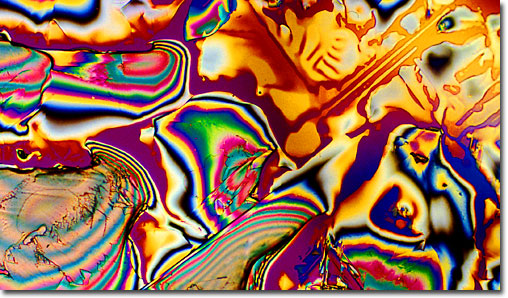
And then compare that simplistic model to what an amino acid actually looks like (photograph apparently taken by Michael Davidson himself):
Actual photograph of amino acid
What I said to Davidson, was my impression that it is difficult to make good use, or even trust the standard models we have of things like amino acids, as there seems to be an awful lot of distinctions to be named in that actual photo of an amino acid and that, in fact, the actual photo and the standard model, look nothing alike. With that being said, I asked Davidson if he thought it was reasonable for anyone to try using our present model of an amino acid as a map to navigate an actual photo of one. Shouldn't we be able to do that? Isn't that what models are for? I think it would be a very noble goal for someone to bring to the masses a more coherent way of making sense of the actual photographs we have of the microcosm. Our present simplistic models just don't seem adequate for making sense of the actual photos. On top of that, I feel that education should introduce children to the actual photos of the microscopic first, and then we should use models, but these models should be introduced very carefully and should leave students in a position where they can use the models as maps to navigate and understand the actual topography seen in the photographs of things like amino acids, proteins, neurons, etc.
I'm particularly interested in being able to take an actual photo of an amino acid, and identify the two major parts that are said to comprise it (e.g., NH2 and COOH)
My question is, are scientists personally able to perceive such distinctions when they look at an amino acid via photo? Or have they empirically detected these differentiations in topography by some other means? (I know Rutherford detected the atom by noting incidental scintillations, rather than perceiving the atom directly - so god knows the sort of techniques physicists and chemists use these days)
the microcosm
-
Cory Duchesne

- Posts: 2320
- Joined: Thu Feb 02, 2006 10:35 am
- Location: Canada
- Contact:
the microcosm
Last edited by Cory Duchesne on Tue Jul 31, 2007 9:26 am, edited 2 times in total.
-
Steven Coyle
Re: A challenge to those who think they understand the microcosm
Strangely psychedelic...
;-)
If physicists could determine a mathematical mean (a set pattern) for the light structure and intensity, and contrast that with the opposing compounds, then perhaps they could better assess the effect that varying acids and other goodies have on the mind, and beyond - by developing creative metaphor.


Re: A challenge to those who think they understand the microcosm
Do a search on "scanning tunneling microscope." It's not exactly a photo, but it is pretty close.Cory Duchesne wrote:I was wondering if one of you could tell me about whether or not attempts have been made at photographing atoms, and can I access those photos? Have people attempted it? Or, given our present technology, is it even logically possible?
http://www.astro.virginia.edu/class/whi ... ttice.html
-
Cory Duchesne
- Posts: 2320
- Joined: Thu Feb 02, 2006 10:35 am
- Location: Canada
- Contact:
Re: A challenge to those who think they understand the microcosm
Thanks for the photo, Dave.DHodges wrote:Do a search on "scanning tunneling microscope." It's not exactly a photo, but it is pretty close.Cory Duchesne wrote:I was wondering if one of you could tell me about whether or not attempts have been made at photographing atoms, and can I access those photos? Have people attempted it? Or, given our present technology, is it even logically possible?
http://www.astro.virginia.edu/class/whi ... ttice.html
What are your thoughts on why the atoms in your photo look so different from the atoms in this photo?

Why do the atoms in this picture look like little piles of sand, or teeth? Are we looking at piles of atoms, forming these tooth like shapes? If not, then I'm a bit confused. Actually, I'm a bit confused either way.
-
Cory Duchesne
- Posts: 2320
- Joined: Thu Feb 02, 2006 10:35 am
- Location: Canada
- Contact:
Re: A challenge to those who think they understand the microcosm
I got a reply from Mr. Davidson. Here is the verbatim:Cory wrote:With that being said, I asked Davidson if he thought it was reasonable for anyone to try using our present model of an amino acid as a map to navigate an actual photo of one. Shouldn't we be able to do that? Isn't that what models are for?
Alrighty then.The answer to your questions is NO. We have merely photographed crystals of the purified amino acids, which don’t correlate with the structure as you suggest.
Re: A challenge to those who think they understand the microcosm
I think this is because of how a scanning tunneling microscope works. As I mentioned, it's not exactly a photograph, and there are different ways of representing the results of what it produces.Cory Duchesne wrote:What are your thoughts on why the atoms in your photo look so different from the atoms in this photo?
An analogy might be a probe sending down radar to the surface of Mars. You can build up a picture of what the surface of Mars looks like from that and present it in different ways, with height represented by color or deformation of a surface. But that picture is not really a photo.
-
ExpectantlyIronic
- Posts: 411
- Joined: Wed Nov 29, 2006 7:11 pm
Re: A challenge to those who think they understand the microcosm
I wasn't even sure that an atom had a theoretically perceivable physical correlate. I thought the idea was more-or-less an assumption based around the notion that if there were no space between things, then nothing could move (that's how the Greeks came up with the idea). From there it makes sense that things are built from smaller things that have space between them. Furthermore, I thought descriptions of different sorts of atoms were painstakingly developed from mixing various substances together, and taking careful notes of how they react, combine, whatever. It seems that with such information, you could pretty much just infer what substances were at the base of it all, and would have some useful information about them. That's kinda the suck of a lot of science, isn't it? That it occasionally deals with absurd models that work perfectly well in practice, but don't necessarily describe what's going on in any fashion we're really accustomed to.
-
Cory Duchesne
- Posts: 2320
- Joined: Thu Feb 02, 2006 10:35 am
- Location: Canada
- Contact:
Re: A challenge to those who think they understand the microcosm
If you're interested, here's a 3d animation of how an STM works.
-
ExpectantlyIronic
- Posts: 411
- Joined: Wed Nov 29, 2006 7:11 pm
Re: the microcosm
That's cool as hell. I suppose shooting electrons at atoms is about the trick. Now what are we going to shoot at electrons? Tiny things can be so evasive.If you're interested, here's a 3d animation of how an STM works.