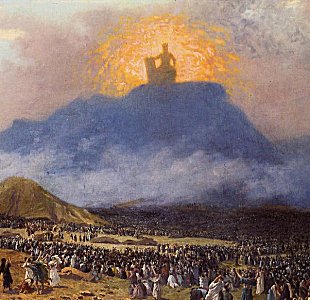
The problem of Myth

Discussion of the nature of Ultimate Reality and the path to Enlightenment.
Locked
User avatar
Diebert van Rhijn
Posts: 6469
Joined: Fri Jun 03, 2005 4:43 pm

The problem of Myth

Post by Diebert van Rhijn »

Many religious, political, nationalistic and economical struggles can be traced back unto a severe misunderstanding, or better: misinterpretation of myth, story and symbol. With economy it's the vision of a 'free' evolving marketplace, with nationalism it's often revisionist history (and denial of the more gross base of ones civilized behavior). With politics it's the misapplication of equality. With religion the great temptation is literalness, a materialistic interpretation of what is essentially a more transcendent issue - something of a whole other nature than people deal with in their daily affairs and concerns. Of course nowadays everything becomes transposed and diminished to something only referring to daily affairs - becoming totally insignificant and self-defeating in the process.

However, the following can be potentially fruitful for challenging at least some contemporary mainstream religious and political views. Or at least understanding how lie and myth could relate and shape history.

Shlomo Sand, Professor of History at Tel Aviv University, a Jew, born to Polish Holocaust survivors and served in the Israeli military during wartime, published a book this year called When and How Was the Jewish People Invented?.

Publishing this line of thought might one get jailed in Europe but when coming from this corner it's rather unexpected [while unavoidable if true] and also embarrassing to the 'usual defenders of the faith', in Christian, Zionist as well as the more general Political Correct Camp [people of the shadow].

Here's an article in the Israeli mainstream Haaretz newspaper.
"The supreme paradigm of exile was needed in order to construct a long-range memory in which an imagined and exiled nation-race was posited as the direct continuation of 'the people of the Bible' that preceded it," Sand explains. Under the influence of other historians who have dealt with the same issue in recent years, he argues that the exile of the Jewish people is originally a Christian myth that depicted that event as divine punishment imposed on the Jews for having rejected the Christian gospel.
No population remains pure over a period of thousands of years. But the chances that the Palestinians are descendants of the ancient Judaic people are much greater than the chances that you or I are its descendents. The first Zionists, up until the Arab Revolt [1936-9], knew that there had been no exiling, and that the Palestinians were descended from the inhabitants of the land. They knew that farmers don't leave until they are expelled. Even Yitzhak Ben-Zvi, the second president of the State of Israel, wrote in 1929 that, 'the vast majority of the peasant farmers do not have their origins in the Arab conquerors, but rather, before then, in the Jewish farmers who were numerous and a majority in the building of the land.'".
The people did not spread, but the Jewish religion spread. Judaism was a converting religion. Contrary to popular opinion, in early Judaism there was a great thirst to convert others. The Hasmoneans were the first to begin to produce large numbers of Jews through mass conversion, under the influence of Hellenism. The conversions between the Hasmonean Revolt and Bar Kochba's rebellion are what prepared the ground for the subsequent, wide-spread dissemination of Christianity. After the victory of Christianity in the fourth century, the momentum of conversion was stopped in the Christian world, and there was a steep drop in the number of Jews. Presumably many of the Jews who appeared around the Mediterranean became Christians. But then Judaism started to permeate other regions - pagan regions, for example, such as Yemen and North Africa. Had Judaism not continued to advance at that stage and had it not continued to convert people in the pagan world, we would have remained a completely marginal religion, if we survived at all..
Another article by Sand

Anyone with a sense of the tragic could see how totally believable the situation would be of a self-proclaimed Jew occupying the land of the original Jew, or in post-modernist words: the simulation replacing the original in all discourse and manifestation.
User avatar
Alex Jacob
Posts: 1671
Joined: Mon Jun 27, 2011 2:10 am
Location: Meta-Rabbit Hole

Re: The problem of Myth

Post by Alex Jacob »

In this case, though, you'd instead have to say that instead of a misunderstanding or a misinterpretation, Judaism as we know it is an active and deceptive use of a constructed mythology. (What was the original thing that was misunderstood? The revelation at Sinai?) Nothing was misunderstood, and a merely convenient myth has been the fuel for a peculiar Will to Power. I think that sums up pretty much the views of Shlomo, and it seems to be the gist you wish to present here.

But Shlomo's myth is not inactive, since it points to the need for a 'complete revolution of Israeli society' to avert 'another holocaust'. (There is a threat and there is a promise).

Shlomo, in his way, represents another sort of myth-making, wouldn't that be fair to say, Diebert? His connections to Matzpan (there is a link on Shlomo's Wiki page) gives an indication of the radical nature of the position he is invested in. It is a tempting narrative, I am sure it has some truthful features, but it is of course contested.

Might you be saying (implying?) that in the end all protagonists in all terrestrial conflicts, of all sorts, everywhere and at all times, are all caught up in the hallucination and intoxication of essentially false positions? That we are all People of the Lie no matter what we may think and believe about our respective 'causes'?
Ni ange, ni bête
User avatar
Diebert van Rhijn
Posts: 6469
Joined: Fri Jun 03, 2005 4:43 pm

Re: The problem of Myth

Post by Diebert van Rhijn »

Hello there Alex.
You wrote:In this case, though, you'd instead have to say that instead of a misunderstanding or a misinterpretation, Judaism as we know it is an active and deceptive use of a constructed mythology.
The only reason I used the prefix mis, is because of what you call "deceptive use". So I'd guess we're saying the same thing.
(What was the original thing that was misunderstood? The revelation at Sinai?) Nothing was misunderstood, and a merely convenient myth has been the fuel for a peculiar Will to Power. I think that sums up pretty much the views of Shlomo, and it seems to be the gist you wish to present here.
This was actually about the Jewish exiles, that not the people spread but merely the mythical ideas. But those ideas changed - the story about a holy people became a story of we are these people, and therefore others not.

I don't think it's as much an effective fuel for the power game, but it's more like a perfect cover. As Mr. Will of Power himself said: "Every instinct that seeks domination, but is placed under a yoke, needs as support for his self-assurance, as reinforcement, all beautiful names and approved values".
Shlomo, in his way, represents another sort of myth-making, wouldn't that be fair to say, Diebert? His connections to Matzpan (there is a link on Shlomo's Wiki page) gives an indication of the radical nature of the position he is invested in. It is a tempting narrative, I am sure it has some truthful features, but it is of course contested.
The main thing here is the uncovering of a mistaken myth, which might enable people to make their own, new ones. But one can only start constructing the new when the old is out of the way, or at least unable to constrain developments.
Might you be saying (implying?) that in the end all protagonists in all terrestrial conflicts, of all sorts, everywhere and at all times, are all caught up in the hallucination and intoxication of essentially false positions? That we are all People of the Lie no matter what we may think and believe about our respective 'causes'?
The moment one asserts something like "we are all people of the lie", no matter if it's ultimately true or false, some type of truth is birthed nevertheless. Are people of the lie then capable of approaching something that's not inherently them. In other words: would this make truth inhuman, or perhaps beyond human?

It's perhaps like sitting in Plato's cave and suggesting the light and objects at the entrance are just another shadow ultimately: a man of shadows defining the world in terms of shadow. And yet - the man of shadows only mistake here would be to not understand his position, his lack of inner vision that is the only real shadow at play.
User avatar
Alex Jacob
Posts: 1671
Joined: Mon Jun 27, 2011 2:10 am
Location: Meta-Rabbit Hole

Re: The problem of Myth

Post by Alex Jacob »

Hope all's going well with you,

It seems the analogy may in truth be correct: the light streaming into the cave will at some later date be seen as 'just another level of story'. These metaphors are, of course, just metaphors. I can entertain the analysis of people like Shlomo, though I am of course deeply suspicious of so much other stuff that comes in the door with him (his communistic leanings, and the philosophy that underpins that world view), but I don't think that view can be compared to a 'true light', an enlightened view.

I think that, for thinking people who stand at least partially outside of an issue, we can look at all our stories and modify our absolute certainty with an alternate view, a modifying view. At the same time, though our belief-systems, our 'constructed narratives', may be seen as partial and certainly imperfect (and disguising the age-old Power Principal), so that just as we look cynically at, say, the Jewish Narrative and pick it apart, so to can we look back through it to see, if you will, a light that is shining in, something corresponding to enlightened view, a radiance of idea, etc. It depends on one's metaphysics as to whether one considered this ray of light as something Divine or 'merely constructed'.

"This was actually about the Jewish exiles, that not the people spread but merely the mythical ideas. But those ideas changed - the story about a holy people became a story of we are these people, and therefore others not."

But isn't the whole narrative called into question when even the Egyptian captivity is doubted? If there was no captivity, what is one to think of the Revelation at Sinai? Then, the whole story will be seen to have been cobbled together and the whole story is therefor questionable (which of course it is---questionable). As to the factuality of the last exile, it is an area I have always been curious about but about which there is not much information.

Isolating, emphasising, and welding story-lines----this is how domination of the present is carried out. I will grant you that.
Ni ange, ni bête
User avatar
Diebert van Rhijn
Posts: 6469
Joined: Fri Jun 03, 2005 4:43 pm

Re: The problem of Myth

Post by Diebert van Rhijn »

Alex Jacob wrote: But isn't the whole narrative called into question when even the Egyptian captivity is doubted? If there was no captivity, what is one to think of the Revelation at Sinai? Then, the whole story will be seen to have been cobbled together and the whole story is therefor questionable (which of course it is---questionable). As to the factuality of the last exile, it is an area I have always been curious about but about which there is not much information.
When it comes to the formation of the state of Israel there were two issues that went hand in hand, but not necessarily shared by every migrating Jew in the last hundred years.

One issue was to have a nation where one could defend the Jew against every price (including nuclear weapons, international liquidation, spy operations, apartheid and economical repression of competitors in their own as well neighboring territory). The question how historical the claims on the land were, is not crucial for the naked need for territory - which lays the ground for a counter-reaction to the long-time persecution experienced in many countries. The victim becoming the bully.

The second issue is the believe in a historical connection, not as much the time of Moses, David or Solomon, which are known to be disputable by most Jews, but more centered around the time of the Hasmonean Kingdom, one that is documented quite well. The missing link that Shlomo brings to the foreground here is the claim, generally undoubted for near a century, that the modern Jew would be directly related to the Jews of the Hasmonean Kingdom, and not only in a religious sense.

For a 'real-politician' the issue is not that interesting perhaps but even they realize that without support of the religious extremists, the 'literalists', the position in negotiations about land would be much weaker, also in the eyes of the international community or the Israel lobby in the US. It's about perception shaping, ultimately and secular Zionists know that very well. Which makes them not much better than the extremists, as they deal with material 'literal' power as aim, and disregard truth the same. They are truly sons and daughters of the very ideology that confused millions of minds, instead of empowering them, resulting in a whole generation relying on force and trickery to survive. In other words: the common animal realm.
User avatar
Alex Jacob
Posts: 1671
Joined: Mon Jun 27, 2011 2:10 am
Location: Meta-Rabbit Hole

Re: The problem of Myth

Post by Alex Jacob »

A myth is only a myth when it ceases to be one's solid truth. For many Jews, what you are calling myth has all the ring Truth, and even those who operate in a secular atmosphere, even they have sublimated the story, have expanded the story, and it is still there functioning on different levels. I think I do grasp where you are going here, and with this:

They are truly sons and daughters of the very ideology that confused millions of minds, instead of empowering them, resulting in a whole generation relying on force and trickery to survive. In other words: the common animal realm.

...I believe I understand your core feelings about the Jewish project in history, that is if I read you correctly. I imagine that you see most of what has arisen from Judaism to be a sort of delirium, something to be overcome. Still, I could imagine you understanding and appreciating the God-Idea if it operated in subtle levels, or was handled by subtle individuals for subtle purposes. I pick up that sense when I read:

With religion the great temptation is literalness, a materialistic interpretation of what is essentially a more transcendent issue - something of a whole other nature than people deal with in their daily affairs and concerns. Of course nowadays everything becomes transposed and diminished to something only referring to daily affairs - becoming totally insignificant and self-defeating in the process.

I would only point out that, with Judaism perhaps more particularly, the whole idea of halacha (the ethical emphasis or commandments) became the main focus of the religious life-style (the Pharisaic emphasis), and really has no other platform but the literal. There is no way to interpret God 'transcendentally' in Judaism. God only has relevance in history and on the platform we are all sharing.

All aspects of Judaism and Jewishness can be debated down to the most minute points, but I think it is generally accepted that the religion is expressed through halacha, and that halacha is the outcome of the Event that was the receiving of Torah. It took a long time to get to that, and a great deal of intellectual work, but this was not an issue of transcendence, it was (and still is) an acutely material issue, and I think that Shlomo, in fact, is evidence of this. (Funny, isn't it? how that works?)

I don't at all mean to diminish Shlomo's emphasis or even his literary and historiographical project, but Shlomo's type seems to be well known within Judaism, and these types have sometimes done a great deal of harm. I suppose it should also be said that they've done a great deal of good too. In fact, it is really this that is Judaism's strength: the willingness, as a result (if you will permit me) of a command (thou shalt) to literalize one's religious life-style. There is nothing transcendent here at all, it is acutely about the here-and-now, about what you do and don't do. So, Shlomo gets his spot in Ha'aretz and gets to put forth his ideas. Ten will come forward to contradict him, to advance new evidence on the Khazars (or what-have-you), and the conversation goes on and on, meanwhile Israeli society also keeps going on. I am certainly not an insider, but even as an outsider with at least some sort of connection to Jewish culture and Israeli society, I can say that it all must appear unutterably strange, incomprehensible really, to non-Jews.

Today, to understand anything---even to get to the threshold where you merely begin to understand something---you have to make it a research project, a medical specialty. To even get to the outer chamber of understanding Jews and Judaism, well, I just don't think many people get anywhere close to this.

I don't profess to understand much of anything that I have lived up to this point (I mean my life, not as a Jew just as an incarnated being on the planet), and I suppose I will spend the rest of my days trying to understand even a little bit. Maybe I'll never understand it. So just imagine how strange it is to look back over such a long history, of such a weird religion, such a strange people, such a strange trajectory! How is anyone ever going to 'figure it out'?

Yet to reduce it to a sort of deflated 'myth' would be, in my opinion, a grotesque error. I think you are far more subtle and intelligent than this, so some part of what you have written above puzzles me.

Finally, all I can really say about Shlomo is that he is one facet on a stone with a million facets.
Ni ange, ni bête
User avatar
Diebert van Rhijn
Posts: 6469
Joined: Fri Jun 03, 2005 4:43 pm

Re: The problem of Myth

Post by Diebert van Rhijn »

Alex Jacob wrote:A myth is only a myth when it ceases to be one's solid truth. For many Jews, what you are calling myth has all the ring Truth, and even those who operate in a secular atmosphere, even they have sublimated the story, have expanded the story, and it is still there functioning on different levels.(...)

Yet to reduce it to a sort of deflated 'myth' would be, in my opinion, a grotesque error. I think you are far more subtle and intelligent than this, so some part of what you have written above puzzles me.
Ultimately I see myths functioning the way thinkers like Carl Jung and Joseph Campbell described. So in that sense I do not think one can say some myth was once someone's solid truth. It appears to me that the further one delves in the mindset of people living in the past, as far as possible, the less of a literalist they appear to be. Perhaps for them reality itself was functioning way more metaphorically, way more mysterious at least.

Instead of talking about a deflated myth I'd rather see it as expired myth. The narrative needs to change, but I doubt if the current age is capable of escaping the recurrence of their own rehashing, the endless overdeveloping recycle, the ever-chilling cryogenics that current myth-making seems to boil down to. But perhaps they don't need to have that capability, but at least they could destroy the fable, read the last page and spoil the plot.
User avatar
Alex Jacob
Posts: 1671
Joined: Mon Jun 27, 2011 2:10 am
Location: Meta-Rabbit Hole

Re: The problem of Myth

Post by Alex Jacob »

Diebert writes:

"It appears to me that the further one delves in the mindset of people living in the past, as far as possible, the less of a literalist they appear to be. Perhaps for them reality itself was functioning way more metaphorically, way more mysterious at least."

It seems to me that with this supposition you are wildly speculating. Only with the arrival---or invention---of a modern frame of mind does the stance of a CG Jung or a J Campbell come into existence. When Jung wrote about the Medieval order of perception, a time when there was order to existence and to the cosmos, it seems that he believed that this perception was solid, that one could confide in it. Life had order, it made sense. It is with our modern viewpoints that we have undermined these certainties, and for us the cosmos is a cold place, a futile place, where there is no discernible order. That is a peculiarly modern problem, and it is our problem insofar as we are squarely in it, dealing with it every day. Our own investigations---our questioning minds---have undermined the platform on which we stand.

"Ultimately I see myths functioning the way thinkers like Carl Jung and Joseph Campbell described."

If that is true, then there is not really a way to escape the functioning of myth, or whatever we may mean when we use this word. To say 'myth' implies a sort of chimera, a wispy veil that one can dismiss with the wave of one's hand. But when Jung wrote of Archetypes and potencies within the 'collective unconscious' (a loaded term, a label that covers over a vast, unknown and possibly unknowable territory), he directly stated (if I have read him correctly) that these potencies are, in fact, unavoidable, that they stand directly in our path, that like it or not we will encounter them time and time again. A Jungian viewpoint can also connect with a sort of futility, a cynicism too. For example in The Undiscovered Self. It is in some respects a doomsday text with an apocalyptic message.

"Instead of talking about a deflated myth I'd rather see it as expired myth. The narrative needs to change, but I doubt if the current age is capable of escaping the recurrence of their own rehashing, the endless overdeveloping recycle, the ever-chilling cryogenics that current myth-making seems to boil down to."

In the sense I meant, it is you who deflate the 'myth', because your stance, at least as I see it, has no connection to a Living God or a Living Myth. You seem to exist in a pure intellectual realm which is, perhaps, wonderful for interesting Nietzschean prose but that might be far harder to actually live. Or maybe I am speaking for myself? ;-) If one takes Campbell as a guidepost, we would have a vital task to discover a relevant myth and to jump inside of it like into some sort of vehicle that will move us through our incarnation.

What you seem to take issue with is the low-brow and the democratic usurpation of myth, and by democratic I mean mass usurpation. Maybe it was different in some other time-period, maybe not, but now it is the common, drooling idiot with all his vulgar and violent stupidities who has access to the inner sanctum, to the halls of power, for example the US presidency. He is the sort of guy the masses would feel comfortable sitting down on a picnic table smeared with rancid barbecue sauce and downing a cheap American beer. Today, it is all about the ascendancy of not just the mediocre but the downright awful.

The way I see things---with my Tragic Viewpoint---is that all this is completely perfect and exactly as it should be. It is in the nature of the place that any old protoplasmic entity gets to force its way to the forefront, and gets to go through the tragic learning curve, gets to fail and gets to learn from failure. If I've been reading history correctly, this is the whole meaning of 'democracy'. Instead of being mere subjects they all get to be actors. No longer huddled, ignorant masses living in their hovels, they get to come out into the Commons and burp and spit, shove their weight around, show some righteous indignation, show the world what they are made of. It all reminds me of a Kafka story that I can never quite shake: An Old Manuscript.

But in response to your statement about 'expired myth', I don't think this is at all the case, but you'd have to reveal what exactly you mean and why. You started with the building of a case for the non-existence of Israel, but where do you wish to go now?
Ni ange, ni bête
User avatar
Diebert van Rhijn
Posts: 6469
Joined: Fri Jun 03, 2005 4:43 pm

Re: The problem of Myth

Post by Diebert van Rhijn »

Alex Jacob wrote: When Jung wrote about the Medieval order of perception, a time when there was order to existence and to the cosmos, it seems that he believed that this perception was solid, that one could confide in it. Life had order, it made sense.
That seems the only way he could conceive of it, looking back. The noses were way closer to earth in my view, the only relevant order for anyone not being a scholar was the one imposed, a simple power relation, combined with stories: rumor and myth.
The way I see things---with my Tragic Viewpoint---is that all this is completely perfect and exactly as it should be. It is in the nature of the place that any old protoplasmic entity gets to force its way to the forefront, and gets to go through the tragic learning curve, gets to fail and gets to learn from failure.
That's easy, almost popular to say, and I don't disagree, but what do you think is learned? A way to create bigger tragedies?
But in response to your statement about 'expired myth', I don't think this is at all the case, but you'd have to reveal what exactly you mean and why.
Myths seem to expire and become born-again every moment, and there's a lot of memetic mutation in between, no doubt. But this thread started with an example of one specific myth, that loses power (truth-value) and stands in the way of a more rational discourse, creating real-life suffering-through-ignorance, although perhaps not relevant in your intellectual realm where all suffering is a sort of ever-lasting child-birth that is totally perfect.
You started with the building of a case for the non-existence of Israel, but where do you wish to go now?
Perhaps we can start with you renouncing the idea that you have "some sort of connection to Jewish culture and Israeli society". You're clinging here to a fragment of a shadow of a sun set long ago. At nighttime a whole different set of senses and connections will have to be grown.
User avatar
Alex Jacob
Posts: 1671
Joined: Mon Jun 27, 2011 2:10 am
Location: Meta-Rabbit Hole

Re: The problem of Myth

Post by Alex Jacob »

Well yes, Jung has been accused of nursing nostalgia for the Medieval Order, and some have said his basic underpinning is essentially Christian. But I still think his point stands: we have undermined the very platform of our life, there is no Truth to which we can resort, everything is up in the air, and we have no real idea what we are doing and why. How has this come about?

With all that, I submit that you cannot present any truth that is not, still, ensconced within contemptible 'rumor and myth'. I don't want to rain on your parade or anything, yet we all live and breathe through the animating stories. The question, as always, is finding the living and relevant ones, not all that easy given modern confusions. Even all this mishegoss about 'enlightenment' and truth-absolutes is always presented within (rigid) story. I know we have come to this same place before, and I never sensed it made you very happy (the use of a modern narrative against an ultra-modern), but it is you who proposes to eliminate a story (Israel, Judaism, an on-going Jewish project, not to mention the off-shoots, not the least of which is Christianity). I want to bring them from out of the swamp, rinse them off, and bathe in the light from that golden patina.

(BTW, have you ever read Lucretius? His ideas and what comes from them would appear to resonate with some of your ideas.)

"That's easy, almost popular to say, and I don't disagree, but what do you think is learned? A way to create bigger tragedies?"

I guess we all have our ways of dealing with the nagging, and biting, sense of futility. Through all sorts of subtle acrobatic manoeuvres---some of them patented---I arrive at the notion that the most relevant extract of our entire existence is something that takes place 'in consciousness'. All things, in perfect and cruel tragic manner, conduce toward this weird quintessence, like an ant milking an aphid. A zillion years of swirling nothingness, another zillion years of lumbering lizards, and finally, as if by accident, some oversized lemurs who stepped down from the trees and began to beat things to death with clubs---et voilà! Nous sommes arrivés.

The core human experience---I have found---is in the most silent and internal recesses of our own selves. That is pretty much where we exist, 24/7. All sorts of things happen in the course of life, but in a substantial sense, as far as our 'souls' are concerned, it all hinges upon what happens in this consciousness, in our perception, and also our feeling.

There is an eternal existence in which we participate, and all that is happening to us is just a particle occurring in a total experience, a total awareness, that just goes on and on and on. The one 'thing' that we can never really explain or give an answer to, and that ultimately makes no sense at all, and yet it nags at all of us constantly, unrelentingly, is the undeniable fact of suffering. Yet---and I say this not wanting to believe it---suffering is in reality the key to the origin of consciousness, and a 'sacred' thing. Whatever would become of us if we didn't have our suffering?

I personally think that this is one of the main reasons the religion of Jesus has such power and endurance, and it all hinges on the fact of the Suffering God, which is to say everything that all of us are experiencing.

You ask what is there to be learned, and I only suggest that it is an empty question, it cannot really be answered, you kind of have to avoid it, to deflect it, and yet the answer is there, in the essential core of suffering.

Still, you gotta mow the lawn and get a bite to eat every now and again...

"Myths seem to expire and become born-again every moment, and there's a lot of memetic mutation in between, no doubt. But this thread started with an example of one specific myth, that loses power (truth-value) and stands in the way of a more rational discourse, creating real-life suffering-through-ignorance, although perhaps not relevant in your intellectual realm where all suffering is a sort of ever-lasting child-birth that is totally perfect."

Well, it was your skewed example, which likely makes sense to you, and which you likely think is a good example for such a discussion. But I can assure you that for most Israelis and for most Jews it is not a 'myth', will not give way to 'a more rational discourse', and so on and so forth. I don't want to appear intractable or anything, but I do know one little thing about Israel and that is that, for nearly all, it is a life-and-death issue, and very real dangers lurk for which they are prepared. I am sure that you, as an outsider, have some sort of program, some gauntlet, that Israel must run, and in this there is nothing new under the sun, but some people know that there very life hangs in the balance, and it provides life with an inexplicable zest which is sometimes enviable. I make no definitive statement, really, about anything, I only appear here to squabble with you...

"Perhaps we can start with you renouncing the idea that you have "some sort of connection to Jewish culture and Israeli society". You're clinging here to a fragment of a shadow of a sun set long ago. At nighttime a whole different set of senses and connections will have to be grown."

No man, that is in fact the one, basic, underpinning 'truth' that I have become aware of. It is in fact the one thing that for me remains constant. And that is one reason why this whole incomprehensible nexus, the 'portal' that is this loaded Idea-of-God religion that has so impacted the planet and will continue to do so until 'the end of days', remains so weirdly relevant. (No genuflections, please...)

I am not of course saying that to convince you of anything, it is more something I exclaim out loud just because it baffles me sometimes.

Por la plata baila el perro...

It's a useful and quotable Spanish saying, the best translation might be 'Roll a coin and the dog will dance'.

You rolled a coin and for you I dance. I hope you feel you get your moneys worth. I would honestly feel bad if you didn't.

;-)
Ni ange, ni bête
User avatar
Diebert van Rhijn
Posts: 6469
Joined: Fri Jun 03, 2005 4:43 pm

Re: The problem of Myth

Post by Diebert van Rhijn »

More, more!
Alex Jacob wrote:But I still think his point stands: we have undermined the very platform of our life, there is no Truth to which we can resort, everything is up in the air, and we have no real idea what we are doing and why. How has this come about?
We never really knew in the first place, of course. Like all balloons going up, no matter how pretty and colorful, they will come down again. So one could say the reality of the situation becomes more clear but at the same time efforts to distract from it become more extreme. I think there never was so much boundless distraction available, so much effort put into it.
The question, as always, is finding the living and relevant ones, not all that easy given modern confusions. Even all this mishegoss about 'enlightenment' and truth-absolutes is always presented within (rigid) story.
Well, and so what? The story fits the age. Does it conduct well, remains your question. For you it always was too boring, too rigid, too still and dead-like, perhaps too stunted in 'normal' development? But is it?
I know we have come to this same place before, and I never sensed it made you very happy (the use of a modern narrative against an ultra-modern), but it is you who proposes to eliminate a story (Israel, Judaism, an on-going Jewish project, not to mention the off-shoots, not the least of which is Christianity). I want to bring them from out of the swamp, rinse them off, and bathe in the light from that golden patina.
In doing so you might eliminate them even more so than you think I'm attempting. What if the story has become its own swamp?
I guess we all have our ways of dealing with the nagging, and biting, sense of futility. Through all sorts of subtle acrobatic maneuvers---some of them patented---I arrive at the notion that the most relevant extract of our entire existence is something that takes place 'in consciousness'. [...snip...]

The core human experience---I have found---is in the most silent and internal recesses of our own selves. That is pretty much where we exist, 24/7. All sorts of things happen in the course of life, but in a substantial sense, as far as our 'souls' are concerned, it all hinges upon what happens in this consciousness, in our perception, and also our feeling.
Fair enough, but it's this place, this internal recesses of our own selves which defines the problem of ego. You have found and described the core human experience, which is the ego, in this age more than ever. No matter if we talk Freudian or Buddhist notions right now - although they do differ substantially - because your description covers both. Very good!
There is an eternal existence in which we participate, and all that is happening to us is just a particle occurring in a total experience, a total awareness, that just goes on and on and on. The one 'thing' that we can never really explain or give an answer to, and that ultimately makes no sense at all, and yet it nags at all of us constantly, unrelentingly, is the undeniable fact of suffering. Yet---and I say this not wanting to believe it---suffering is in reality the key to the origin of consciousness, and a 'sacred' thing. Whatever would become of us if we didn't have our suffering?
True, this is an important realization and it's nice to see someone understanding a bit of the meaning of the Passion. One that its followers mostly have confused, focused as they are on the salvation aspect as way out and who can blame them? What do you make of the salvation, the ascension, the forgiveness? After giving the suffering so many earthly hands and feet, are you gonna interpret this in a whole other realm?
But I can assure you that for most Israelis and for most Jews it is not a 'myth', will not give way to 'a more rational discourse', and so on and so forth. I don't want to appear intractable or anything, but I do know one little thing about Israel and that is that, for nearly all, it is a life-and-death issue, and very real dangers lurk for which they are prepared.
That's exactly what I was talking about.
I am sure that you, as an outsider, have some sort of program, some gauntlet, that Israel must run, and in this there is nothing new under the sun, but some people know that there very life hangs in the balance, and it provides life with an inexplicable zest which is sometimes enviable.
Hanging above the abyss, life can be experienced most fully you mean? The more is clung to a beginning, some birth, some demarcation - the quicker death, the end, approaches. Some appear to be addicted to this spin.
"Perhaps we can start with you renouncing the idea that you have "some sort of connection to Jewish culture and Israeli society". You're clinging here to a fragment of a shadow of a sun set long ago. At nighttime a whole different set of senses and connections will have to be grown."

No man, that is in fact the one, basic, underpinning 'truth' that I have become aware of. It is in fact the one thing that for me remains constant. And that is one reason why this whole incomprehensible nexus, the 'portal' that is this loaded Idea-of-God religion that has so impacted the planet and will continue to do so until 'the end of days', remains so weirdly relevant.
So it is some sort of ultimate truth to you, how Judaism, the whole story of Israel and its children like Social Christianity, underpins you? Many reflections, indeed, but don't get too lost in the mirrors, Narcissus!
User avatar
Alex Jacob
Posts: 1671
Joined: Mon Jun 27, 2011 2:10 am
Location: Meta-Rabbit Hole

Re: The problem of Myth

Post by Alex Jacob »

Diebert wrote:

"We never really knew in the first place, of course. Like all balloons going up, no matter how pretty and colorful, they will come down again. So one could say the reality of the situation becomes more clear but at the same time efforts to distract from it become more extreme. I think there never was so much boundless distraction available, so much effort put into it."

It is a curious thing. If I read you right, you seem to think that our ideas about Grand Things, our projections, our imaginings, and perhaps all the stuff of our poets and myth-makers, are all examples of delirium, something that we may 'come down' from, like some drug, and then we will 'see' reality and know 'truth'. You clearly imply that there is a 'clarity', and in this clarity some level of freedom. I was thinking about this today and it occurred to me that you, like so many, have and present a sort of bottom-line truth, and yet it also takes the shape of a story that is, I think, superimposed on all the 'stuff' that makes up our existence. It is a story about a truth, a rock-bottom truth, but it is just a different one, and one that denies certain possibilities that, for you, are seen as 'unreal'.

I have a similar way of seeing things, oddly enough, but always, and always in unusual ways, as if something or someone wants to remind me of its presence, I have the sense of this 'something' that is pushing through the veil toward me, that makes itself known to me, and it of course increases when I make a 'gesture' toward 'it'. I think this is what separates us: that in my case this is the example of my theism, and that for you even deism is tentative, and theism is an impossibility. It cannot even appear in your vocabulary. But for me, because it exists in vocabulary, it therefor exists. An idea, a fact, has an a priori existence, and all things manifest from out of the matrix of all-possibilities, that is to say our existence, this platform, this reality.

I am beginning to think that the Judeo-Christian 'story' has so much relevance and potency because when it is reduced to its most basic parts, when its most basic parts are separated out, they are parts that speak very directly to an eternal truth, an essential truth that will always keep popping up. True, there is all sorts of gross distortions that have accreted to this 'myth', and all levels of human disease, but somehow, at the core, there is represented some profound truths about the nature of existence, and that is why this 'myth' will never die, it will never go away.

As to the distractions, I see it differently as well. I think there are certain kinds of lies perpetrated by the world itself, and people participate in these lies, and one of the main ones is lack of connection to the 'spiritual truths', but a spiritual truth having to do with the 'one spiritual body'. It is an incredibly radical fact, and of course it is at the core of the Christian myth. But it is a story that cannot be fully lived, it has to be suppressed, and in this climate it would have to remain more-or-less 'illegal'. But it is a truth that will someday become a reality. This 'truth' is in fact a healing thing, a unifying thing, and it gives life in greater abundance and makes life worth living, and there would be no reason to seek distractions from it. It is in an environment of death and lie that people simply cannot stay still within themselves and are forced to seek distractions in false images, in 'false' sensations. It is after all an attempt to become alive or to keep oneself alive.

"Well, and so what? The story fits the age. Does it conduct well, remains your question. For you it always was too boring, too rigid, too still and dead-like, perhaps too stunted in 'normal' development? But is it?"

If you are asking me what I think you are asking me, yes.

"Hanging above the abyss, life can be experienced most fully you mean? The more is clung to a beginning, some birth, some demarcation - the quicker death, the end, approaches. Some appear to be addicted to this spin."

That is my impression of the way it was often turned out for the Jews, I mean in European history. It has become for many a sort of habit, a way of life. It does add an interesting zest to the whole show.

"So it is some sort of ultimate truth to you, how Judaism, the whole story of Israel and its children like Social Christianity, underpins you?"

Can you name an alternative?
Ni ange, ni bête
Locked