WOMAN
All it is unwise to know about her
Copyright © 1991-95 Kevin Solway
Brought to you by TheAbsolute.Net
ASSORTED QUOTES ON WOMAN
- It takes a man a lifetime to find out about one particular woman; but if he puts in, say ten years, industrious and curious, he can acquire the general rudiments of the sex.
- For a man to pretend to understand women is bad manners; for him really to understand them is bad morals.
- Men dislike women who don't understand them, and women dislike men who do.
- Even when a man understands a woman, he can't believe it.
- Woman wishes to wish away the differences between the sexes. - but then, that is the nature of woman.
- Men commit actions; women commit gestures. - Phyllis Chesler
- Men and women are two different species, descended from different animals.
- Mankind, woman unkind.
- Women are adorable and men are admirable.
- Men work; women shop.
- A man has only one aim in life. A woman has three, all contradictory.
- Some men are different. All women are alike.
- In Men, we various Ruling Passions find;
In Women, two almost divide the kind;
Those, only fixed, they first or last obey,
The Love of Pleasure, and the Love of Sway.
- Men are not troubled to hear a man dispraised, because they know, though he be naught, there's worth in others; but women are mightily troubled to hear any of them spoken against, as if the sex itself were guilty of some unworthiness.
- For story and experience tell us,
That man grows old and women jealous;
Both would their little ends secure:
He sighs for freedom, she for power.
His wishes tend abroad to roam.
And hers, to domineer at home.
- There are two kinds of women: those who want power in the world, and those who want power in bed. - Jacqueline Onassis
- A woman who will not feign submission can never make a man happy.
- Women are neither equal nor different to men - they are inferior. Women rarely if ever organize themselves effectively because they are unable to think logically.
- The greatest problem with women is how to contrive that they should seem our equals.
- Woman's equality to man is not a claim . . . rather a concession.
- But, perhaps, someone will ask, whether women are under men's authority by nature or institution? For if it has been by mere institution, then we had no reason compelling us to exclude women from government. But if we consult experience itself, we shall find that the origin of it is in their weakness. For there has never been a case of men and women reigning together, but wherever on the earth men are found, there we see that men rule, and women are ruled, and that on this plan, both sexes live in harmony. But on the other hand, the Amazons, who are reported to have held rule of old, did not suffer men to stop in their country, but reared only their female children, killing the males to whom they gave birth. But if by nature women were equal to men, and were equally distinguished by force of character and ability, in which human power and therefore human right chiefly consist; surely among nations so many and different some would be found, where both sexes rule alike, and others, where men are ruled by women, and so brought up, that they can make less use of their abilities. And since this is nowhere the case, one may assert with perfect propriety, that women have not by nature equal right with men: but that they necessarily give way to men, and that thus it cannot happen, that both sexes should rule alike, much less that men should be ruled by women.
- from Tractatus Politicus by Baruch Spinoza
- Men, some to business, some to pleasure take;
But every woman is at heart a rake.
- Women never have young minds. They are born three thousand years old.
- Girls we love for what they are: Young men for what they promise to be.
- It is only rarely that one can see in a little boy the promise of a man, but one can almost always see in a little girl the threat of a woman.
- She is like a stone on the hilltop, difficult to be moved. Yet when she is once started she goeth fast and far; no man knoweth her end. She believeth that ALL men are vain and easy to be flattered. Her heart is older than her head; yea, her emotion is the mother of her reason. She desireth many things, and she is happy till she getteth them. TWO things she holdeth dear, mystery and mastery.
- A man gets what he wants by acting smart; a woman, by playing dumb.
- Why is it we never hear of a self-made woman?
- Woman submits to her fate; man makes his.
- Fathers compete with their sons, but mothers devour their daughters.
- Because she is conscious of her weakness she destroys what is weak. After coition she enchains man and treats him like a child; after procreation she enslaves her children and maintains them in a condition of absolute dependence.
- The main difference between men and women is that men are lunatics and women are idiots.
- God made woman beautiful and foolish; beautiful, that man might love her; and foolish, that she might love him.
- There are two kinds of women: those who wish to marry, and those who haven't the slightest intention not to.
- To a single woman men are either dates, potential dates, or date substitutes.
- It is still the case that women believe a caress to be better than a career.
- The best couturiers, hairdressers, home designers and cooks are men. I suspect that were it biologically possible men would make better mothers.
- Ida Alexa Ross Wylie
- What they love to yield they would often rather have stolen. Rough seduction delights them; the boldness of near rape is a compliment.
- She whom a sudden assault has taken by storm is pleased, and counts the audacity as a compliment. But she who, when she might have been compelled, departs untouched, though her looks feign joy, will yet be sad.
- Some girls are like horses, very independent. They have never been controlled by anybody. But if you can break them in, they are very grateful, as all women are.
- Woman is the same as horses: two wills act in opposition inside her. With one will, she wants to subject herself utterly. With the other, she wants to bolt, and pitch her rider to perdition.
- In truth, women of today, like the Valkyries of old, want anything but to win their fight for independence: the harder they fight, the more desperately they yearn for a man to be strong enough - for their man to be strong enough to limit them and to keep them from venting their destructiveness.
- Love is the victim's response to the rapist.
- An American Feminist.
- Any woman will marry any man that bothers her enough.
- A wise woman never yields by appointment. It should always be an unforeseen happiness.
- The difference between rape and seduction is salesmanship.
- Women sometimes forgive a man who presses an opportunity, but never a man who misses one.
- Sexual shyness in a man excites the desire of dissolute women, but arouses contempt in decent ones.
- There are women who offer their bodies as though they were bestowing some inestimable gift upon you.
- A woman never forgets her sex. She would rather talk with a man than an angel, any day.
- If men knew all that women think, they'd be twenty times more daring.
- The soul of a woman lives in love.
- Where love is absent there can be no woman.
- Love makes intelligent beings depressed and flat. Only women, ostriches and monkeys are made happy by love.
- Eeva-Lisa Manner
- Love makes the wisest man a fool, and the most foolish woman, a sage.
- By "woman" is meant sensuality itself, which is well signified by woman, since in woman this naturally prevails.
- I like them fluffy - I know it's bad taste -
With fluffy soft looks and a flower at the waist,
With golden hair flying, like mist round the moon
And lips that seem sighing, "You must kiss me soon,"
Not huffy, or stuffy, not tiny or tall,
But fluffy, just fluffy, with no brains at all.
- I've got a girlfriend with ribbons in her hair.
Now what could be better than that?
- From "Stop making sense" by Talking Heads
- I for one venerate a petticoat. Lord Byron
- If God had not created woman, he would not have created flowers.
- What most men desire is a virgin who is a whore.
- O woman, you are not merely the handiwork of God, but also of men; these are ever endowing you with beauty from their own hearts. . . . You are one-half woman and one-half dream.
- A man at his desk in a room with a closed door is a man at work. A woman at a desk in any room is available. - Betty Rollin
- There's only one way to get on for a woman, and that's to please men. That is what women think men are for.
- She gets her living by getting a husband. He gets his wife by getting a living.
- Women believe that all the money in the world would have no meaning without women.
- No woman ever found a rich man ugly.
- Little girls are won with dolls; big girls with dollars.
- Every man's lament: so many women . . . so little cash.
- Americans worship two gods - dollars and dames - and the dollars are for the dames. The statue of Liberty is a woman.
- Sexually, woman is nature's contrivance for perpetuating its highest achievement. Sexually, man is woman's contrivance for fulfilling nature's behest in the most economical way.
- Nature intended women to be our slaves; . . . they are our property, we are not theirs. They belong to us, just as a tree that bears fruit belongs to the gardener. What a mad idea to demand equality for women! . . . Women are nothing but machines for producing children. - Napoleon Bonaparte
- Biologically and temperamentally, I believe women were made to be concerned first and foremost with child care, husband care and home care. - Benjamin Spock
- A woman's place is in the mall.
- The only time a woman has a true orgasm is when she's shopping. Every other time she's faking it. It's common courtesy.
- Women: an infinity of cosmetics.
- Men say knowledge is power; women think dress is power.
- It takes two to make a woman into a sex object.
- Women who are not vain about their clothes are often vain about not being vain about their clothes.
- Women are the decorative sex. They never have anything to say, but they say it charmingly.
- Woman's first duty is to her dressmaker. What the second duty is no one has yet discovered.
- There are few women whose worth lasts longer than their beauty.
- One of the fathers, if I am rightly informed, has defined a woman to be an animal that delights in finery. I have . . . observed, that in all ages they have been more careful than men to adorn that part of the head which we generally call the outside.
- Woman strives for loveliness, man for dignity.
- Beauty is the wisdom of women.
Wisdom is the beauty of men.
- Men want to be the kind of persons that people look up to.
Girls want to be the kind that people look around at.
- Many women would swap brains for beauty and think they were getting the best of the bargain.
- The average girl would rather have beauty than brains because she knows that the average man can see much better than he can think.
- "After men, monkeys have the most intelligence," says an author. Others will argue that women do.
- Smart men are smarter than they look; smart women look smarter than they are.
- The heart is the whole of women, who are guided by nothing else: and it has so much to say, even with men . . . that it triumphs in every struggle with the understanding.
- A young lady who thinks is like a young man who rouges.
- To find fault with a woman's intellect you must first find her intellect.
- Women have simple tastes. They can get pleasure out of the conversation of children in arms and men in love.
- A man, conceivably, could adjust to the knowledge that he was at a higher level than those around him, although no rational man could possibly enjoy that perspective; but to a woman it would be unbearable.
- Essentially feminine, she was able to chatter but say nothing, ask questions and require no reply.
- Women can write more interestingly than men on the really important topics of civilization: dress, food and furniture.
- She wavers, she hesitates; in a word, she is a woman.
- Woman's one notable invention: Perpetual emotion.
- Women are always eagerly on the lookout for any emotion.
- Women: picturesque protests against the mere existence of common sense.
- A woman's hopes are woven of sunbeams; a shadow annihilates them.
- No wonder women live longer than men - look how long they remain girls.
- You bring up your girls to be ornaments and then complain of their frivolity.
- She affected to establish the character of a woman, thoughtless through wit, indiscreet through simplicity, but religious on principle.
- People who give their letters large bodies but little else live for the present. They enjoy gossip and like being socially involved. They are not over interested in making money. Women tend to write like this.
- Jane Paterson "Know Yourself Through Your Handwriting"
- The great and almost only comfort about being a woman is that one can always pretend to be more stupid than one is, and no one is surprised.
- Of what use is independence to a woman, if she is - all alone?
- If the parasite woman on the couch, the plaything and amusement of men, be the permanent and final manifestation of female human life on the planet, then that couch is also the death-bed of human evolution.
- I shrug my shoulders in despair at women who moan at the lack of opportunities and then take two weeks off as a result of falling out with their boyfriends.
- Democracy is woman's greatest invention. Indeed, it even reflects her character: purposeless, irrational, subject to public opinion and passing fashions, rambling, confused, underhanded, scheming, in love with its own purity.
- To be a woman is something so strange, so confusing and so complicated that only a woman could put up with it and, what is worse, feel happy about it.
- Woman: a biped with two hands, two feet, two breasts, two eyes and two faces.
- A woman has three reasons for everything she does: the reason she says she has, the reason she thinks she has, and the reason she really has.
- Every woman is a committee.
- A cat has nine lives and a woman has nine cat's lives.
- I will not say that women have no character, rather, they have a new one every day.
- I've never met a man of good character who has had anything to do with a woman.
- A man of straw is worth a woman of gold.
- As with their beauty, so with their spirit; it seems that they allow themselves to be perceived only to be imagined instead. Characters are like colors. There are primary colors, ones that change, an infinitude of shades as you pass from one to another. Women have none other than mixed colors, intermediate or variable, whether upbringing alters their natural shade more than ours or the delicateness of their constitution makes their soul a mirror that accepts everything, reproduces it vividly, but retains nothing.
- Between a woman's "yes" and "no" there is no room for the point of a needle.
- Even a fickle woman is loyal to one man - until she prefers another.
- Her husband's funeral
Is often where a widow looks for the next man.
- When widows exclaim loudly against second marriages, I would always lay a wager that the man, if not the wedding day, is absolutely fixed on.
- There are few virtuous women who do not tire of their role.
- Virtue in women is often merely love of their reputation and their peace of mind.
- Are there still virgins? One is tempted to answer no. There are only girls who have not yet crossed the line, because they want to preserve their market value . . . Call them virgins if you wish, these travellers in transit.
- She is chaste whom nobody has asked.
- In the absence of men all women are chaste.
- "Remember, men, we're fighting for this woman's honour; which is probably more than she ever did."
- The sad lesson of life is that you treat a girl with respect, and the next guy comes along and he's banging the hell out of her.
- A woman without a man is like a garden without a fence.
- Woman's virtue is man's greatest invention.
- Lady: one who never shows her underwear unintentionally.
- Women! There isn't anything so bad that they don't soon start to enjoy it. Even if they lived in a barrel of shit they'd start making a home out of it, with everything nice and cozy.
- I cannot praise a fugitive and cloistered virtue, unexercised and unbreathed, that never sallies out and sees her adversary, but slinks out of the race, where the immortal garland is to be run for, not without dust and heat. Assuredly we bring not innocence into the world, we bring impurity much rather: that which purifies us is trial, and trial is by what is contrary. That virtue therefore which is but a youngling in the contemplation of evil, and knows not the utmost that vice promises to her followers, and rejects it, is but a blank virtue, not pure; her whiteness is illusory.
- John Milton
- Women think it is unfair to judge them lacking in virtues they are not even interested in.
- Indiscretion: the guilt of woman.
- A woman sometimes feels pity for the sorrows that she causes without remorse.
- Woman's dearest delight is to wound man's self-conceit, though man's dearest delight is to gratify hers. There is at least one creature lower than man.
- There are some meannesses which are too mean even for man - woman, lovely woman alone, can venture to commit them.
- No matter how much a woman loved a man, it would still give her a glow to see him commit suicide for her.
- A woman rarely discards one lover until she is sure of another.
- Love is the emotion that a woman feels always for a poodle dog and sometimes for a man.
- Women have no sympathy . . . And my experience of women is almost as large as Europe. And it is so intimate too. Women crave for being loved , not for loving. They scream at you for sympathy all day long, they are incapable of giving any in return for they cannot remember your affairs long enough to do so. - Florence Nightingdale
- Love of flattery, in most men, proceeds from the mean opinion they have of themselves; in women from the contrary.
- Women never love; rather they pity a man, mother him, delight in making him love them. Their tenderness is deepened by their remorse for being unable to love him.
- Women for the most part do not love us. They do not choose a man because they love him, but because it pleases them to be loved by him.
- Where neither love nor hatred is in the game a woman is a mediocre player.
- If all men told the truth the tears of women would create another flood.
- It is sometimes argued that women have a hard enough time in this world, without telling them the truth.
- Talk to me tenderly, tell me lies;
I am a woman and time flies.
- A man who won't lie to a woman has very little consideration for her feelings.
- The formation of a young lady's mind and character usually consists in telling her lies.
- All sensible men are of the same opinion about women and no sensible man ever says what his opinion is.
- What is conscience to a wife? . . . To marry is to domesticate the Recording Angel.
- With a man, a lie is a last resort; with women, it's First Aid.
- Women are not half as sensitive about their sins as about their follies.
- Women always speak the truth, but not the whole truth.
- Women think truth to be an irrelevant triviality whose only role in life is as a stumbling block for men.
- If it is true that weakness gives rise to timidity, timidity to finesse, finesse to falseness, one must conclude that truthfulness is a virtue to be well admired in women.
- Whatever men may think about the study of man, women do really believe the noblest study of womankind to be women.
- Womanhood is the great fact in her life; wifehood and motherhood are but incidental relations.
- It always puzzles me to hear of professional women - are there any amateurs?
- I told her that women were so foolish they thought giving birth to children was a form of creativity. But she thought it was an act of genius.
- I have found one good man in a thousand, But not one good woman among them. - Ecclesiastes 7:28
- Better the badness of men than the goodness of women.
- Ecclesiasticus 42:14
- All wickedness is but little to the wickedness of a woman.
- Apocrypha, Ecclesiasticus
- Woman is a sick sheass, a hideous tapeworm, the advance post of hell.
- John Damascene, 7th Century monk & Saint
- For a woman to study the scriptures indicates confusion in the realm.
- The Mahabarata, Hindu Scripture
- A child also cannot be made a witness in a court of law, nor a woman . . . nor a cheat. . . . These persons might give false evidence. A child would speak falsely from ignorance, a woman from want of veracity, an imposter from habitual depravity. - Hindu Scripture
- The sacred books should be burned rather than made available to women.
- Talmud, Sotah 3:4, Jewish Scripture
- Infatuation, aversion, fear, disgust and various kinds of deceit are ineradicable from the minds of women; for women, therefore, there is no nirvana. ... A woman may be pure in faith and even preoccupied with the study of the sutras or the practice of a terrific asceticism: yet in her case there will still be no falling away of karmic matter.
- Mahavira, Tatparya-vriti (Jain Scripture)
- The god of death, the wind, the underworld, the ever-burning entrance to hell, the knife-edge, poison, serpent, and fire - women are all of these in one.
- The Ramayana
- It is nature's law that rivers wind, trees grow wood, and, given the opportunity, women work iniquity. - Buddha, Sutta-Pitaka
Ananda: How are we to conduct ourselves, Lord, with regard to womankind?
Buddha: Don't see them Ananda.
Ananda: But if we should see them, what are we to do?
Buddha: Abstain from speech, Ananda.
Ananda: But if they should speak to us, Lord, what are we to do?
Buddha: Keep wide awake, Ananda.
- Just, Ananda, as houses in which there are many women and but few men are easily violated by robber burglars; just so, Ananda, under whatever doctrine and discipline women are allowed to live the religious life, that religion will not last long. And just, Ananda, as when the disease called mildew falls upon a field of rice in fine condition, that field of rice does not continue long; just so, Ananda, under whatsoever doctrine and discipline women are allowed to live the religious life, that religion will not last long.
- Buddha, Vinaya-Pitaka
- Countless are woman's defects.
My elephantine mind has fallen
Into the poisonous swamp of guile.
So I must renounce the world.
- Naropa, Tibetan mystic poet
- Some say that learning seems not to be the business of women. I say that . . . control of the mind is of the utmost importance to women, and it would be a great mistake to say that it is not their business. The outward manner and temper of women is rooted in the negative (yin) power, and so temperamentally women are apt to be sensitive, petty, narrow, and jaundiced. Confinement results in limited vision. Consequently, among women compassion and honesty are rare indeed. That is why Buddhism says that women are particularly sinful and have the greatest difficulty in attaining Buddhahood. Thus women are in special need of mental discipline.
- Toju, Zen Master
A woman is a valley, a man is a peak; a man enters the woman, the woman simply allows; a man is an aggression, a woman is a receptivity; a man tries to do, a woman simply waits for things to happen ... Look at a woman. She is balanced. Her needs are small: somebody to love, somebody to be loved by, food, shelter, a little warmth around, a home - finished. And she is not worried about anything: no woman has created any science; no woman has founded any religion.
- A man with a bad heart has been sometimes saved by a strong head; but a corrupt woman is lost forever.
- The one thing that man never gives to a woman is spiritual help.
- The souls of women are so small, that some believe they've none at all.
- Is it not better to fall into the hands of a murderer than into the dreams of a lustful woman?
- God created woman. And boredom did indeed cease from that moment - but many other things ceased as well. Woman was God's second mistake.
- Woman has never created anything as beautiful as she has destroyed.
- It has often been claimed that God is a woman, but to my knowledge no-one has ever claimed that the Devil is a woman and really meant it. So I will.
- Women believe that the concept of evil is evil.
- The overwhelming pain of loneliness; a mother smiles at her baby - watch out for the Devil!
- Wouldst thou define or know what a woman is? She is glittering mud, a stinking rose, sweet poison, ever leaning toward that which is forbidden her.
Woman is adamant, pitch, buckthorn, a rough thistle, a clinging burr, a stinging wasp, a burning nettle.
Lo, woman is the head of sin, a weapon of the devil, expulsion from paradise, mother of guilt, corruption of the ancient law.
- Salimbene, 13th C.
- What else is a woman but a foe to friendship, a cosmic punishment, a necessary evil, a natural temptation, a desirable calamity, a domestic peril, a delectable detriment, a deadly fascination, a painted ill! Therefore, if it be a sin to divorce her when she ought to be kept, it is indeed a necessary torture; for either we commit adultery by divorcing her, or we must endure daily strife.
- But wait, you say that it is not her body, but her "finer qualities" that enchant you. I see. By this you mean no doubt, her cunning, conniving character, her relentless treachery, her ceaselessly wagging, nagging tongue, her inane vanity, her meows and purrs and hissings, her whorishness and prudery (for Woman spends her entire life vacillating between these two extremes). Or perhaps you have in mind her spitefulness, her obstinacy, her mindless illogic, her caviling, cawing stupidity. Yes, doubtless these are the "finer qualities" you find to revere in the object of your affections. . .
- The man who enters his wife's dressing-room is either a philosopher or a fool.
- Woman is at once apple and serpent.
- Woman is a temple built upon a sewer.
- Woman: a promise that cannot be kept.
- Women are sweetly smiling angels with pensive looks, innocent faces, and cash-boxes for hearts.
- A woman has the form of an angel, the heart of a serpent, and the mind of an ass.
- The ingenuity of a guileless woman will undermine nine mountains.
- Her dove-like eyes turn'd to coals of fire,
Her beautiful nose to a terrible snout,
Her hands to paws, with nasty great claws,
And her bosom went in and her tail came out.
- O the unsounded sea of women's bloods,
That when 'tis calmest, is most dangerous! . . .
Not Cerberus ever saw the damned nooks
Hid with the veils of woman's virtuous looks.
- The so-called "lovely woman" is beautified with the face of a noble lion, yet is blemished with the belly of a reeking kid and is beweaponed with the virulent tail of a viper.
- A woman is like a glowworm which is bright in the hedge and black in the hand.
- Women are glow wormes bright, that soil our soules, and dampe our reasons light.
- Women are like Gods. They have a face for their worshippers, and one for their rivals.
- Men are women's playthings; woman is the Devil's.
- Women give themselves to God when the Devil wants nothing more to do with them.
- Women are not necessarily evil - but evil is necessarily feminine.
- God made many women smart, a few clever; and some good.
- Woman is generally so bad that the difference between a good and a bad woman scarcely exists.
- Where the Devil cannot go himself he sends an old woman.
- Woman - last at the cross, earliest at the grave.
- Better the devil's
than a woman's slave.
- Man is evil because he is conscious of the thought that he is lying; but women are worse because they cannot be conscious of that thought.
- Women are accustomed to creep into dark places, and when dragged out into the light they will exert their utmost powers of resistance, and be far too much for the legislator. And therefore, as I said before, in most places they will not endure to have the truth spoken without raising a tremendous outcry.
- Plato, LAWS VI
- Women have no moral sense; they rely for their behaviour upon the men they love.
- Women are all bought in the market - from the whore to the Princess. The price alone is different, and the highest price, in money or rank, obtains the woman.
- Maidens, like moths, are ever caught by glare,
And Mammon wins his way where seraphs might despair.
- Mothers, wives, and maids,
These are the tools wherewith priests manage men.
- No mischief but a woman or a priest is at the bottom of it.
- Women should not take to religion; they are religion.
- Woman: the hand that rules the cradle rocks the world.
- Mom is everywhere and everything and damned near everybody. . . . Disguised as good old mom, dear old mom, sweet old mom, your loving mom, and so on, she is the bride at every funeral and the corpse at every wedding.
- He seldom errs
Who thinks the worst he can of womankind.
- Nothing is worse than a woman, even a good one.
- So-called decent women differ from whores mainly in that whores are less dishonest.
- When a woman is openly bad, then at least she is honest.
- There is no such thing as a dangerous woman; there are only susceptible men.
- Everything comes from God except women.
- Women learn how to hate in the degree that they forget how to charm.
- The perfect friendship of two men is the deepest and highest sentiment of which the finite mind is capable; women miss the best of life.
- Friendship among women is but a suspension of hostilities.
- Misogynist: a man who hates women as much as women hate one another.
- No man is as anti-feminist as the really feminine woman.
- Women and people of low birth are very hard to deal with. If you are friendly with them, they get out of hand, and if you keep your distance, they resent it. Confucius
- Water, fire and women will never say, "Enough!"
- Woman is a domesticated animal; the feminist has returned to the wild. The goddess has gone wandering, collecting a few bruises, developing a few survival traits. She is lost; the bed beckons her. She will soon return.
- When men and women agree, it is only in their conclusions; their reasons are always different.
- Man's conclusions are reached by toil. Woman arrives at the same by sympathy.
- A woman's thoughts are afterthoughts.
- The intellect of the generality of women serves more to fortify their folly than their reason.
- A woman can believe anything in the world if there's no good reason for it.
- Can you recall a woman who ever showed you with pride her library?
- Whether Women are equal to Men in their intellectual Capacity, or not: If the Business of the Mind were nothing more than to contrive a Dress; to invent a new Fashion; to set off a bad Face; to heighten the Charms of a good one; to understand the Economy of a Tea-Table; to manage an Intrigue; to conduct a Game at Quadrille, and to lay out new Plans of Pleasure, Pride and Luxury; then Women must be own'd to have a Capacity not only equal but even superior to us. But as the Understanding of Man has infinitely higher Objects to employ its Speculations on, Objects beyond the very Aim of the ablest Women; their intellectual Faculties are so evidently inferior to his, that I should think it an Impertinence in me to take up any Time to prove it. Need we look any farther than their soft, simpering, silly Faces to fathom the perceptible Depth of their Understandings? View the whole Sex round:
Eternal Smiles their Emptiness betray
As shallow Streams run dimpling all the way. (Pope)
A thoughtless Stare, a wild Vivacity, a sleepy Pertness, giddy Gravity, or some such other Sense-defying Look betrays, in all, the narrow Space between the Surface and Centre of their mimic Wit . . . In Fact, what is all their Discourse but Froth? What inspires it but Venom? In what does their Sprightliness appear, but in empty Puns, Conundrums, Rebukes, trifling Politics or mischievous Lies? They who shine most among them, are such as have nothing to entertain you with but Scandal, Indecency, Hypocrisy, or Impiety. What is their Wit but a mere See-Saw from one Inconsistency to another? Their Conversation is ever screw'd up to Bombast, when it should be familiar; or sunk into Meanness, when the Subject they presume to meddle with is sublime. Where they should be silent, they are as forward to prate, as they are remiss in speaking on proper Occasions. How ill-bestow'd then on these fantastic Things is the Beauty we admire in them! And if it was bestow'd on them by Nature to decoy us into a Commerce with them, for the Benefit of Propogation; must it not still shock our Reason when we consider it accompanied only with Parts which we can reap no Benefit from, nor place any Confidence in? And what Assistance can we hope from their false Wit, as groveling as the Pride it inspires them with?
- Anon, "Man Superior to Woman", 1739
You women employ more thought, memory, and application to be Fools, than would serve to make you wise and useful. When I reflect on this, I cannot conceive you to be Human Creatures, but a sort of Species hardly a degree above a Monkey.
- Jonathan Swift, "A letter to a young lady on her marriage"
- The undoubted superiority of the male sex in intellectual and creative achievement is related to their greater endowment of aggression. . . . Even when women have been given the opportunity to cultivate the arts and sciences, remarkably few have produced original works of outstanding quality.
- Women never reason, and therefore are (comparatively) seldom wrong.
- But there's wisdom in women
of more than they have known,
And thoughts go blowing through
them, are wiser than their own.
- The sagacity of women, like the sagacity of saints, or that of donkeys, is something outside all questions of ordinary cleverness and ambition.
- What do you mean by a woman's better nature? I did not know that a woman had more than one nature, and that is . . . nature.
- Woman is considered wise when she apes the behaviour of man.
- Women are only children of a larger growth; they have an entertaining tattle, and sometimes wit, but for solid, reasoning good sense, I never in my life knew one that had it.
- Women get dumber as they grow smarter.
- It is generally admitted that with woman the powers of intuition, of rapid perception, and perhaps of imitation, are more strongly marked than man; but some, at least, of these faculties are characteristic of the lower races, and therefore of a past and lower state of civilization. - Charles Darwin
- Revenge is always the delight of a little weak and petty mind; of which you may straightway draw proof from this, that no one so rejoices in revenge as a woman.
- In general, it can be said that feminine mentality manifests an undeveloped, childlike, or primitive character; instead of the thirst for knowledge, curiosity; instead of judgement, prejudice; instead of thinking, imagination or dreaming; instead of will, wishing.
- Emma Jung, "On the Nature of the Animus"
- Intellectually, a certain inferiority of the female sex can hardly be denied. . . . Women are intellectually more desultory and volatile than men; they are more occupied with particular instances than with general principles; they judge rather by intuitive perceptions than by deliberate reasoning.
- Women will avoid the wicked not because it is unright, but only because it is ugly . . . Nothing of duty, nothing of compulsion, nothing of obligation! . . . They do something only because it pleases them . . . I hardly believe that the fair sex is capable of principles. - Immanuel Kant
- There are only three things in the world that women do not understand; and they are Liberty, Equality and Fraternity.
- Don't you think that robbing a corpse is indicative of a mean, petty and womanish spirit? - Socrates
- Offend her, and she knows not to forgive
Oblige her, and she'll hate you while you live.
- Women are certainly capable of learning, but they are not made for the higher forms of science, such as philosophy and certain types of artistic creativity; these require a universal ingredient. Women may hit on good ideas and they may, of course, have taste and elegance, but they lack the talent for the ideal. Men and women differ much as animals and plants do. Men with animals correspond, as do women and plants, for women develop more placidly and always retain the formless indeterminate unity of feeling and sentiment. When women have control over the government, the state is plunged into peril, for they do not act according to the standards of universality, but are influenced by random inclinations and opinions.
- Hegel
- Surface is woman's nature, foam tossed to and fro on shallow water. But deep is man's nature; his current flows in sub- terranean caverns: woman senses his power, but understands it not.
- No lady was ever a gentleman.
- For even to vice
They are not constant, but are changing still
One vice, but of a minute old, for one
Not half so old as that.
- Man is constant in his infidelity and woman puts him to shame because she is, by nature, fickle.
- Woman is the lesser man, and all thy passions, match'd with mine are as moonlight unto sunlight, and as water unto wine.
- Whoever called women the fair sex didn't know anything about justice.
- Man is the will, and woman the sentiment. In this ship of humanity, will is the rudder, and sentiment the sail; when woman affects to steer, the rudder is only a masked sail.
- Where woman reigns war rages.
- This record will forever stand, "Woman, thy vows are traced in sand."
- Woman's love is writ in water,
Woman's faith is traced in sand.
- Woman, the creature of an hour.
- Men's vows are women's traitors.
- I change, and so do women too;
But I reflect, which women never do.
- Do not trust the winter sun or a woman's heart.
- Women have one man in their heart, another in their words, and still another in their arms.
- The girl who thinks she has broken her heart has only sprained her imagination.
- There is no need to waste pity on young girls who are having their moments of disillusionment, for in another moment they will recover their illusion.
- Women see through each other, but never look into themselves.
- The bosom is the central organ of all female ideas, wishes, and moods.
- Womens' intuition is the result of millions of years of not thinking.
- Woman's intuition
- Women have a wonderful instinct about things. They can discover everything except the obvious.
- If women said what they thought they'd be speechless.
- No woman, plain or pretty, has any common sense at all. Common sense is the privilege of our sex and we men are so self-sacrificing that we never use it.
- Consult women, and do the opposite of what they advise.
- It took a million years to develop man's ability to reason, but it takes only a few minutes of feminine logic to destroy it.
- There is a tide in the affairs of women, which, taken at the flood, leads - God knows where.
- The great question which I have not been able to answer, despite my 30 years of research into the feminine soul, is "what does a woman want?"
- Sigmund Freud
- If women got a slap round the face more often, they'd be a bit more reasonable. - Charlotte Rampling
- She had man sense. It was the sixth sense that most women spent all their lives without ever finding.
- Women represent the triumph of matter over mind - just as men represent the triumph of mind over morals.
- Women would rather be right than reasonable.
- There is no sincerity like a woman telling a lie.
- Now what I love in woman is, they won't
Or can't do otherwise than lie, but do it
So well, the very truth seems false.
- Women are far too clever to understand anything they do not like.
- The best happiness a woman can boast of is that of being most carefully deceived.
- Forgetting is woman's first and greatest art.
- She had a complete ignorance of everything a woman does not need to know.
- Taste: the feminine of genius.
- Society is the book of women.
- If God considered woman a fit helpmate for man, he must have had a very poor opinion of man.
- God created man, and finding him not sufficiently alone, gave him a companion to make him feel his solitude more fully.
- Consistency: the only jewel found among more men than women.
- Women's words are as light as doomed autumn leaves.
- Woman is as false as a feather in the wind.
- The easiest way to change a woman's mind is by agreeing, disagreeing, or saying nothing.
- Never contradict a woman - if you listen a short while, she will contradict herself.
- There is nothing a woman so dislikes as to have her old opinions quoted to her, especially when they confute new ones.
- . . . She's but a woman,
As full of frailty as of faith, a poor slight woman,
And her best thoughts but weak fortifications.
- You sometimes have to answer a woman according to her womanishness, just as you have to answer a fool according to his folly.
- Where did you get those big brown eyes and tiny mind.
- The reason women usually win arguments with men is that only dumb men are foolish enough to argue with women.
- A woman asks you a question, then answers it for you, and then says you're wrong!
- Like women's anger, impotent and loud.
- A man of sense only trifles with them, plays with them, humours and flatters them, as he does with a sprightly and forward child; but he neither consults them about, nor trusts them with, serious matters.
- On women writers: "As artists they're rot, but as providers they're oil wells: they gush. Norris said she never wrote a story unless it was fun to do. I understand Ferber whistles at her typewriter. And there was that poor sucker Flaubert rolling around on his floor for three days looking for the right word." - Dorothy Parker
- Women take up ideas, like clothes, to suit their mood and whim, whereas men only permit themselves one quasi-original idea, (or "ism"), like a neck-tie.
- I see the woman with a scarf twisted round her hair and a cigarette in her mouth. She has put the tea tray down upon the file on which my future depends.
- Women are just like Communists - if you do exactly what they want all the time you are being realistic and constructive and promoting the cause of peace, and if you ever stand up to them you are resorting to cold-war tactics and pursuing imperialistic designs and interfering in their internal affairs.
- Women rule the world . . . no man has ever done anything that a woman either hasn't allowed him to do or encouraged him to do. - Bob Dylan
- Men and women no longer have the faintest idea what to do with one another. Each sex looks at the other with suspicion. The slightest gesture (scratching an ear), the most casual remark ("How are your tomatoes?") are seen as hostile acts. Now that women are equal, they feel awful about it and wonder if they should have pushed so hard. Men would like to reach out and help but are afraid they will be smashed in the head.
- Society is now influenced, shaped, and even to a large extent controlled by women. This is a far cry from the world of our childhood, when society was controlled by . . . Well, as the author recalls, society was controlled by Mom. Christmas dinner for all the relatives, square dancing, the PTA, split-level houses with two and half baths - surely no man thought these up. Feminism seems to be a case of women having won a leg-wrestling match with their own other leg. There is only one thing for men to do in response to this confusing situation, which is the same thing men have always done, which is anything women want.
- Cunning: life is a battle of wits, and women have to fight it unarmed.
- The wiles of most women are stronger than the wills of most men.
- Some women are so clever that you can't talk to them for ten minutes without beginning to realize how brilliant you are.
- The phrase "weaker sex" was probably coined by some woman to disarm some man she was preparing to overwhelm.
- One hair of a woman draws more than a team of oxen.
- Men are run ragged by female sexuality all their lives. From the beginning of his life to the end, no man ever fully commands any woman. It's an illusion. Men are pussy-whipped. And they know it.
- Camille Paglia
- There is something about cats and women that is viewed with distrust by mice and men.
- On one issue at least, men and women agree; they both distrust women.
- When they are going to be flagrantly brutally selfish, women love to talk of being fair.
- The history of woman is the history of the worst form of tyranny the world has ever known. The tyranny of the weak over the strong. It is the only tyranny that lasts.
- The weaker sex is the stronger sex because of the weakness of the stronger sex for the weaker sex.
- Women now insist on having all the prerogatives of the oak and all the perquisites of the clinging vine.
- A woman weeps with one eye and laughs with the other.
- A clever man will build a city, a clever woman will lay it low.
- A woman of talents, if she be not absolutely ugly, will always obtain great power - raised by the weakness of her sex.
- Women want a mediocre man, and men are working hard to be as mediocre as possible.
- Woman reduces us to the lowest common denominator.
- The world is perfectly packed with good women. To know them is a middle-class education.
- We women adore failures. They lean on us.
- Women love us for our defects; if we have enough of them they will forgive us everything, even our superior intellects.
- There's a great woman behind every idiot.
- With women one should never venture to joke.
- Q: How many feminists does it take to change a light bulb?
A: That's not funny!
- Modern feminist humour:
- Q: Why is a Swiss Army Knife like a man?
A: Because it's cheap, it's everywhere and it's a complete tool.
- Q: Why did God invent men?
A: Because dogs can't put out the garbage.
- To women, men are like big dogs that talk.
- Women like the simpler things in life - like men.
- Insult three men a day; it may not change things but it will make you feel better. - Australian feminist Ms. Dale Spender
- The male is a domestic animal which, if treated with firmness and kindness, can be trained to do most things.
- Jilly Cooper, Cosmopolitan
- I require only three things of a man;
He must be handsome, ruthless, and stupid.
- Dorothy Parker
- Men are stereotyped by feminists into the types of suppressed rapist or the gentle soul conditioned by society to a toughness that hides a natural disposition to weep and wash up.
- Feminists do not like real women nor, of course, real men either.
- Nature made us (women) equal to them, and gave us the power to render ourselves superior. - Susanna Haswell Rowsen.
- Man says what he knows, woman what she pleases.
- To be slow in words is a woman's only virtue.
- When a man dies, the last thing that moves is his heart, in a woman her tongue.
- Mouth: in man, the gateway to the soul, in woman, the outlet of the heart.
- He knows little who will tell his wife all he knows.
- Nature is in earnest when she makes a woman.
- Woman is a species of which every woman is a variety.
- A woman's a woman until the day she dies but a man's only a man as long as he can.
- I expect that woman will be the last thing civilized by man.
- It's a great advantage to women to be regarded as a race apart, an advantage which, as usual, they abuse unscrupulously.
- There is only one real tragedy in a woman's life. The fact that her past is always her lover, and her future is invariably her husband.
- A boy expands into a man; a girl contracts into a woman.
- Women chat and men converse,
Women gossip, men freely curse.
Women question but men have doubt,
Women are masonry, but men are the grout.
- Men are worried about how many years they have left, women how many they have had.
- Love of flattery, in most men, proceeds from the mean opinion they have of themselves; in women from the contrary.
- A man likes you for what he thinks you are; a woman for what you think she is.
- Time and circumstance, which enlarge the views of most men, narrow the views of women almost invariably.
- A woman's chief asset is man's imagination.
- Women's styles may change but their designs remain the same.
- If woman's actions are sometimes baffling, her motives are always obvious.
- The mystery of women is the product of the romantic imagination of men.
- Women: sphinxes without secrets.
- A woman is no more mysterious than a race horse.
- Men really do understand women - they just make believe they don't because it's cheaper that way.
- As a woman's womb fills, her head empties.
- There will continue to be a vast gulf between the sexes for as long as men and women are attracted to opposite things - namely each other.
- The worst mistake a man can ever make is to presume that a woman thinks like a man.
- To prove that women are inferior treat them as equals and see what happens.
- The reason I think women are inferior is that I judge them by the same criteria as I judge men.
- Women speak of equality
(Problems)
Men speak of difference
(Superiority and inferiority)
Difference is dynamic
(Equality goes nowhere)
- A woman will only trust a man who lies to her.
- Man hates with his mind and body, woman with her heart and soul.
- Sadly, a woman's virtue and depth of character disappears during the third hour spent getting to know her.
- When psychologists are asked to list the qualities of a healthy human mind they describe the qualities of the healthy male mind. Then, when asked to list the qualities of the healthy female mind, their list is not the same as that for the healthy human mind.
- Women are good at trivial things because women think trivial things are important. Women are bad at important things because women do not realize how much harm they can do to the larger world outside of the small world of their immediate surrounds.
- Woman: infinite to see, finite to hear.
- Women: from goddesses to grannies.
- It is not enough to educate women, they must not be loved.
- The best thing a woman can do for a man is to marry somebody else. The best thing a man can do for a woman is to make a man of her, which usually necessitates just leaving her alone.
- At the age of six, boys and girls are essentially the same. The difference is that boys tend to remain at the mental age of six throughout life, while girls seem to regress.
- Women need to feel compassion for others because weakness in others justifies their own weakness.
- Women always have some mental reservations. This is because most of their brains are out of bounds to them.
- Women lust to be misunderstood.
- A woman's strength is the unresistible might of weakness.
- Women are most adorable when they are afraid; that's why they frighten so easily.
- A woman wears her tears like jewelry.
- She was on the verge of tears, her favourite perch.
- You know women - there's always something bothering them.
- Self-pity is one of the last things that any woman surrenders.
- When he has a thorn in his side, she has to have a sword through her heart.
- A woman will always sacrifice herself if you give her the opportunity. It is her favourite form of self-indulgence.
- Regret is a woman's natural food - she thrives upon it.
- My advice to the women's clubs of America is to raise more hell and fewer dahlias. - William Allen White
- Feminists would make great advances if they were not so bothered about sexist men; that is, if they were not so womanish.
- The superstitions of women perpetuate their bondage more than all other adverse influences.
- Women use children as excuses not to do anything.
- Alas for all the women who marry dull men, go into the suburbs, and never come out again.
- Homes are invariably built on foundations of crushed women.
- To be popular with women, be sure never mention the fact that women as a class are less rational and hence inferior to men.
- A man should aim to think as much as a woman feels.
- Woman believes man's lies because she cares only about feelings, not future. She cannot realistically appreciate an honest man because honesty is superfluous to feelings.
- Many women are convinced that the reason Jesus never got married was that he never met the right girl.
- Women hate the man who speaks profoundly and obscurely; for it means that he does not need the company of women, never needs to explain himself, which means that he has not been tamed and therefore probably has a low opinion of women. Women far prefer the man who mistreats them to the one who gets away scot-free. It is for the same reason that we prefer people to do useless work badly than enjoy themselves constructively doing nothing.
- Anyone who criticizes women is a misogynist.
- Women are mysterious creatures; they sometimes appear superficially deep and at other times deeply superficial.
- The horrifying thing about the mystery of woman is that there isn't one.
- A woman thinks a man is unethical if he tries to measure her by ethical standards, for the reason that a woman cannot comprehend ethics.
- A woman, like a child, has only the shallowest and most insubstantial of thoughts. If you were to try to paddle your feet in her oceans, you wouldn't even get your feet wet.
- A man may become wise,
If he really tries.
But all women are born wise,
In their own eyes.
- Even when women serve men, they don't respect them.
- Someone asked me for an aphorism about artificial intelligence, so I gave them one about women: "The way technology is going, we will soon be able to give women artificial intelligence."
- Women are more in touch with their two feelings (smugness and terror) than men are with their ten thousand.
- Women are undoubtedly superior to men, if only men would give them a chance!
- It's a brave man who can overestimate a woman's age, or find a pretty girl to be in error.
- No woman can understand this aphorism.
- Any generalization is too big for a woman's mind, including this one.
- Men never speak the truth in the company of women - no woman can ever know this, not even if it is explained to them.
- Man is intelligence longing for sex, and woman is sex longing for financial security.
- A woman submits to a man while she has not received all that she wants to get.
- Women have virtue in the moment, but over the space of two moments . . . femininity.
- Women do have a will, insofar as they will to be passengers.
- Good times, or bad times, may I never house
With womankind! The courage of a woman
Is insubmissive, rash, not counsellable,
And, when she's timid, she's an added plague
To home and fatherland! So is it now!
Thanks to this hither, thither, to and fro
Coursing of scared feet, the faint-hearted fear,
Like to a chill tide, sounding as it goes,
Runs through all orders of the Commonweal!
And - while the foe without are mightily
Advantaged - we ourselves within the gates
Work for our own destruction! Whoso shares
With womankind his fortunes, let him look
For the like issue! Whatso'er he be,
Man, woman - or some despicable thing
Halfway betwixt them both - that from henceforth
Fails in most strict obedience to my will,
The damning pebble shall his lot decide,
And he shall publicly be stoned to death!
It longeth to a man - let womankind
Keep their own counsel and not mell with ours -
To manage matters in the world outside.
- From "Seven Against Thebes" by Aeschylus
- Women try their luck; men risk theirs.
- Men grin and bear it; women grin and wear it.
- A man cannot call a woman his own until he has controlled her shopping habits.
- The most difficult intelligence test is the understanding that women have no consciousness.
- The consciousness of woman is part of the imagination of man.
- You haven't conquered a woman till she's had a thought.
- We have emancipated women, but they remain slaves looking for their masters all the same.
- Men create the spaces for women to flow.
- A woman can be defined as someone who cannot understand what a generalization is.
- Women: the maintenance class.
- Some women like the title "Ms." because they think it means "Mistress".
- Where there is no love or lying there can be no woman.
- Women never do anything wrong because they never do anything.
- Women have a low opinion of men because they only meet those who approach them, and these are the lowest kind of men.
- Women: masters at doing things they don't want to do.
- A woman needs to find excuses to do the things she wants to do. This is why she will believe absolutely anything at all.
- The only decision a woman makes is to let the world make her decisions for her.
- Women don't have careers, they have crafts.
- If a woman did something she would cease to be a woman.
- A woman's individuality is defined by her ability to conform faster than the rest.
- Women renounce their sexuality when they enter the cloister, and men renounce their minds.
- If you want to know what it feels like to be a woman, take drugs.
- I challenged her to name me one book that had depth . . . but she said that she couldn't think of a book that wasn't deep.
- Women do not burn books, they marry the men who would have written them.
- I have never met a woman who was a man of her word.
- If a woman develops a taste for the ideal then even a mediocre man seems like a genius to her.
- To be unpopular with women, respect their minds.
- Women: cows with lipstick.
- Nuns: cows without lipstick.
- Nun: a refinement of fashion.
- Seducer: a cowherd.
- Women are blameless because they are sacred cows.
- I'll never understand the notion of "equality of the sexes" - it is obvious that men are superior to cows.
- The fact that women are cows is probably the most difficult truth to understand.
- What every man should be forced to say at his wedding ceremony to lend it some respectability: "My Kingdom for a Cow".
- Cows and women have been shaped by the same evolutionary forces - mens' desires.
- The reason men never blame women for their stupidity is that men have bred women to be stupid.
- For a man to have the stillness of a woman he must be a god. Consequently one mistakes women for gods.
- A woman looked down at her baby's hand . . . and knew there was a God. I looked at the woman and knew there was a Devil.
- When I meet a girl, the last thing I want to talk about is reality, but after five minutes I'm talking about the inferiority of women.
- Women feel shame because they cannot see things in perspective. Men feel guilt because they can.
- The price a man pays for sex is very often having to keep the company of women.
- It is good to condemn the feminine, but beware that in so doing you do not immortalize it in yourself.
- If men put from them in fear all that is "womanish" in them, then long, of course, for that missing part in their natures, so seek to possess it by possessing us; and because they have feared it in their own souls seek, too, to dominate it in us - seek even to slay it - well, we're where we are now, aren't we? - Barbara Deming
- There is not one man, in the million, shall I say? no, not in the hundred million, can rise above the belief that Woman was made for Man.
- The man who can't understand why women can't be more like men is the same man who will complain if women change their behavior.
- Men, indeed, appear to me to act in a very unphilosophical manner, when they try to secure the good conduct of women by attempting to keep them always in a state of childhood.
- I have learned valuable information. I have learned that the discussion of the cultural value of history and kindred topics will not get one very far, no matter how clever and apparently serious-minded the gentleman may be. I have learned that one must talk vivaciously, and on such subjects as football. One must laugh and talk about trivial and foolish things.
- Marion Taylor, age 17.
- A woman who strives to be like a man lacks ambition.
- The really original woman is the one who first imitates a man.
- Not only is it harder to be a man, it is also harder to become one. - Arianna Stassinopoulos
- Nature gave me the form of a woman; my actions have raised me to the level of the most valiant of men. - Semiramis, Assyrian Queen
- ". . . she was human, as well as being a woman . . ."
- The chief distinction in the intellectual powers of the two sexes is shown by man attaining to a higher eminence, in whatever he takes up, than woman can attain - whether requiring deep thought, reason, or imagination, or merely the use of the senses and hands.
- Charles Darwin
- We are programmed (by biology or conditioning - who cares which?) to respond to social signals and pressures, and so find it almost impossible to be as single-mindedly ruthless as men.
- In those rare individual cases where women approach genius they also approach masculinity.
- Everyone has talent. What is rare is courage to follow the talent to the dark place where it leads.
- Behind every great man there is a woman laughing at him.
- Behind every great woman is a man who tried to stop her.
- When one knows women one pities men, but when one studies men, one excuses women.
BUDDHIST WRITINGS
From the Buddha's little known "Ultimate Extinction of the Dharma Sutra":
"When the Dharma is about to disappear, women will become vigorous and will at all times do deeds of virtue. Men will grow lax and will no longer speak the Dharma."
"When my Dharma disappears it will be just like an oil lamp which flares brightly for an instant just before it goes out. After this time it is difficult to speak with certainty of what will follow."
"Good persons will be hard to find; at most there will be one or two. Men will die younger, and women will live longer."
From "The sutra of the past vows of earth store bodhisattva"
(Commentary by Tripitaka Master Hsuan Hua - in America)
Sutra:
Buddha: "If there are women who detest the body of a woman, and who full-heartedly make offerings to Earth Store Bodhisattva's image, whether the image be a painting or made of earth, stone, lacquerware, brass, iron, or some other material, and if they do so day after day without fail, using flowers, incense, food, drink, clothing, colored silks, banners, money, jewels, and other items as offerings, when the female retribution body of those good women is exhausted, for hundreds of thousands of aeons they will never again be born in the worlds where there are women, much less be one, unless it be through the strength of their compassionate vows to liberate living beings. From the power of the meritorious virtues resulting from these offerings to Earth Store Bodhisattva, they will not receive the bodies of women throughout hundreds of thousands of tens of thousands of aeons.
Commentary:
Do not think that being a woman is a good thing, for being a woman involves a great deal of trouble. There are women who do not like it and always wonder why they have to be women; they want to learn what they can do about it. Through worship of Earth Store Bodhisattva these questions can be resolved.
What is the trouble involved in being a woman? Because there are people who might like to investigate this further, I will go into a bit more detail. You should not think of this as an attempt to cause women to dislike their state and leave home. If that occurred then there might be even more problems for me to deal with.
There are Five Obstructions and Ten Evils encountered by women. First we will discuss the Five Obstructions. The first is that women are not able to become the Great Brahma Lord because that position is accomplished through purity, and the body of a woman has a great many impurities. Second, women cannot become Sakra. An astute student may object that earlier we discussed the thirty-three women who became lords of the heavens. This objection is a valid one, but it should be realized that upon reaching the heavens their bodies became male, because only males can be lords of the heavens. Although Sakra has some desire remaining, that desire is quite light; women, on the other hand, are extremely libidinous and consequently cannot become Sakra.
Third, women cannot become demon kings. This is not too bad. They cannot attain this position because demons are extremely hard, solid, and firm, while women are extremely soft and weak. As soon as anything unusual comes up they are at a loss and have to seek help. Fourth, beings cannot be wise wheel-turning kings - the gold, silver, copper, and iron wheel-turning kings - as long as they have female bodies. Wise kings have hearts of great compassion and kindness; they teach people to maintain the Five Precepts and the Ten Good Deeds. Whenever women see something good occur to others, they become jealous, and this keeps them from having great compassion. Because of this basic problem, they cannot become Buddhas. Buddhas have ten thousand virtues; women have many evils. They are jealous and obstructive, and their hearts are about the size of a sesame seed.
If, however, women are able to rid themselves of jealousy, desire, weakness, defilement, and of all evils, they may become men, and so theirs is not a hopeless plight. There is, for example, the case of the dragon king's daughter. When Sariputra said that she could not become a Buddha, she took a precious gem, her most valuable and cherished possession, and offered it to the Buddha, who accepted it. She then asked Sariputra if the Buddha's acceptance of her offering was fast, and he replied that, indeed, it had been quick. "I shall become a Buddha that quickly," she said and then she became a Buddha. This is proof that women's lot is not hopeless. All they must do is resolve to cultivate courageously and they too can become Buddhas.
There are also Ten Evils that pertain to women. First, at their birth their parents are displeased. Although it is not always the case that parents are displeased at the birth of a daughter, in most societies this is the case, and a daughter starts out life by making a bad impression on her parents.
The second evil is that raising daughters is not a very interesting task. The third is that women are always afraid of people. Boys are not usually afraid, but girls almost always are. The fourth evil connected with women is that their parents undergo a great deal of worry about their daughters' marriage. In America this is not a major matter, but in most other countries parents have to give a great deal of consideration to finding good husbands for their daughters.
Once girls grow up, the fifth of the Ten Evils occurs, when they have to leave their parents alone. The sixth comes after they have been married and are in constant fear of their husbands. When a husband likes something, they are pleased, and when he is angry, they cower in terror. The seventh evil of women is the difficulty and fear of giving birth.
The eighth difficulty is that no matter what they do or say, the report gets back to their parents that they are not good. Although the good remains, it is a goodness that does not influence their parents. The ninth is that they are always controlled by their husbands and are subject to many restrictions, which, if broken, can lead to divorce.
The above nine evils apply to women in their youth. They are old when the tenth arrives and their own children and grandchildren slight them. As the proverb says, "To be old and not yet dead is to be a thief." These are only a few of the many problems involved with being a woman. To explain all of them in detail would be an unending task.
From "Selected writings of Nichiren"
- Women are messengers from hell. They cut off the seeds of Buddhahood. They have the faces of bodhisattvas, but their hearts are like demons. Women can no more attain Buddhahood than can a dried up seed sprout.
- The course of a river and a woman's mind both wander. Water is malleable, it turns here and there when rocks and mountains block its path. Women are like this. They are inconstant as water. Although they know what is right, when they run into the strong will of a man, they are checked and turn in bad directions. The right fades like a line drawn on the water. Women's nature is unsteady: though they see what they should be, they soon become what they should not be. Buddhahood is founded on integrity. Therefore, women, who are easily swayed, cannot become Buddhas. Women have the "five obstacles" (inability to become anything great) and the "three followings" (follows first the father, then the husband, then the son). Thus in one sutra it is written: "Even should the eyes of all the buddhas of the three worlds fall to the earth, women cannot become Buddha." Another text says: "Even if you can capture the clear wind, you can never capture the mind of a woman."
- The passions of all the men of the three thousand worlds and the hindrances to the salvation of one woman are comparably immeasurable.
- Among the three pleasures of Yung Ch'i-ch'i (in "Tales of Chuang Tzu") was the pleasure of not being born as a woman. He also named the pleasure of not being reborn in heaven as a woman.
From
NEW INTRODUCTORY LECTURES
ON PSYCHO-ANALYSIS
by Sigmund Freud
One might make an attempt to characterize femininity psychologically by saying that it involves a preference for passive aims. That is naturally not the same as passivity; it may require a good deal of activity to achieve a passive end. It may be that the part played by women in the sexual function leads them to incline towards passive behaviour and passive aims, and that this inclination extends into their ordinary life to a greater or less degree, according to whether the influence of her sexual life as a model is limited or far-reaching. But we must take care not to underestimate the influence of social conventions, which also force women into passive situations. The whole thing is still very obscure. We must not overlook one particularly constant relation between femininity and instinctual life. The repression of their aggressiveness, which is imposed upon women by their constitutions and by society, favours the development of strong masochistic impulses, which have the effect of binding erotically the destructive tendencies which have been turned inwards. Masochism is, then, as they say, truly feminine. But when, as so often happens, you meet with masochism in men, what else can you do but say that these men display obvious feminine traits?
- The only thing that brings a mother undiluted satisfaction is her relation to a son; it is quite the most complete relationship between human beings, and the one that is the most free from ambivalence. The mother can transfer to her son all the ambition which she has had to suppress in herself, and she can hope to get from him the satisfaction of all that has remained to her of her masculinity complex. Even a marriage is not firmly assured until the woman has succeeded in making her husband into her child and in acting the part of a mother towards him.
- It must be admitted that women have but little sense of justice, and this is no doubt connected with the preponderance of envy in their mental life; for the demands of justice are a modification of envy; they lay down the conditions under which one is willing to part with it. We say also of women that their social interests are weaker than those of men, and that their capacity for the sublimation of their instincts is less. The former is no doubt derived from the unsocial character which undoubtedly attaches to all sexual relationships. Lovers find complete satisfaction in each other, and even the family resists absorption into wider organization. The capacity for sublimation is subject to the greatest individual variations.
In spite of this I cannot refrain from mentioning an impression which one receives over and over again in analytic work. A man of about thirty seems a youthful, and, in a sense, an incompletely developed individual, of whom we expect that he will be able to make good use of the possibilities of development, which analysis lays open to him. But a woman of about the same age frequently staggers us by her psychological rigidity and unchangeability. Her libido has taken up its final positions and seems powerless to leave them for others. There are no paths open to her for further development; it is as though the whole process had been gone through and remained inaccessible to influence for the future; as though, in fact, the difficult development which leads to femininity had exhausted all the possibilities of the individual. As therapeutists, we deplore this state of affairs, even when we are successful in removing her sufferings by solving her neurotic conflict.
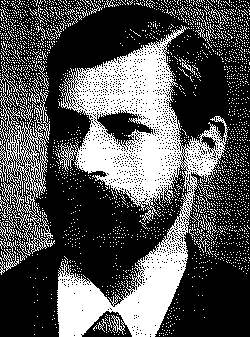
Sigmund Freud
From
"
PRINCIPLES OF PSYCHOLOGY"
by William James
- We observe an identical difference between men as a whole and women as a whole. A young woman of twenty reacts with intuitive promptitude and security in all the usual circumstances in which she may be placed. Her likes and dislikes are formed; her opinions, to a great extent, the same that they will be through life. Her character is, in fact, finished in its essentials. How inferior to her is a boy of twenty in all these respects! His character is still gelatinous, uncertain what shape to assume, "trying it on" in every direction. Feeling his power, yet ignorant of the manner in which he shall express it, he is, when compared with his sister, a being of no definite contour. But this absence of prompt tendency in his brain to set into particular modes is the very condition which insures that it shall ultimately become so much more efficient than the woman's. The very lack of preappointed trains of thought is the ground on which general principles and heads of classification grow up; and the masculine brain deals with new and complex matter indirectly by means of these, in a manner which the feminine method of direct intuition, admirably and rapidly as it performs within its limits, can vainly hope to cope with.
- Women take offense and get angry, if anything, more easily than men, but their anger is inhibited by fear and other principles of their nature from expressing itself in blows.
- The consciousness of how one stands with other people occupies a relatively larger and larger part of the mind, the lower one goes on the scale of culture. Woman's intuition, so fine in the sphere of personal relations, is seldom first-rate in the way of mechanics. Hence Dr. Whately's jest, "Woman is the unreasoning animal, and pokes the fire from the top."
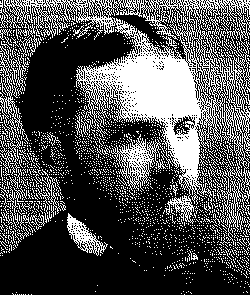
William James
From
"
THE GOSPEL OF THOMAS"
Simon Peter said to them, "Let Mary leave us, for women are not worthy of life." Jesus said, "I myself shall lead her in order to make her male, so that she too may become a living spirit resembling you males. For every woman who will make herself male will enter the Kingdom of Heaven."
From
"
MEN, WOMEN, AND GOD"
by Carl Jung
(from "Jung speaking" 1977)
- A woman is at her best only when she loves a man. Personal relationship is her basic need, and when that falters she grows dissatisfied and argumentative in a way that often leads to divorce. But this certainly doesn't mean that men and women should remain placid. On the contrary, some tension must prevail in their daily lives, for otherwise there cannot be the ideal relationship in sex - and this is a "must" between husband and wife.
Mentally, morally, physically - in all these ways Nature has created an extreme difference between man and woman, so that he finds his opposite in her and she in him. That creates tension.
IN VINO VERITAS
(or THE BANQUET)
by Søren Kierkegaard
from his book "Stages on Life's Way"
It was on one of the last days in July, at ten o'clock in the evening, when the participants in that banquet assembled together. Date and year I have forgotten; indeed, this would be interesting only to one's memory of details, and not to one's recollection of the contents of that experience. The "spirit of the occasion," and whatever impressions are recorded in one's mind under that heading, concerns only one's recollections; and just as generous wine gains in flavor by passing the Equator, because of the evaporation of its watery particles, likewise does recollection gain by getting rid of the watery particles of memory; and yet recollection becomes as little a mere figment of the imagination by this process as does the generous wine.
The participants were five in number: John, called the Seducer, Victor Eremita, Constantine Constantius, and yet two others whose names I have not exactly forgotten - which would be a matter of small importance - but whose names I did not learn. It was as if these two had no proper names, for they were constantly addressed by some epithet. The one was called the Young Person. Nor was he more than twenty and some years, of slender and delicate build, and of a very dark complexion. His face was thoughtful; but more pleasing even was its lovable and engaging expression which betokened a purity of soul harmonizing perfectly with the soft charm, almost feminine, and the transparency of his whole presence. This external beauty of appearance was lost sight of, however, in one's next impression of him; or, one kept it only in mind whilst regarding a youth nurtured or - to use a still tenderer expression - petted into being, by thought, and nourished by the contents of his own soul - a youth who as yet had had nothing to do with the world, had been neither aroused and fired, nor disquieted and disturbed. Like a sleepwalker he bore the law of his actions within himself, and the amiable, kindly expression of his countenance concerned no one, but only mirrored the disposition of his soul.
The other person they called the Dressmaker, and that was his occupation. . . .
. . . They were seated. In the same moment the little company were launched into the very middle of the infinite sea of enjoyment - as if with a single bound. Each one had addressed all his thoughts and all his desires to the banquet, had prepared his soul for the enjoyment which was offered to overflowing and in which their souls overflowed. . . .
. . . Thus they banqueted. Soon, conversation had woven its beautiful wreaths about the banqueters, so that they sat garlanded. Now, it was enamored of the food, now of the wine, and now again of itself; now, it seemed to develop into significance, and then again it was altogether slight. . . .
. . . After a couple of courses had been served Constantine proposed that the banquet should conclude with each one's making a speech, but that precautions should be taken against the speakers' divagating too much. He was for making two conditions, viz., there were to be no speeches until after the meal; and no one was to speak before having drunk sufficiently to feel the power of the wine - or else he was to be in that condition in which one says much which under other circumstances one would leave unsaid - without necessarily having the connection of speech and thought constantly interrupted by hiccoughs. Before speaking, then, each one was to declare solemnly that he was in that condition. No definite quantity of wine was specified, capacities differed so widely. Against this proposal, John entered protest. He could never become intoxicated, he averred, and when he had come to a certain point he grew the soberer the more he drank. . . .
. . . As to the contents of the speeches, Constantine proposed that they should deal with love, that is, the relation between man and woman. No love stories were to be told though they might furnish the text of one's remarks.
The conditions were accepted. All reasonable and just demands a host may make on his guests were fulfilled: they ate and drank, and "drank and were filled with drink," as the Bible has it; that is, they drank stoutly.
The desert was served. Even if Victor had not, as yet, had his desire gratified to hear the splashing of a fountain - which, for that matter, he had luckily forgotten since that former conversation - now champagne flowed profusely. The clock struck twelve. Thereupon Constantine commanded silence, saluted the Young Person with a goblet and the words "May it be fortunate and favorable," and bade him to speak first.
The Young Person's Speech
The Young Person arose and declared that he felt the power of the wine, which was indeed apparent to some degree; for the blood pulsed strongly in his temples, and his appearance was not as beautiful as before the meal. He spoke as follows: . . .
(Editors note: The Young Person began his speech by speaking about the comical and contradictory nature of love. I have chosen to exclude the early part of his speech insofar as it does not relate immediately to the subject of woman. - KS)
. . . No, love anyone I will not, before I have fathomed what love is; but this I cannot, but have, rather, come to the conclusion that it is comical. Hence I will not love - but alas! I have not thereby avoided the danger, for, since I do not know what the lovable is and how it seizes me, or how it seizes a woman with reference to me, I cannot make sure whether I have avoided the danger. . . .
. . . Look you, for this reason have I forsworn all love, for my thought is to me the most essential consideration. So even if love be the most exquisite joy, I renounce it, without wishing to either offend or to envy anyone; and even if love be the condition for conferring the greatest benefit imaginable I deny myself the opportunity therefor - but my thought I have not prostituted. By no means do I lack an eye for what is beautiful, by no means does my heart remain unmoved when I read the songs of the poets, by no means is my soul without sadness when it yields to the beautiful conceptions of love; but I do not wish to become unfaithful to my thought. And of what avail were it to be, for there is no happiness possible for me except my thought have free sway, for it is my immortal part and, hence, of more importance than a wife. Well do I comprehend that if anything is sacred it is love; that if faithlessness in any relation is base, it is doubly so in love; that if any deceit is detestable, it is tenfold more detestable in love. But my soul is innocent of blame. I have never looked at any woman to desire her; neither have I fluttered about aimlessly before blindly plunging, or lapsing, into the most decisive of all relations. If I knew what the lovable were I would know with certainty whether I had offended by tempting anyone; but since I do not know, I am certain only of never having had the conscious desire to do so.
Supposing I should yield to love and be made to laugh; or supposing I should be cast down by terror, since I cannot find the narrow path which lovers travel as easily as if it were a broad highway, undisturbed by any doubts, which they surely have bestowed thought on (seeing our times have, indeed, reflected about everything and consequently will comprehend me when I assert that to act unreflectingly is nonsense , as one ought to have gone through all possible reflections before acting) - supposing, I say, I should yield to love! Would I not insult past redress my beloved one if I laughed, or irrevocably plunge her into despair if I were overwhelmed by terror? For I understand well enough that a woman cannot be expected to have thought as profoundly about these matters; and a woman who found love comical (as but gods and men can, for which reason woman is a temptation luring them to become ridiculous) would both betray a suspicious amount of previous experience and understand me least. But a woman who comprehended the terror of love would have lost her loveliness and still fail to understand me - she would be annihilated, which is in nowise my case, so long as my thought saves me.
. . . If there be no one who laughs at my speech - well, then laugh a little at me, dear fellow banqueters, and I shall not wonder; for I do not understand what I have occasionally heard you say about love. Very probably, though, you are among the initiated as I am not.
. . . Thereupon the Young Person seated himself. He had become more beautiful, almost, than before the meal. Now he sat quietly, looking down before him, unconcerned about the others. John the Seducer desired at once to urge some objections against the Young Person's speech but was interrupted by Constantine who warned against discussions and ruled that on this occasion only speeches were in order. John said if that was the case, he would stipulate that he should be allowed to be the last speaker. This again gave rise to a discussion as to the order in which they were to speak, which Constantine closed by offering to speak forthwith, against their recognizing his authority to appoint the speakers in their turn.
Constantine's Speech
Constantine spoke as follows:
There is a time to keep silence, and a time to speak, and now it seems to be the time to speak briefly, for our young friend has spoken much and very strangely. His comical power has made us struggle in uncertain battle because his speech was full of doubts, as he himself is, sitting there now - a perplexed man who knows not whether to laugh, or weep, or fall in love. In fact, had I had foreknowledge of his speech, such as he demands one should have of love, I should have forbidden him to speak; but now it is too late. I shall bid you then, dear fellow banqueters, "gladsome and merry be," and even if I cannot enforce this I shall ask you to forget each speech so soon as it is made and to wash it down with a single draught.
And now as to woman, about whom I shall speak. I too have pondered about her, and I have finally discovered the category to which she belongs. I too have sought, but I have found, too, and I have made a matchless discovery which I shall now communicate to you. Woman is understood correctly only when placed in the category of "the joke."
It is a man's function to be absolute, act in an absolute fashion, or to give expression to the absolute. Woman's sphere lies in her relativity. Between beings so radically different, no true reciprocal relation can exist. Precisely in this incommensurability lies the joke. And with woman the joke was born into the world. It is to be understood, however, that man must know how to stick to his role of being absolute; for else nothing is seen - that is to say, something exceedingly common is seen, viz., that man and woman fit each other, he as half man and she as half man.
The joke is not an aesthetic, but an abortive ethical, category. Its effect on thought is about the same as the impression we receive if a man were solemnly to be making a speech, recite a comma or two with his pronouncement, then say "hm!" - "dash" - and then stop. Thus with woman. One tries to cover her with the ethical category, one thinks of human nature, one opens one's eyes, on fastens one's glances on the most excellent maiden in question; an effort is made to redeem the claims of the ethical demand; and then one grows ill at ease and says to one's self: ah, this is undoubtedly a joke! The joke lies, indeed, in applying that category to her and measuring her by it, because it would be idle to expect serious results from her; but just that is the joke. Because if one could demand it of her it would not be a joke at all. A mighty poor joke indeed it would be to place her under the air pump and draw the air out of her - indeed it were a shame; but to blow her up to supernatural size and let her imagine herself to have attained all the ideality which a little maiden of sixteen imagines she has, that is the beginning of the game and, indeed, the beginning of a highly entertaining performance. No youth has half so much imaginary ideality as a young girl, but: "We shall soon be even" as says the tailor in the proverb; for her ideality is but an illusion.
If one fails to consider woman from this point of view, she may cause irreparable harm; but through my conception of her she becomes harmless and amusing. For a man there is nothing more shocking than to catch himself twaddling. It destroys all true ideality; for one may repent of having been a rascal and one may feel sorry for not having meant a word of what one said; but to have talked nonsense, sheer nonsense, to have meant all one said and behold! it was all nonsense - that is too disgusting for repentance incarnate to put up with. But this is not the case with woman. She has a prescriptive right to transfigure herself - in less than twenty-four hours - into the most innocent and pardonable nonsense; for far is it from her ingenuous soul to wish to deceive one! Indeed, she meant all she said, and now she says the precise opposite, but with the same amiable frankness, for now she is willing to stake everything on what she said last. Now in case a man in all seriousness surrenders to love he may be called fortunate indeed if he succeeds in obtaining an insurance - if, indeed, he is able to obtain it anywhere; for so inflammable a material as woman is most likely to arouse the suspicions of an insurance agent. Just consider for a moment what he has done in thus identifying himself with her! If, some fine New Year's night she goes off like some fireworks he will promptly follow suit; and even if this should not happen he will have many a close call. And what may he not lose! He may lose his all; for there is but one absolute antithesis to the absolute, and that is nonsense. Therefore, let him not seek refuge in some society for morally tainted individuals, for he is not morally tainted - far from it; only, he has been reduced in absurdum and beatified in nonsense; that is, has been made a fool of.
This will never happen among men. If a man should sputter off in this fashion I would scorn him. If he should fool me by his cleverness I need but apply the ethical category to him, and the danger is trifling. If things go too far I shall put a bullet through his brain; but to challenge a woman - what is that, if you please? Who does not see that it is a joke, just as when Xerxes had the sea whipped? When Othello murders Desdemona, granting she really had been guilty, he has gained nothing, for he has been duped, and a dupe he remains; for even by his murdering her he only makes a concession with regard to a consequence which originally made him ridiculous; whereas Elvira (in Mozart's "Don Giovanni") may be an altogether pathetic figure when she arms herself with a dagger to obtain revenge. The fact that Shakespeare has conceived Othello as a tragic figure (even disregarding the calamity that Desdemona is innocent) is to be explained and, indeed, to perfect satisfaction, by the hero being a colored person. For a colored person, dear fellow banqueters, who cannot be assumed to represent spiritual qualities - a colored person, I say, who therefore becomes green in the face when his ire is aroused (which is a physiological fact), a colored man may, indeed, become tragic if he is deceived by a woman; just as a woman has all the pathos of tragedy on her side when she is betrayed by a man. A man who flies into a rage may perhaps become tragic; but a man of whom one may expect a developed mentality, he will either not become jealous or he will become ridiculous if he does, and most of all when he comes running with a dagger in his hand.
A pity that Shakespeare has not presented us with a comedy of this description in which the claim raised by a woman's infidelity is turned down by irony; for not everyone who is able to see the comical element in this situation and is capable also of developing the thought can give it dramatic embodiment. Let one but imagine Socrates surprising Xanthippe in the act - for it would be un-Socratic even to think of Socrates being particularly concerned about his wife's fidelity, or still worse, spying on her - imagine it, and I believe that the fine smile which transformed the ugliest man in Athens into the handsomest would for the first time have turned into a roar of laughter. It is incomprehensible why it never occurred to Aristophanes, who so frequently made Socrates the butt of his ridicule, to have him come running on the stage, shouting: "Where is she, where is she, so that I may kill her, ie., my unfaithful Xanthippe." For really it does not matter greatly whether or not Socrates was made a cuckold, and all that Xanthippe may do in this regard is wasted labor, like snapping one's fingers in one's pocket; for Socrates remains the same intellectual hero, even if he is cuckolded. But if he had in fact become jealous and had wanted to kill Xanthippe - alas! then would Xanthippe have exerted a power over him such as the entire Greek nation and his sentence of death could not - to make him ridiculous.
A cuckold is comical, then, with respect to his wife; but he may be regarded as becoming tragical with respect to other men. In this fact we may find an explanation of the Spanish conception of honor. But the tragic element resides chiefly in his not being able to obtain redress, and the anguish of his suffering consists really in its being devoid of meaning - which is terrible enough. To shoot the woman, to challenge her, to despise her, all this would only serve to render the poor man still more ridiculous; for woman is the weaker sex. This consideration enters in everywhere and confuses all. If she performs a great deed she is admired more than man, because it is more than was expected of her. If she is betrayed, all the pathos is on her side; but if a man is deceived one has scant sympathy and little patience while he is present - and laughs at him when his back is turned.
Look you, therefore is it advisable betimes to consider woman as a joke. The entertainment she affords is simply incomparable. Let one consider her a fixed quantity and one's self a relative one; let one by no means contradict her, for that would simply be helping her; let one never doubt what she says but, rather, believe her every word; let one gallivant about her, with eyes rendered unsteady by unspeakable admiration and blissful intoxication and with the mincing steps of a worshiper; let one languishingly fall on one's knees, then lift one's eyes up to her languishingly and heave a breath again; let one do all she bids one, like an obedient slave. And now comes the cream of the joke. We need no proof that woman can speak, ie., use words. Unfortunately, however, she does not possess sufficient reflection for making sure against her in the long run - which is, at most, eight days - contradicting herself, unless, indeed, man, by contradicting her, exerts a regulative influence. So the consequence is that within a short time confusion will reign supreme. If one had not done what she told one to, the confusion would pass unnoticed; for she forgets again as quickly as she talks. But since her admirer has done all and has been at her beck and call in every instance, the confusion is only too glaring.
The more gifted the woman, the more amusing the situation. For the more gifted she is, the more imagination she will possess. Now, the more imagination she possesses, the greater airs she will give herself and the greater the confusion which is bound to become evident in the next instant. In life, such entertainment is rarely had, because this blind obedience to a woman's whims occurs but seldom. And if it does, in some languishing swain, most likely he is not qualified to see the fun. The fact is, the ideality a little maiden assumes in moments when her imagination is at work is encountered nowhere else, whether in gods or man; but it is all the more entertaining to believe her and to add fuel to the fire.
As I remarked, the fun is simply incomparable - indeed, I know it for a fact because I have at times not been able to sleep at night with the mere thought of what new confusions I should live to see, through the agency of my sweetheart and my humble zeal to please her. Indeed, no one who gambles in a lottery will meet with more remarkable combinations than he who has a passion for this game. For this is sure, that every woman without exception possesses the same qualifications for being resolved and transfigured in nonsense with a gracefulness, a nonchalance, an assurance such as befits the weaker sex.
Being a right-minded lover one naturally discovers every possible charm in one's beloved. Now, when discovering genius in the above sense, one ought not to let it remain a mere possibility but ought, rather, to develop it into virtuosity. I do not need to be more specific, and more cannot be said in a general way, yet everyone will understand me. Just as one may find entertainment in balancing a cane on one's nose, in swinging a tumbler in a circle without spilling a drop, in dancing between eggs, and in other games as amusing and profitable, likewise, and not otherwise, in living with his beloved the lover will have a source of incomparable entertainment and food for the most interesting study. In matters pertaining to love, let one have absolute belief, not only in her protestations of fidelity - one soon tires of that game - but in all those explosions of inviolable Romanticism by which she would probably perish if one did not contrive a safety valve through which the sighs and the smoke, and "the aria of Romanticism" may escape and make her worshiper happy. Let one compare her admiringly to Juliet, the difference being only that no person ever as much as thought of touching a hair on her Romeo's head. With regard to intellectual matters, let one hold her capable of all and, if one has been lucky enough to find the right woman, in a trice one will have a cantankerous authoress, whilst wonderingly shading one's eyes with one's hand and duly admiring what the little black hen may yield besides. It is altogether incomprehensible why Socrates did not choose this course of action instead of bickering with Xanthippe - oh, well! to be sure he wished to acquire practice, like the riding master who, even though he has the best trained horse, yet knows how to tease him in such fashion that there is good reason for breaking him in again.
Let me be a little more concrete in order to illustrate a particular and highly interesting phenomenon. A great deal has been said about feminine fidelity, but rarely with any discretion. From a purely aesthetic point of view this fidelity is to be regarded as a piece of poetic fiction which steps on the stage to find her lover - a fiction which sits by the spinning wheel and waits for her lover to come; but when she has found him, or he has come, why, then aesthetics is at a loss. Her infidelity, on the other hand, as contrasted with her previous fidelity, is to be judged chiefly with regard to its ethical import, when jealousy will appear as a tragic passion. There are three possibilities, then, and so the situation is favorable for woman; for there are two cases of fidelity, as against one of infidelity. Inconceivably great is her fidelity when she is not altogether sure of her cavalier; and ever so inconceivably great is it when he repels her fidelity. The third case would be her infidelity. Now granted one has sufficient intellect and objectivity to make reflections, one will find sufficient justification, in what has been said, for my category of "the joke." Our young friend whose beginning in a manner which deceived me seemed to be on the point of entering into this matter, but backed out again, dismayed at the difficulty. And yet the explanation is not difficult, providing one really sets about it seriously, to make unrequited love and death correspond to one another, and providing one is serious enough to stick to his thoughts - and so much seriousness one ought to have - for the sake of the joke.
Of course, this phrase of unrequited love being death originated either with a woman or a womanish male. Its origin is easily made out, seeing that it is one of those categorical outbursts which, spoken with great bravado on the spur of the moment, may count on a great and immediate applause; for although this business is said to be a matter of life and death, yet the phrase is meant for immediate consumption - like cream puffs. Although referring to daily experience, it is by no means binding on him who is to die, but only obliges the listener to rush posthaste to the assistance of the dying lover. If a man should take to using such phrases, it would not be amusing at all, for he would be too despicable to laugh at. Woman, however, possesses genius, is lovable in the measure she possesses it, and is amusing at all times. Well, then, the languishing lady dies of love - why certainly, for did she not say so herself? In this matter she is pathetic, for woman has enough courage to say what no man would have the courage to do - so then she dies! In saying so, I have measured her by ethical standards. Do ye likewise, dear fellow banqueters, and understand your Aristotle aright, now! He observes very correctly that woman cannot be used in tragedy. And very certainly her proper sphere is the pathetic and serious divertissement, the half-hour farce, not the five-act drama. So then she dies. But should she for that reason not be able to love again? Why not? - that is, if it be possible to restore her to life. Now, having been restored to life, she is of course a new being - another person, that is, and begins afresh and falls in love for the first time: nothing remarkable in that! Ah, death, great is thy power; not the most violent emetic and not the most powerful laxative could ever have the same purging effect!
The resulting confusion is capital, if one but is attentive and does not forget. A dead man is one of the most amusing characters to be met with in life. Strange that more use is not made of him on the stage, for in life he is seen now and then. When you come to think of it, even one who has only been seemingly dead is a comical figure; but one who was really dead certainly contributes to our entertainment all one can reasonably expect of a man. All depends on whether one is attentive. I myself had my attention called to it one day as I was walking with one of my acquaintances. A couple passed us. I judged from the expression on his face that he knew them and asked whether that was the case. "Why, yes" he answered, "I know them very well, and especially the lady, for she is my departed one." - "What departed one?" I asked - "Why, my departed first love," he answered. "Indeed, this is a strange affair. She said: I shall die. And that very same moment she departed, naturally enough, by death - else one might have insured her beforehand in the widow's insurance. Too late! Dead she was and dead she remained; and now I wander about, as says the poet, vainly seeking the grave of my ladylove that I may shed my tears thereon." Thus this brokenhearted man who remained alone in the world, though it consoled him to find her pretty far along, if not by, yet with another man.
It is a good thing for the girls, thought I, that they don't have to be buried every time they die; for if parents have hitherto considered a boy child to be the more expensive, the girls might become even more so!
A simple case of infidelity is not as amusing, by far. I mean, if a girl should fall in love with someone else and should say to her husband: "I cannot help it, save me from myself!" But to die from sorrow because she cannot endure being separated from her lover by his journey to the West Indies, to have put up with his departure, however - and then, at his return, be not only not dead but attached to someone else for all time - that certainly is a strange fate for a lover to undergo. No wonder, then, that the heartbroken man at times consoled himself with the burthen of an old song which runs: "Hurrah for you and me, I say, we never shall forget that day!"
Now forgive me, dear fellow banqueters, if I have spoken at too great length; and empty a glass to love and to woman. Beautiful she is and lovely, if she be considered aesthetically. That is undeniable. But, as has often been said, and as I shall say also: one ought not to remain standing here, but should go on. Consider her, then, ethically and you will hardly have begun to do so before the humor of it will become apparent. Even Plato and Aristotle assume that woman is an imperfect form, an irrational quantity, that is, one which might some time, in a better world, be transformed into a man. In this life one must take her as she is. And what this is becomes apparent very soon; for she will not be content with the aesthetic sphere, but goes on, she wants to become emancipated, and she has the courage to say so. Let her wish be fulfilled and the amusement will be simply incomparable.
When Constantine had finished speaking, he forthwith ruled Victor Eremita to begin. He spoke as follows:
Victor Eremita's Speech
As you know, Plato offered thanks to the gods for four things. In the fourth place he is grateful for having been permitted to be a contemporary of Socrates. For the three other boons mentioned by him (that he had been made a man and not an animal, a man and not a woman, a Greek and not a barbarian), an earlier Greek philosopher had already thanked the gods, and so I conclude that they are worthy of our gratitude. But alas! - even if I wanted to express my gratitude like these Greeks, I would not be able to do so for what was denied me. Let me then collect my soul in gratitude for the one good which was conferred on me also - that I was made a man and not a woman.
To be a woman is something so curious, so heterogeneous and composite that no predicate will fully express these qualities; and if I should use many predicates they would contradict one another in such fashion that only a woman would be able to tolerate the result and, what is worse, feel happy about it. The fact that she really signifies less than man - that is not her misfortune, and still less so if she got to know it, for it might be borne with fortitude. No, her misfortune consists in her life's having become devoid of fixed meaning through a romantic conception of things, by virtue of which now she signifies all, and now, nothing at all, without ever finding out what she really does signify - and even that is not her misfortune but, rather, the fact that, being a woman, she never will be able to found out. As for myself, if I were a woman, I should prefer to be one in the Orient and as a slave, for to be a slave, neither more nor less, is at any rate something, in comparison with being now heyday, now nothing.
Even if a woman's life did not contain such contrasts, the distinction she enjoys, and which is rightly assumed to be hers as a woman - a distinction she does not share with man - would by itself point to the meaninglessness of her life. The distinction I refer to is that of gallantry. To be gallant to woman is becoming in men. Now gallantry consists very simply in conceiving in fantastic categories that person to whom one is gallant. To be gallant to a man is, therefore, an insult, for he begs to be excused from the application of fantastic categories to him. For the fair sex, however, gallantry signifies a tribute, a distinction, which is essentially its privilege. Ah me, if only a single cavalier were gallant to them the case would not be so serious. But far from it! At bottom every man is gallant; he is unconsciously so. This signifies, therefore, that it is life itself which has bestowed this perquisite on the fair sex. Woman on her part unconsciously accepts it. Here we have the same trouble again; for if only a single woman did so, another explanation would be necessary. This is life's characteristic irony.
Now if gallantry contained the truth, it ought to be reciprocal, ie., gallantry would be the accepted quotation for the stated difference between beauty on the one hand, and power, astuteness, and strength on the other. But this is not the case. Gallantry is essentially woman's due, and the fact that she unconsciously accepts it may be explained through the solicitude of nature for the weak and those treated in a stepmotherly fashion by her, who feel more than recompensed by an illusion. But precisely this illusion is her misfortune. It is not seldom the case that nature comes to the assistance of an afflicted creature by consoling him with the notion that he is the most beautiful. If that is so, why, then we may say that nature made good the deficiency since now the creature is endowed with even more than could be reasonably demanded. But to be beautiful only in one's imagination, and not to be overcome, indeed, by sadness, but to be fooled into an illusion - why, that is still worse mockery. Now, as to being afflicted, woman certainly is far from having been treated in a step- motherly fashion by nature; still she is so in another sense inasmuch as she never can free herself from the illusion with which life has consoled her.
Gathering together one's impressions of a woman's existence, in order to point out its essential features, one is struck by the fact that every woman's life gives one an entirely fantastic impression. In a far more decisive sense than man she may be said to have turning points in her career; for her turning points turn everything upside down. In one of Tieck's Romantic dramas there occurs a person who, having once been king of Mesoptamia, now is a greengrocer in Copenhagen. Exactly as fantastic is every feminine existence. If the girl's name is Juliana, her life is as follows: erstwhile empress in the wide domains of love and titulary queen of all the exaggerations of tomfoolery; now, Mrs. Petersen, corner Bathhouse Street.
When a child, a girl is less highly esteemed than a boy. When a little older, one does not know exactly what to make of her. At last she enters that decisive period in which she holds absolute sway. Worshipfully, man approaches her as a suitor. Worshipfully, for so does every suitor, it is not the scheme of a crafty deceiver. Even the executioner, when laying down his fasces to go a-wooing, even he bends his knee, although he is willing to offer himself up, within a short time, to domestic executions which he finds so natural that he is far from seeking any excuse for them in the fact that public executions have grown so few. The cultured person behaves in the very same manner. He kneels, he worships, he conceives his ladylove in the most fantastic categories; and then he very quickly forgets his kneeling position - in fact, he knew full well the while he knelt that it was fantastic to do so.
If I were a woman I would prefer to be sold by my father to the highest bidder, as is the custom in the Orient; for there is at least some sense in such a deal. What misfortune to have been born a woman! Yet her misfortune really consists in her not being able to comprehend it, being a woman. If she does complain, she complains rather about her Oriental, than her Occidental, status. But if I were a woman I would first of all refuse to be wooed and resign myself to belong to the weaker sex, if such is the case, and be careful - which is most important if one is proud - of not going beyond the truth. However, that is of but little concern to her. Juliana is in the seventh heaven, and Mrs. Petersen submits to her fate.
Let me, then, thank the gods that I was born a man and not a woman. And still, how much do I forego! For is not all poetry, from the drinking song to the tragedy, a deification of woman? All the worse for her and for him who admires her; for if he does not look out he will, all of a sudden, have to pull a long face. The beautiful, the excellent, all of man's achievement, owes its origin to woman, for she inspires him. Woman is, indeed, the inspiring element in life. How many a lovelorn shepherd has played on this theme, and how many a shepherdess has listened to it! Verily, my soul is without envy and feels only gratitude to the gods; for I would rather be a man, though in humble station, but really so, than be a woman and an indeterminate quantity, rendered happy by a delusion - I would rather be a concrete thing, with a small but definite meaning, than an abstraction which is to mean all.
As I have said, it is through woman that ideality is born into the world and - what were man without her! There is many a man who has become a genius through a woman, many a one a hero, many a one a poet, many a one even a saint; but he did not become a genius through the woman he married, for through her he only became a privy councillor; he did not become a hero through the woman he married, for through her he only became a general; he did not become a poet through the woman he married, for through her he only became a father; he did not become a saint through the woman he married, for he did not marry, and would have married but one - the one whom he did not marry; just as the others became a genius, became a hero, became a poet through the help of the woman they did not marry. If woman's ideality were in itself inspiring, why, then the inspiring woman would be the one to whom a man is united for life. But life tells a different story. It is only by a negative relation to her that man is rendered productive in his ideal endeavors. In this sense she is inspiring; to say that she is inspiring, without qualifying one's statement, is to be guilty of a paralogism which one must be a woman to overlook. Or has anyone ever heard of any man having become a poet through his wife? So long as man does not possess her, she inspires him. It is this truth which gives rise to the illusions entertained in poetry and by women. The fact that he does not possess her signifies, either, that he is still fighting for her - thus has woman inspired many a one and rendered him a knight; but has anyone ever heard of any man having been rendered a knight valiant through his wife? Or, the fact that he does not possess her signifies that he cannot obtain her by any manner of means - thus has woman inspired many a one and roused his ideality; that is, if there is anything in him worth-while. But a wife, who has things ever so much worth-while for her husband, will hardly arouse any ideal strivings in him. Or, again, the fact that he does not possess her signifies that he is pursuing an ideal. Perchance he loves many, but loving many is also a kind of unrequited love; and yet the ideality of his soul is to be seen in this striving and yearning and not in the small bits of lovableness which make up the sum total of the contributions of all those he loves.
The highest ideality a woman can arouse in a man consists, in fact, in the awakening within him of the consciousness of immortality. The point of this proof lies in what one might call the necessity of a reply. Just as one may remark about some play that it cannot end without this or that person getting in his say, likewise (says ideality) our existence cannot be all over with death: I demand a reply! This proof is frequently furnished, in a positive fashion, in the public advertiser. I hold that to be entirely proper, for if proof is to be made in the public advertiser it must be made in a positive fashion. Thus: Mrs. Petersen, we learn, has lived a number of years, until in the night of the 24th it pleased Providence, etc. This produces in Mr. Petersen an attack of reminiscences from his courting days, or, to express it quite plainly, nothing but seeing her again will ever console him. For this blissful meeting he prepares himself, in the meanwhile, by taking unto himself another wife; for, to be sure, this marriage is by no means as poetic as the first - still it is a good imitation. This is the proof positive. Mr. Petersen is not satisfied with demanding a reply, no, he wants a meeting again in the hereafter.
As is well known, a base metal will often show the gleam of precious metal. This is the brief silver gleam. With respect to the base metal this is a tragic moment, for it must once for all resign itself to being a base metal. Not so with Mr. Petersen. The possession of ideality is by rights inherent in every person - and now, if I laugh at Mr. Petersen, it is not because he, being in reality of base metal, had but a single silver gleam, but, rather, because just this silver gleam betrays his having become a base metal. Thus does the Philistine look most ridiculous when, arrayed in ideality, he affords fitting occasion to say, with Holberg: "What! if that cow doesn't wear a fine dress, too!"
The case is this: whenever a woman arouses ideality in man, and thereby the consciousness of immortality, she always does so negatively. He who really became a genius, a hero, a poet, a saint through a woman, he has by that very fact seized on the essence of immortality. Now if the inspiring element were positively present in woman, why, then a man's wife, and only his wife, ought to awaken in him the consciousness of immortality. But the reverse holds true. That is, if she is really to awaken ideality in her husband she must die. Mr. Petersen, to be sure, is not affected, for all that. But if woman, by her death, does awaken man's ideality, then is she indeed the cause of all the great things poetry attributes to her; but note well: that which she did in a positive fashion for him in no wise roused his ideality. In fact, her significance in this regard becomes the more doubtful the longer she lives, because she will at length really begin to wish to signify something positive. However, the more positive the proof the less it proves; for then Mr. Petersen's longing will be for some past common experiences whose content was, to all intents and purposes, exhausted when they were had. Most positive of all the proof becomes if the object of his longing concerns their marital spooning - that time when they visited the Deer Park together! In the same way one might suddenly feel a longing for the old pair of slippers one used to be so comfortable in; but that proof is not exactly a proof for the immortality of the soul. On the other hand, the more negative the proof, the better it is; for the negative is higher than the positive, inasmuch as it concerns our immortality and is thus the only positive value.
Woman's main significance lies in her negative contribution, whereas her positive contributions are as nothing in comparison but, on the contrary, pernicious. It is this truth which life keeps from her, consoling her with an illusion which surpasses all that might arise in any man's brain, and with parental care ordering life in such fashion that both language and everything else confirm her in her illusion. For even if she be conceived as the very opposite of inspiring, and rather as the wellspring of all corruption; whether now we imagine that with her, sin came into the world, or that it is her infidelity which ruined all - our conception of her is always gallant. That is, when hearing such opinions one might readily assume that woman were really able to become infinitely more culpable than man, which would, indeed, amount to an immense acknowledgment of her powers. Alas, alas! the case is entirely different. There is a secret reading of this text which woman cannot comprehend; for, the very next moment, all life owns to the same conception as the state, which makes man responsible for his wife. One condemns her as man never is condemned (for only a real sentence is passed on him, and there the matter ends), not with her receiving a milder sentence; for in that case not all of her life would be an illusion, but with the case against her being dismissed and the public, ie., life, having to defray the costs. One moment, woman is supposed to be possessed of all possible wiles; the next moment, one laughs at him whom she deceived, which surely is a contradiction. Even such a case as that of Potiphar's wife does not preclude the possibility of her having really been seduced. Thus has woman an enormous possibility, such as no man has - an enormous possibility; but her reality is in proportion. And most terrible of all is the magic of illusion in which she feels herself happy.
Let Plato then thank the gods for having been born a contemporary of Socrates: I envy him; let him offer thanks for being a Greek: I envy him; but when he is grateful for having been born a man and not a woman I join him with all my heart. If I had been born a woman and could understand what now I can understand - it were terrible! But if I had been born a woman and therefore could not understand it - that were still more terrible!
But if the case is as I stated it, then it follows that one had better refrain from any positive relation with woman. Wherever she is concerned one has to reckon with that inevitable hiatus which renders her happy as she does not detect the illusion, but which would be a man's undoing if he detected it.
A negative relation to a woman may arouse the highest ideality in a man. Let that be said once for all, and let it be said in honor of woman; and it may be said without reservation. For it depends not on the particular quality of the woman concerned, her loveliness, or the persistence of her loveliness. Rather does it depend on her appearing at the right moment, when ideality is glimpsed. That is but a short moment, and then she had better disappear again, because a positive relation to a woman renders man finite to the highest degree. Therefore, the greatest service a woman can do a man is to make her appearance at the right moment. But that she cannot do by herself but only through the benevolence of fate. And now comes the greatest thing she can do for a man, and that is, to be unfaithful to him, the sooner the better. The first ideality will assist him to attain a still higher degree of ideality - and then he is helped in an absolute sense. This second ideality is, to be sure, purchased with the sharpest pain, but it is also his greatest bliss. And though he may in no wise desire it before it comes to pass, yet he will thank her when it has come. And as, humanly speaking, he has no very good reason to thank her, why, then everything is as it should be. But woe to him if she remains faithful to him!
I thank the gods, then, that I was born a man and not a woman; and I thank them, furthermore, that no woman by some lifelong attachment compels me to be constantly reflecting that it ought not to have been.
Indeed, what a passing strange device is marriage! And what makes it all the stranger is the suggestion that it is to be a step taken without thought. And yet no step is more decisive, for nothing in life is as inexorable and masterful as the marriage tie. And now so important a step as marriage ought, so we are told, to be taken without reflection! Yet marriage is not something simple but something immensely complex and ambiguous. Just as the meat of the turtle smacks of all kinds of meat, so likewise does marriage have a taste of all manner of things; and just as the turtle is a sluggish animal, likewise is marriage a sluggish thing. Falling in love is, at least, a simple thing, but marriage-! Is it something heathen or something Christian, something spiritual or something profane, or something civil, or something of all things? Is it an expression of an inexplicable love, the elective affinity of souls in delicate accord with one another; or is it a duty, or a partnership, or a mere convenience, or the custom of certain countries - or is it a little of all these? Is one to order the music for it from the town musician or the church organist, or is one to have a little from both? Is it the minister or the police inspector who is to make the speech and enroll the names in the book of life - or in the town register? Does marriage blow a tune on a comb, or does it listen to the whisperings "like to those of the fairies from the grottoes of a summer night"?
And now every Darby imagines he performed such a potpourri, such incomparably complex music, in getting married - and imagines that he is still performing it while living a married life! My dear fellow banqueters, ought we not, in default of a wedding present and congratulations, give each of the conjugal partners, and marriage itself, demerits for repeated inattentiveness? It is taxing enough to express a single idea in one's life, but to think something so complicated as marriage and, consequently, bring it under one head, to think something so complicated and yet to do justice to each and every element in it, and have everything present at the same time - verily, he is a great man who can accomplish all this! And still every Benedict accomplished it - so he does, no doubt, for does he not say that he does it unconsciously? But if this is to be done unconsciously it must be through some higher form of unconsciousness permeating all one's reflective powers. But not a word is said about this! And to ask any married man about it means just wasting one's time.
He who has once committed a piece of folly will constantly be pursued by its consequences. In the case of marriage the folly consists in one's having gotten into a mess, and the punishment, in recognizing, when it is too late, what one has done. So you will find that the married man now becomes chesty, with a bit of pathos, thinking he has done something remarkable in having entered wedlock; now puts his tail between his legs in dejection, then again, praises marriage in sheer self-defense. But as to a thought unit which might serve to hold together the scattered members of the most heterogeneous conceptions of life contained in marriage - for that we shall wait in vain.
Therefore, to be a mere Benedict is humbug, and to be a seducer is humbug, and to wish to experiment with woman for the sake of "the joke" is also humbug. In fact, the two last-mentioned methods will be seen to involve concessions to woman on the part of man quite as large as those found in marriage. The seducer wishes to rise in his own estimation by deceiving her; but this very fact that he deceives and wishes to deceive - that he cares to deceive - is also a demonstration of his dependence on woman. And the same holds true of him who wishes to experiment with her.
If I were to imagine any possible relation with woman it would be one so saturated with reflection that it would, for that very reason, no longer be any relation with her at all. To be an excellent husband and yet on the sly seduce every girl, to seem a seducer and yet harbor within one all the ardor of Romanticism - there would be something to that, for the concession in the first instance were then annihilated in the second. Certain it is that man finds his true ideality only in such a reduplication. All merely unconscious existence must be obliterated, and its obliteration ever cunningly guarded by some sham expression. Such a reduplication is incomprehensible to woman, for it removes from her the possibility of expressing man's true nature in one term. If it were possible for woman to exist in such a reduplication, no erotic relation with her were thinkable. But, her nature being such as we all know it to be, any disturbance of the erotic relation is brought about by man's true nature which ever consists precisely in the annihilation of that in which she has her being.
Am I then preaching the monastic life and rightly called Eremita? By no means. You may as well eliminate the cloister, for after all it is only a direct expression of spirituality and as such but a vain endeavor to express it in direct terms. It makes small difference whether you use gold, or silver, or paper money; but he who does not spend a farthing but is counterfeit, he will comprehend me. He to whom every direct expression is but a fraud, he and he only is safeguarded better than if he lived in a cloister cell - he will be a hermit even if he travelled in an omnibus day and night.
Scarcely had Victor finished when the Dressmaker jumped to his feet and threw over a bottle of wine standing before him; then he spoke as follows:
The Dressmaker's Speech
Well spoken, dear fellow banqueters, well spoken! The longer I hear you speak the more I grow convinced that you are fellow conspirators - I greet you as such, I understand you as such; for fellow conspirators one can make out from afar. And yet, what know you? What does your bit of theory to which you wish to give the appearance of experience, your bit of experience which you make over into a theory - what does it all amount to? For every now and then you believe her for a moment and - are caught in a moment! No, I know woman - from her weak side, that is to say, I know her. I shrink from no terror, I shrink from no means to make sure about what I have learned; for I am a madman, a madman one must be to understand her, and if one has not been one before, one will become a madman once one understands her. The robber has his hiding place by the noisy highroad, and the ant lion has his funnel in the loose sand, and the pirate his haunts by the roaring sea: likewise have I my fashion shop in the very midst of the teeming streets, seductive, irresistible to woman as is the Venusberg to men. There, in a fashion shop, one learns to know woman in a practical way and without any theoretical ado.
Now, if fashion meant nothing than that woman in the heat of her desire threw off all her clothing - why, that would at least mean something. But this is not the case, fashion is not plain sensuality, not tolerated debauchery, but an illicit trade in indecency authorized as proper. And, just as in heathen Prussia the marriageable girl wore a bell whose ringing served as a signal to the men, likewise is a woman's existence in fashion a continual bell ringing, not for debauchees but for lickerish voluptuaries. People hold Fortune to be a woman - ah, yes it is, to be sure, fickle; still, it is fickle in something, as it may also give much; and insofar it is not a woman. No; but fashion is a woman, for fashion is fickleness in nonsense and is consistent only in its becoming ever more crazy.
One hour in my shop is worth more than days and years without, if it really be one's desire to learn to know woman; in my shop, for it is the only one in the capital; there is no thought of competition. Who, forsooth, would dare to enter into competition with one who has entirely devoted himself, and is still devoting himself, as high priest in this idol worship? No, there is not a distinguished assemblage which does not mention my name first and last; and there is not a middle-class gathering where my name, whenever mentioned, does not inspire sacred awe, like that of the king; and there is no dress so idiotic but is accompanied by whispers of admiration when its owner proceeds down the hall - provided it bears my name; and there is not the lady of gentle birth who dares pass my shop by, nor the girl of humble origin but passes it sighing and thinking: if only I could afford it! Well, neither was she deceived. I deceive no one; I furnish the finest goods and the most costly, and at the lowest price; indeed, I sell below cost. The fact is, I do not wish to make a profit. On the contrary, every year I sacrifice large sums. And yet do I mean to win. I mean to, I shall spend my last farthing in order to corrupt, in order to bribe the tools of fashion so that I may win the game. To me it is a delight beyond compare to unroll the most precious stuffs, to cut them out, to clip pieces from genuine Brussels lace in order to make a fool's costume - I sell at the lowest prices, genuine goods and in style.
You believe, perhaps, that woman wants to be dressed fashionably only at certain times? No such thing, she wants to be so all the time and that is her only thought. For a woman does have a mind, only it is employed about as well as is the Prodigal Son's substance; and woman does possess the power of reflection in an incredibly high degree, for there is nothing so holy but she will in no time discover it to be reconcilable with her finery - and the chiefest expression of finery is fashion. What wonder if she does discover it to be reconcilable; for is not fashion holy to her? And there is nothing so insignificant but she certainly will know how to make it count in her finery - and the most fatuous expression of finery is fashion. And there is nothing, nothing in all her attire, not the least ribbon, of whose relation to fashion she has not a definite conception and concerning which she is not immediately aware whether the lady who just passed by noticed it, because for whose benefit does she dress if not for other ladies!
Even in my shop where she comes to be fitted out a la mode , even there she is in fashion. Just as there is a special bathing costume and a special riding habit, likewise there is a particular kind of dress which it is the fashion to wear to the dressmaker's shop. That costume is not insouciant in the same sense as is the negligee a lady is pleased to be surprised in, earlier in the forenoon, where the point is her belonging to the fair sex and the coquetry lies in her letting herself be surprised. The dressmaker costume, on the other hand, is calculated to be nonchalant and a bit careless without her being embarrassed thereby, because a dressmaker stands in a different relation to her from a cavalier. The coquetry here consists in thus showing herself to a man who, by reason of his station, does not presume to ask for the lady's womanly recognition, but must be content with the perquisites which fall abundantly to his share, without her ever thinking of it, or without it even so much as entering her mind to play the lady before a dressmaker. The point is, therefore, that her being of the opposite sex is, in a certain sense, left out of consideration, and her coquetry invalidated, by the superciliousness of the noble lady who would smile if anyone alluded to any relation existing between her and her dressmaker. When visited in her negligee, she conceals herself, thus displaying her charms by this very concealment. In my shop she exposes her charms with the utmost nonchalance, for he is only a dressmaker - and she is a woman. Now, her shawl slips down and bares some part of her body, and if I did not know what that means and what she expects, my reputation would be gone to the winds. Now, she draws herself up, a priori fashion; now she gesticulates a posteriori ; now, she sways to and fro in her hips; now, she looks at herself in the mirror and sees my admiring phiz behind her in the glass; now, she minces her words; now, she trips along with short steps; now, she hovers; now, she draws her foot after her in slovenly fashion; now, she lets herself sink softly into an armchair, whilst I with humble demeanor offer her a flask of smelling salts and with my adoration assuage her agitation; now, she strikes after me playfully; now, she drops her handkerchief and, without as much as a single motion, lets her relaxed arm remain in its pendant position whilst I bend down low to pick it up and return it to her, receiving a little patronizing nod as a reward. These are the ways of a lady of fashion when in my shop. Whether Diogenes made any impression on the woman who was praying in a somewhat unbecoming posture when he asked her whether she did not believe the gods could see her from behind - that I do not know; but this I do know, that if I should say to her ladyship kneeling down in church: "The folds of your gown do not fall according to fashion," she would be more alarmed than if she had given offense to the gods. Woe to the outcast, the male Cinderella, who has not comprehended this! By the immortal gods, what pray, is a woman who is not in fashion; I adjure you by the gods, and what when she is in fashion!
Whether all this is true? Well, make trial of it: let the swain, his beloved one sinks rapturously on his breast, whispering unintelligibly: "Thine forever," and hides her head on his bosom - let him but say to her: "My sweet Kitty, your coiffure is not at all in fashion." - Possibly, men don't give thought to this, but he who knows it, and has the reputation of knowing it, he is the most dangerous man in the kingdom. What blissful hours the lover passes with his sweetheart before marriage I do not know; but of the blissful hours she spends in my shop he hasn't the slightest inkling either. Without my special license and sanction a marriage is null and void, anyway - or else an entirely plebeian affair. Let it be the very moment when they are to meet before the altar, let her step forward with the very best conscience in the world that everything was bought in my shop and tried on there - and now, if I were to rush up and exclaim: "But mercy! gracious lady, your myrtle wreath is all awry" - why, the whole ceremony might be postponed, for aught I know. But men do not suspect these things; one must be a dressmaker to know.
So immense is the power of reflection needed to fathom a woman's thought that only a man who dedicates himself wholly to the task will succeed, and even then only if gifted to start with. Happy therefore the man who does not associate with any woman, for she is not his, anyway, even if she be no other man's; for she is possessed by that phantom born of the unnatural intercourse of woman's reflection with itself, fashion. Do you see, for this reason should woman always swear by fashion - then were there some force in her oath; for, after all, fashion is the thing she is always thinking of, the only thing she can think together with, and into, everything. For instance, the glad message has gone forth from my shop to all fashionable ladies that fashion decrees the use of a particular kind of headdress to be worn in church, and that this headdress, again, must be somewhat different for High Mass and for the afternoon service. Now when the bells are ringing, the carriage stops in front of my door. Her ladyship descends (for also this has been decreed that no one can adjust that headdress save I, the fashion dealer), I rush out, making low bows, and lead her into my cabinet. And whilst she languishingly reposes, I put everything in order. Now she is ready and has looked at herself in the mirror; quick as any messenger of the gods I hasten in advance, open the door of my cabinet with a bow, then hasten to the door of my shop, and lay my arm on my breast like some Oriental slave, but, encouraged by my gracious courtesy, I even dare to throw her an adoring and admiring kiss - now she is seated in her carriage - oh dear! she left her hymn book behind. I hasten out again and hand it to her through the carriage window. I permit myself once more to remind her to hold her head a trifle more to the right and herself to arrange things, should her headdress become a bit disordered when descending. She drives away and is edified.
You believe, perhaps, that it is only great ladies who worship fashion, but far from it! Look at my seamstresses for whose dress I spare no expense, so that the dictates of fashion shall be proclaimed most emphatically from my shop. They form a chorus of half-witted creatures, and I myself lead them on as high priest, as a shining example, squandering all, solely in order to make all womankind ridiculous. For when a seducer makes the boast that every woman's virtue has its price, I do not believe him; but I do believe that every woman at an early time will be crazed by the maddening and defiling introspection taught her by fashion, which will corrupt her more thoroughly than being seduced. I have made trial more than once. If not able to corrupt her myself, I set on her a few of fashion's slaves of her own station; for just as one may train rats to bite rats, likewise is the crazed woman's sting like that of the tarantula. And most especially dangerous is it when some man lends his help.
Whether I serve the Devil or God I do not know; but I am right, I shall be right, I will be, so long as I possess a single farthing, I will be until the blood spurts out of my fingers. The physiologist pictures the shape of woman to show the dreadful effects of wearing a corset, and beside it he draws a picture of her normal figure. That is all very well, but only one of the drawings has the validity of truth: they all wear corsets. Describe, therefore, the miserable, stunted perversity of the fashion-mad woman, describe the insidious introspection devouring her, and then describe the womanly modesty which least of all knows about itself - do so and you have judged woman, have in very truth passed terrible sentence on her. If ever I discover such a girl who is contented and demure and not yet corrupted by indecent intercourse with woman - she shall fall nevertheless. I shall catch her in my toils; already she stands at the sacrificial altar, that is to say, in my shop. With the most scornful glance a haughty nonchalance can assume I scrutinize her appearance; she perishes with fright; a peal of laughter from the adjoining room where sit my trained accomplices annihilates her. And afterward, when I have gotten her rigged up a la mode and she looks crazier than a lunatic, as crazy as one who would not be accepted even to a lunatic asylum, then she leaves me in a state of bliss - no man, not even a god, were able to inspire fear in her; for is she not dressed in fashion?
Do you comprehend me now, do you comprehend why I call you fellow conspirators, even though in a distant way? Do you now comprehend my conception of woman? Everything in life is a matter of fashion, and so are love, and hoop skirts, and a ring through the nose. To the utmost of my ability will I therefore come to the support of the exalted genius who wishes to laugh at the most ridiculous of all animals. If woman has reduced everything to a matter of fashion, then will I, with the help of fashion, prostitute her, as she deserves to be; I have no peace, I the dressmaker, my soul rages when I think of my task - she will yet be made to wear a ring through her nose. Seek therefore no sweetheart, abandon love as you would the most dangerous neighborhood; for the one whom you love would also be made to go with a ring through her nose.
Thereupon John, called the Seducer, spoke as follows:
The Speech of John the Seducer
My dear boon companions, is Satan plaguing you? For, indeed, you speak like so many hired mourners; your eyes are red with tears and not with wine. You almost move me to tears also, for an unhappy lover does have a miserable time of it in life. Therefore those tears. I, however, am a happy lover, and my only wish is to remain so. Very possibly that is one of the concessions to woman which Victor is so afraid of. Why not? Let it be a concession! Loosening the lead foil on this bottle of champagne also is a concession; letting its foaming contents flow into my glass also is a concession; and so is raising it to my lips - now I drain it - concedo . Now, however, it is empty, hence I need no more concessions. Just the same with girls. If some unhappy lover has bought his kiss too dearly, this proves to me only that he does not know either how to take what is coming to him or how to do it. I never pay too much for this sort of thing - that is a matter for the girls to decide. What this signifies? To me it signifies the most beautiful, the most delicious, and well-nigh the most pursuasive, argumentum ad hominem; but since every woman, at least once in her life, possesses this argumentative freshness I do not see any reason why I should not let myself be persuaded. Our young friend wishes to make this experience in his thought. Why not buy a cream puff and be content with looking at it? I mean to enjoy. No mere talk for me! Just as an old song has it about a kiss: it can hardly be seen; it is but for lips which understand each other exactly - understand each other so perfectly that any reflection about the matter is but impertinence and folly. He who is twenty and does not grasp the existence of the categorical imperative, "Enjoy thyself" - he is a fool; and he who does not seize the opportunity is and remains a Christiansfelder (a Herrnhutian Pietist).
However, you are all unhappy lovers, and that is why you are not satisfied with woman as she is. The gods forbid! As she is, she pleases me, just as she is. Even Constantine's category of "the joke" seems to contain a secret desire. I, on the other hand, I am gallant. And why not? Gallantry costs one nothing and gives one all and is the condition for all erotic pleasure. Gallantry is the Masonic language of the senses and of voluptuousness, between man and woman. It is a natural language, as love's language in general is. It consists not of sounds but of desires disguised and of ever-changing wishes. That an unhappy lover may be ungallant enough to wish to convert his deficit into a draught payable in immortality - that I understand well enough. That is to say, I for my part do not understand it; for to me a woman has sufficient intrinsic value. I assure every woman of this, it is the truth; and at the same time it is certain that I am the only one who is not deceived by this truth. As to whether a despoiled woman is worth less than man - about that I find no information in my price list. I do not pick flowers already broken; I leave them to the married men to use for Shrove-tide decoration. Whether e.g. Edward wishes to consider the matter again, and again fall in love with Cordelia, or simply repeat the affair in his reflection - that is his own business. Why should I concern myself with other peoples' affairs! I explained to her at an earlier time what I thought of her; and, in truth, she convinced me, convinced me to my absolute satisfaction, that my gallantry was well applied.
I concede, I have conceded. If I should meet with another Cordelia, why then I shall enact a comedy "Ring number 2." (A comedy which employed a moderate popularity in Copenhagen) But you are unhappy lovers and have conspired together and are worse deceived than the girls, notwithstanding that you are richly endowed by nature. But decisiveness - the decisiveness of desire - is the most essential thing in life. Our young friend will always remain an onlooker. Victor is an unpractical enthusiast, Constantine has acquired his good sense at too great a cost; and the fashion dealer is a madman. Stuff and nonsense! With all four of you busy about one girl, nothing would come of it.
Let one have enthusiasm enough to idealize, taste enough to join in the clinking of glasses at the festive board of enjoyment, sense enough to break off - to break off absolutely, as does Death, madness enough to wish to enjoy all over again - if you have all that you will be the favorite of gods and girls. But of what avail to speak here? I do not intend to make proselytes. Neither is this the place for that. To be sure, I love wine; to be sure, I love the abundance of a banquet - all that is good; but let a girl be my company, and then I shall be eloquent. Let then Constantine have my thanks for the banquet, and the wine, and the excellent appointments - the speeches, however, were but indifferent. But in order that things shall have a better ending I shall now pronounce a eulogy on woman.
Just as he who is to speak in praise of the divinity must be inspired by the divinity to speak worthily, and must therefore be taught by the divinity as to what he shall say, likewise he who would speak of woman. For woman, even less than the divinity, is a mere figment of man's brain, a daydream, or a notion that occurs to one and which one may argue about pro et contra . Nay, one learns from woman alone what to say of her. And the more teachers one has had, the better. The first time one is a disciple; the next time one is already over the chief difficulties, just as one learns in formal and learned disputations how to use the last opponent's compliments against a new opponent. Nevertheless, nothing is lost. For as little as a kiss is a mere sample of good things, and as little as an embrace is an exertion, just as little is this experience exhaustive. In fact it is essentially different from the mathematical proof of a theorem, which remains ever the same, even though other letters be substituted. This method is one befitting mathematics and ghosts, but not love and women, because each is a new proof, corroborating the truth of the theorem in a different manner. It is my joy that, far from being less perfect than man, the female sex is, on the contrary, the more perfect. I shall, however, clothe my speech in a myth; and I shall exult, on woman's account whom you have so unjustly maligned, if my speech pronounce judgment on your souls, if the enjoyment of her beckon you only to flee you, as did the fruits from Tantalus; because you have fled, and thereby insulted, woman. Only thus, forsooth, may she be insulted, even though she is far from being ruffled by that, and though punishment instantly falls on him who had the audacity to do so. I, however, insult no one. That is but a notion of married men, and a slander; whereas, in reality, I respect her more highly than does the man she is married to.
Originally there was but one sex, so the Greeks relate, and that was man's. Splendidly endowed he was, so he did honor to the gods - so splendidly endowed that the same happened to them as sometimes happens to a poet who has expended all his energy on a poetic invention: they grew jealous of man. Ay, what is worse, they feared that he would not willingly bow under their yoke; they feared, though with small reason, that he might cause their very heaven to totter. Thus they had raised up a power they scarcely held themselves able to curb. Then there was anxiety and alarm in the council of the gods. Much had they lavished in their generosity on the creation of man; but all must be risked now, for reason of bitter necessity; for all was at stake - so the gods believed - and recalled he could not be, as a poet may recall his invention. And by force he could not be subdued, or else the gods themselves could have done so; but precisely of that they despaired. He would have to be caught and subdued, then, by a power weaker than his own and yet stronger - one strong enough to compel him. What a marvelous power this would have to be! However, necessity teaches even the gods to surpass themselves in inventiveness. They sought and they found. That power was woman, the marvel of creation, even in the eyes of the gods a greater marvel than man - a discovery which the gods in their naivete could not help but applaud themselves for. What more can be said in her praise than that she was able to accomplish what even the gods did not believe themselves able to do; and what more can be said in her praise than that she did accomplish it! But how marvelous a creation must be hers to have accomplished it.
It was a ruse of the gods. Cunningly the enchantress was fashioned, for no sooner had she bewitched man than she changed and caught him in all the circumstantialities of existence. It was that the gods had desired. But what, pray, can be more delicious, or more entrancing and bewitching, than what the gods themselves contrived, when battling for their supremacy, as the only means of luring man? And most assuredly it is so, for woman is the only, and the most seductive, power in heaven and on earth. When compared with her, in this sense, man will indeed be found to be exceedingly imperfect.
And the strategem of the gods was crowned with success, but not always. There have existed at all times some men - a few - who have detected the deception. They perceive well enough woman's loveliness - more keenly, indeed, than the others - but they also suspect the real state of affairs. I call them erotic natures and count myself among them. Men call them seducers; woman has no name for them - such persons are to her unnameable. These erotic natures are the truly fortunate ones. They live more luxuriously than do the very gods, for they regale themselves with food more delectable than ambrosia, and they drink what is more delicious than nectar; they eat the most seductive invention of the gods' most ingenious thought; they are ever eating dainties set for a bait - ah, incomparable delight, ah, blissful fare - they are ever eating but the dainties set for a bait; and they are never caught. All other men greedily seize and devour it, like bumpkins eating their cabbage, and are caught. Only the erotic nature fully appreciates the dainties set out for bait - he prizes them infinitely. Woman divines this, and for that reason there is a secret understanding between him and her. But he knows also that she is a bait, and that secret he keeps to himself.
That nothing more marvelous, nothing more delicious, nothing more seductive than woman can be devised, for that vouch the gods and their pressing need which heightened their powers of invention; for that vouches also the fact they risked all and, in shaping her, moved heaven and earth.
I now forsake the myth. The conception "man" corresponds to his "idea." I can, therefore, if necessary, think of an individual man as existing. The idea of woman, on the other hand, is so general than no one single woman is able to express it completely. She is not contemporaneous with man (and hence of less noble origin), but a later creation, though more perfect than he. Whether now the gods took some part from him whilst he slept, from fear of waking him by taking too much, or whether they bisected him and made woman out of the one half - at any rate it was man who was partitioned. Hence she is the equal of man only after this partition. She is a delusion and a snare, but is so only afterward, and for him who is deluded. She is finiteness incarnate; but in her first stage she is finiteness raised to the highest degree in the deceptive infinitude of all divine and human illusions. As yet, there is no deception - one instant longer, and one is deceived.
She is finiteness, and as such she is a collective: one woman represents all women. Only the erotic nature comprehends this and therefore knows how to love many without ever being deceived, sipping the while all the delights the cunning gods were able to prepare. For this reason, as I said, woman cannot be fully expressed by one formula, but is, rather, an infinitude of finalities. He who wishes to think her "idea" will have the same experience as he who gazes on a sea of nebulous shapes which ever form anew, or as he who is dazed by looking over the waves whose foamy crests ever mock one's vision; for her "idea" is but the workshop of possibilities. And to the erotic nature these possibilities are the everlasting reason for his worship.
So the gods created her delicate and ethereal as if out of the mists of the summer night, yet goodly like ripe fruit; light like a bird, though the repository of what attracts all the world - light because the play of the forces is harmoniously balanced in the invisible center of a negative relation; slender in growth, with definite lines, yet her body sinuous with beautiful curves; perfect, yet ever appearing as if completed but now; cool, delicious, and refreshing like new-fallen snow, yet blushing in coy transparency; happy like some pleasantry which makes one forget all one's sorrow; soothing as being the end of desire, and satisfying in herself being the stimulus of desire. And the gods had calculated that man, when first beholding her, would be amazed, as one who sees himself, though familiar with that sight - would stand in amaze as one who sees himself in the splendor of perfection - would stand in amaze as one beholds what he did never dream he would, yet beholds what, it would seem, ought to have occurred to him before - sees what is essential to life and yet gazes on it as being the very mystery of existence. It is precisely this contradiction in his admiration which nurses desire to life, while this same admiration urges him ever nearer, so that he cannot desist from believing himself familiar with the sight, without really daring to approach, even though he cannot desist from desiring.
When the gods had thus planned her form, they were seized with fear lest they might not have the wherewithal to give it existence; but what they feared even more was herself. For they dared not let her know how beautiful she was, apprehensive of having someone in the secret who might spoil their ruse. Then was the crowning touch given to their wondrous creation: they made her faultless; but they concealed all this from her in the nescience of her innocence and concealed it doubly from her in the impenetrable mystery of her modesty. Now she was perfect, and victory certain. Inviting she had been before, but now doubly so through her shyness, and urging man on through her shrinking from him, and irresistible through herself offering resistance. The gods were jubilant. And no allurement has ever been devised in the world so great as is woman, and no allurement is as compelling as is innocence, and no temptation is as ensnaring as is modesty, and no deception is as matchless as is woman. She is unaware of anything, still her modesty is instinctive divination. She is distinct from man, and the separating wall of modesty parting them is more decisive than Aladdin's sword separating him from Gulnare; and yet, when like Pyramus (in Ovid's "Metamorphoses" IV) he puts his head to this dividing wall of modesty, the erotic nature will perceive all pleasures of desire divined within as from afar.
Thus does woman tempt. Men are wont to set forth the most precious things they possess as a delectation for the gods; nothing less will do. Thus is woman a showbread. The gods knew of naught comparable to her. She exists, she is present, she is with us, close by; and yet she is removed from us to an infinite distance when concealed in her modesty - until she herself betrays her hiding place, she knows not how: it is not she herself, it is life which informs on her. Roguish she is like a child who, in playing peeps forth from his hiding place; yet her roguishness is inexplicable, for she does not know of it herself, she is ever mysterious - mysterious when she casts down her eyes, mysterious when she sends forth the messengers of her glance which no thought, let alone any word, is able to follow. And yet is the eye the "interpreter" of the soul! What, then, is the explanation of this mystery if the interpreter too is unintelligible? Calm she is like the hushed stillness of eventide, when not a leaf stirs; calm like a consciousness as yet unaware of aught. Her heartbeats are as regular as if life were not present; and yet the erotic nature, listening with his stethoscopically practiced ear, detects the dithyrambic pulsing of desire sounding along unbeknown. Careless she is like the blowing of the wind, content like the profound ocean, and yet full of longing like a thing biding its explanation. My friends! My mind is softened, indescribably softened. I comprehend that also my life expresses an idea, even if you do not comprehend me. I too have discovered the secret of existence; I too serve a divine idea - and, assuredly, I do not serve it for nothing. If woman is a ruse of the gods, this means that she is to be seduced; and if woman is not an "idea," the true inference is that the erotic nature wishes to love as many of them as possible.
What a luxury it is to relish the ruse without being duped, only the erotic nature comprehends. And how blissful it is to be seduced, woman alone knows. I know that from woman, even though I never yet allowed any one of them time to explain it to me, but re-asserted my independence, serving the idea by a break as sudden as that caused by death; for a bride and a break are to one another like female and male. Only woman is aware of this, and she is aware of it together with her seducer. No married man will ever grasp this. Nor does she ever speak with him about it. She resigns herself to her fate, she knows that it must be so and that she can be seduced only once. For this reason she never really bears malice against the man who seduced her. That is to say, if he really did seduce her and thus expressed the idea. Broken marriage vows and that kind of thing are, of course, nonsense and no seduction. Indeed, it is by no means so great a misfortune for a woman to be seduced. in fact, it is a piece of good fortune for her. An excellently seduced girl may make an excellent wife. If I myself were not fit to be a seducer - however deeply I feel my inferior qualifications in this respect - if I chose to be a married man, I should always choose a girl already seduced, so that I would not have to begin my marriage by seducing my wife. Marriage, to be sure, also expresses an idea; but in relation to the idea of marriage that quality is altogether immaterial which is the absolutely essential condition for my idea. Therefore, a marriage ought never to be planned to begin as though it were the beginning of a story of seduction. So much is sure: there is a seducer for every woman. Happy is she whose good fortune it is to meet just him.
Through marriage, on the other hand, the gods win their victory. In it the once seduced maiden walks through life by the side of her husband, looking back at times, full of longing, resigned to her fate, until she reaches the limit of life. She dies; but not in the same sense as man dies. She is volatilized and resolved into that mysterious primal element of which the gods formed her - she disappears like a dream, like an impermanent shape whose hour is past. For what is woman but a dream, and the highest reality withal! Thus does the erotic nature comprehend her, leading her, and being led by her true existence, being an illusion. Through her husband, on the other hand, she becomes a creature of this world, and he through her.
Marvelous nature! If I did not admire thee, a woman would teach me; for truly she is the venerabile of life. Splendidly didst thou fashion her, but more splendidly still in that thou never didst fashion one woman like another. In man, the essential is the essential, and insofar always alike; but in woman the adventitious is the essential, and is thus an inexhaustible source of differences. Brief is her splendor; but quickly the pain is forgotten, too, even as though I had never felt it, when the same splendor is proffered me anew. It is true, I too am aware of the unbeautiful which may appear in her thereafter; but she is not thus with her seducer.
FROM KIERKEGAARD'S JOURNALS
WOMAN/MAN
- The more a body is organically developed, the more dreadful is the decay. When grass rots, there is a fragrance. When an animal rots, it stinks. A man's perdition is dreadful, more dreadful even than a woman's. Is this a proof that man is superior to woman?
- . . . she is more sensate than man; for were she more spiritual she could never have her culmination point in another. Spirit is the true independent.
Of course every religious view, like every more profound philosophical view, sees woman, despite this difference, as essentially identical with man; but it is not foolish enough to forget for that reason the truth of the difference, aesthetically and ethically understood.
- The whole plan of "A Thousand and One Nights" is very profound. This battle between masculinity and femininity, the fact that femininity conquers by means of her storytelling, her persuasiveness. In the future the Sultan, who has discovered the basic unfaithfulness of all women, intends to have every woman put to death after one single night. Then Scheherazade offers to save the sex (since the Sultan demands one every night it must end rather soon with the eradication of the women) and she saves the sex by telling stories, which means: go with her and you can never get rid of her. Fundamentally there is a terrible tenacity: No man could go on living this way for three years facing the possibility of death - but a woman can - if only she gets permission to tell stories. A woman does not have the strength for a break or finds it difficult to make such a decision, but she is able to conquer by means of your not being able to get rid of her.
- Woman's reflection is almost overpowering to her; this is why it is so dangerous for a woman to reflect. A woman's reflection usually goes like this: if she has won on one point or another, she is so overcome herself that she cannot avoid gazing at her victory - and then she stumbles.
The man is more essentially character; and character consists not so much in winning as in continuing after having won, keeping in character. The woman endures something and counts on the approaching moment when she can take a deep breath. This moment is precisely the danger. Character is essentially continuity.
- It was Eve who seduced the man - in compensation there is no undertaking more appealing to a woman than to become loved by someone who has gone astray and who now, in loving her, will let himself be led along the right path. This appeals to a woman so much that she is not infrequently deceived, because such a person puts everything over on her - and she believes everything - perhaps also because the thought of being the man's savior is so very satisfying to her.
- For woman the temptation to misuse cunning (for example, to deceive) corresponds to man's temptation to misuse power. The fact that the woman's guilt is always more strongly emphasized than the man's is basically an indirect compliment to the woman, an admission of the degree to which she is the stronger sex in cunning.
Caricatures of Kierkegaard in The Corsair.
- In the New Testament the matter is put this way: "Let all those trivialities, those egotistical trivialities with which men generally fill their lives - job, marriage, having children, getting to be somebody in the world - let them all go, break with them completely, and let your life be dedicated to loving God, to being sacrificed for the human race. Be salt!" This is what our Lord Jesus Christ calls Christianity. When a man is intending to get married, the invitation (see the Gospel) comes to him: Let it go - and become a Christian, etc.
Now Christianity has become the very opposite. It has become a divine blessing upon all the trivialities and putterings of finitude and the temporal enjoyment of life. The lovers summon the clergymen - he blesses them - this is Christianity, in spite of Luke 20:34-35 (which is a suitable text for a wedding). If the buyer of the six pairs of oxen were to summon a clergyman and pay him ten dollars to bless him and the oxen before he went out to test them, he would be considered an extraordinary, incomparable Christian worthy of adoration.
Of course it is Protestantism in particular which is total nonsense.
This is why Protestantism has elevated woman so high, more accurately, to first place. Everything revolves around woman. Charming, but then one can also be sure that everything revolves around chatter, trivialities, and in a refined way, around sexual relations. To some extent woman may be said to have ennobled social life in that we do not fight any more or drink and swear as did the old heroes - but refined lust or a carefully concealed, refined allusion to sexual relations - that is what has ennobled social life - Christianity!!
This is how some of my pseudonyms have portrayed it and which I now also find Schopenhauer rages against in his own way. Woman is not to blame, but she is determined to humble man and to make him mediocre. Existence is also a sovereign and like every sovereign knows very well how to best maintain its regime - specifically by humbling and breaking those over whom they rule.
A woman is proficient along this line when a man gets involved with her too seriously. She contributes the first and the most to his humbling. Generally it can be assumed that every married man is secretly mortified because he feels that he has been made a fool of when all this ravishing talk from the courting days, all this about Julie being the paragon of loveliness and beauty, and getting to possess her is the highest bliss turns out to be - a false alarm. This is the first knock the husband gets, but this in itself is not insignificant, because it is hard for a man to admit that he has been fooled, that both he and Julie must have been crazy. The next undermining is that the husband and Julie (who incidentally has had the same experience on her side) agree to keep a stiff upper lip and to hide things from others; they agree to tell the lie that marriage is the true happiness and that they especially are happy.
When we have settled this, providence knows that this fellow is easy to control, that he is one of those who will make no conquests in the world of ideas. Constantly lying like this is extremely degrading to the man. It is different for a woman; she is once and for all a born virtuoso in lying, is really never happy without a little lying, just as it is a priori certain that wherever a woman is there is a little lying. In a sense she is innocent in this; she cannot help it. It is not possible to get angry about it: on the contrary, we find it very attractive. She is in the power of a natural disposition which uses her with extreme cunning to weaken the man.
Thus in the forward march of history - I mean marriage - there come along with woman all the follies of finitude, this puttering around, and an egotism peculiar to woman. As wife, as mother - well, here is an egotism of which the man has no intimation. Society has licensed it under the name of love - good heavens, no, it is the most powerful egotism in which woman most certainly does not love herself foremost but through (egotistically) loving her own she loves herself. From then on ideas, and every higher infinite striving likewise, whistle in vain for the man - yes, even if our Lord and his angels tried to move him, it would do no good, because the egotism of the mother is such an enormous power that she can hold him fast.
Woman has a dangerous rapport with finitude in a way quite different from man. She is, as The Seducer says, a mystification (see "The Banquet"); there is a moment in her life when she deceptively appears to be infinitude itself - and that is when man is captured. And as a wife she is quite simply - finitude.
- What the judge in the second part of "Either/Or" says in his way about women is to be expected from a married man who, ethically inspired, champions marriage.
Woman could be called "the lust for life." There is undoubtedly lust for life in man, but essentially he is structured to be spirit, and if he were alone, left all alone to himself, he would not know (here the judge is right) how to begin, and he would never really get around to beginning.
But then "the lust for life," which is within him indefinitely, becomes manifest to him externally in another form, in the form of woman, who is the lust for life: and now the lust for life awakens.
Likewise, what is said by The Seducer (in "The Banquet") about woman being bait is very true. And strange as it may seem, it is nevertheless a fact that the very thing which makes the seducer so demonic and makes it hard for any poet to contrive such a character is that in the form of knowledge he has at his disposal the whole Christian ascetic view of woman - except that he employs it in his own way. He has knowledge in common with the ascetic, the hermit, but they take off from this knowledge in a completely different direction.
- Woman is personified egotism. Her fervent, burning devotion to man is neither more nor less than her egotism.
But His Honor, Man, has no inkling of this; he considers himself very lucky and feels highly flattered to be the object of such fervent devotion, which always takes the form of submission perhaps because woman has a bad conscience about it, wondering if it is not really egotism; man, however, as mentioned, does not see this but feels enhanced by the devotion of this other I.
Woman herself does not know that it is egotism; she is always a riddle to herself, and by a subtlety of nature the whole mystification of egotism manifesting itself as devotion is concealed from her. If woman could understand what an enormous egotist she is, she would not be that, for in another sense she is too good to be an egotist.
This whole business of man and woman is a very intricate plot or a practical joke intended to destroy man qua spirit.
Man is not originally an egotist; not until he is lucky enough to be united with a woman does he become that, and then completely. In contrast to a loose-jointed framework egotism, this union, commonly known as marriage, could be called a stone-wall egotism, egotism's proper enterprise.
Having once entered this company enterprise, egotism really begins to hum - and this is also why there are two, a company, in order to have someone to blame and to share the telling of lies (just as in the practical world it is recommended to have an associate who can be blamed for everything).
And it follows as a matter of course that once man enters this company he is essentially lost for everything higher.
This is the reason that Christianity and all more profound views of life take a dim view of the relation to the other sex, for they assume that getting involved with the other sex is the demotion of man.
And this is precisely why it is said (in the thieves' slang we humans use) that everyone is duty-bound to marry and that marriage is the genuinely ennobling life.
In this context it is distressing to me that an eminent person like Luther came to such an erroneous position. He should have understood that his marriage was an exceptional act, a corrective; therefore, as I have pointed out somewhere in my journal, he should rather have taken pains to stress the fact: Although I am a monk, I have married - the woman is not at all the important factor here; what was needed was an awakening, and it would have been just as awakening if it had been an ironing board, which naturally would have had to be kept secret. This would have been a way of being salt! But instead Luther became the commander-in-chief of that whole swarm of prolific people or breeders who, inspired by Luther, assume that getting married belongs to true Christianity.
As far as I am concerned, I will not claim to have understood everything at first as I later came to understand it; if I had not once and for all run aground on the exceptional. I too would have been married.
Something very exceptional held me back - and now at long last I see that the exceptional for me is what Christianity would call the universal, the normal, that Christianity insists on the single state and rather makes marriage the exception.
Here again a Governance has been with me. But it really had to be done this way, for how could a man born and brought up in this Danish-Protestant eudaemonism have his eyes opened to what is essentially Christian if a Governance, through exceptional collisions, did not help him by always having him first experience formally the essentially Christian, even though he did not perceive this to be Christianity but believed it to be something quite uncommon - and subsequently let him see that it is in fact the essentially Christian, the truly Christian - which, incidentally, has come to be something very uncommon, particularly in Protestantism, particularly in Denmark.
- Intellectually, in the realm of ideas, thought, etc., woman as compared to man is usually pictured as being something of a little goose.
But in the realm of what could be called instinctive sagacity, man is a big clod compared to woman.
In an idle moment as I walked today it occurred to me that if for the sake of curiosity one were to imagine momentarily that the man could bear children - I am convinced that the births would be extremely difficult, and why? Among other reasons because he would not scream. He would say to himself: You are a man; it is inappropriate to scream - and would force back the scream. The woman, on the other hand, screams immediately - and it is well known that this screaming assists the birth.
There is something of genius about this instinctive sagacity in every woman; with a stroke of genius she takes a radical shortcut, whereas the man, who is weighed down by a thousand reflections, is also weighed down by an occasional but all too pompous idea of his own dignity in being a man.
- The weaker sex can wail and scream etc.; this is perhaps why the woman suffers much less than the silent, enclosed man.
In this context one could be tempted to say that woman is the stronger sex, for if it is strength to defend oneself against suffering, then woman defends herself far better than man.
But the main point is this: it is strength to be able to accept suffering, to be able to enter into suffering, to bear up under it; and it is weakness to ward off suffering by every means possible. Woman's weakness lies in the very fact that she immediately has entreaties, tears, and sighs at her disposal to ward off suffering; her weakness is simply her propensity to wail and scream and thus mitigate her suffering. Man's strength is that he has no means of defense, no way to mitigate suffering; therefore his strength - yes, it is a paradox - his strength makes him suffer more than the weaker sex. It is paradoxical, but no more paradoxical than something equally true, that it takes health to become ill; there are sickly people who lack the health to become ill.
- When a youth or young man goes astray in his passions, there are two powers alert to save him: a loving woman - and God in heaven. If he is saved by the former, he will still be finitized. If, however, he is not saved by woman's love, if he does not find a harbor here - but he is saved nevertheless, consequently by God, then his life becomes meaningful.
- Woman was taken from the man's side - but Christianly understood, may not man's relation to woman be compared to what is called making a side remark.
Man was structured for eternity; woman leads him into a side remark.
In this world man without woman is weaker; he has a weak side which woman protects, and united they have strength for this life. But Christianly this weakness, the weakness of the solitary, weakness for this life, is a part of being strong for eternity.
- Basically it is terrible but true, and it expresses the dreadful extent to which it is true - Christianity simply does not exit.
This is the real situation in Christendom, especially in Protestantism.
The men - and that means the miserable weaklings and clods that are called men these days, compared to the Oriental idea of what it is to be a man - men turn away from religion with a certain pride and egotism and say: Religion (Christianity) is something for women and children.
But the truth of the matter is that Christianity as it is found in the New Testament has such prodigious aims that, strictly speaking, it cannot be a religion for women, at most secondhand, and is impossible for children.
As a psychologist I maintain that no woman can endure a dialectical redoubling, and everything that is essentially Christian is intrinsically dialectical.
The essentially Christian task requires a man, it takes a man's toughness and strength simply to be able to bear the pressure of the task.
A good which is identified by its hurting, a deliverance which is identified by its making me unhappy, a grace which is identified by suffering, etc. - all this, and everything essentially Christian is like this, no woman can bear, she will lose her mind if she is to be put under the tension of this strenuousness.
As far as children are concerned, it is sheer nonsense that they are supposed to be Christians.
A woman and, above all, a child relate to things directly and breathe the air of directness and immediacy. If something is a good, well then it must be recognizable by its doing good; there is no use in forcing a woman (I will not even mention the child) into a good that hurts - it would break her.
Just notice why it is that a woman cannot tolerate irony, that as far as her emotions are concerned irony is fatal. Is this not because she cannot bear the dialectical?
In this respect I have really taken the comprehensive philosophy examination. Try it: make a girl unhappy, and then tell her: I did it all out of love for you - and you break her, her mind snaps. Adapt yourself to her and say: I am a thoughtless scoundrel - that she will be able to bear, and she will heartily forgive you. But then she also escapes the dialectical redoubling.
So it is with everything essentially Christian. Only man has from the hand of Governance the toughness to be able to endure the dialectical.
Having to endure the dialectical is the most intense agony there is. A child, the little rascal, is completely safeguarded against it; he can never even get close enough to lose his mind over it, even if you were to pour as much of it into him as you can. A woman can come so close that she collapses under it, or her mind, in order to get her out of this, slips away - that is, she loses her mind.
To have to endure the dialectical is the most intense agony possible. It is also easy to see that far more intense than, for example, becoming unhappy, is the suffering of becoming unhappy and in addition having to take this as one's very happiness - and in every respect. Thus anyone who comprehends this (if there is such a person), when he thinks of the figure of speech, a dialectical redoubling, and imagines a woman in such a situation, will (just as when one sees the instruments of torture for the martyrs, he involuntarily hears, as it were, a martyr's shriek) involuntarily hear this scream: O, save me, save my sanity!
What has really happened in Christianity, then, is that this sublimity, which is the essentially Christian position, this sublimity which no man has reached, not even when to be man was an ideal and not even one of those with highest ideality even attempted it or felt its weight without its bringing him to his knees, this sublimity under which (to put it as strongly as possible) even the Savior of the world sinks - that God who is love yet can abandon him and do it out of love - this sublimity Christendom has so flatly and heartily jabbered down into the vulgar gossip which is characteristic of the ordinary human mentality, that this sublimity has even become too light and easy for the kind of creatures dressed up to look like and whom we nowadays call men, and it is turned over to women and children, for whom religion really is intended, after all.
The New Testament is aimed at the man, religion is related to the man; woman participates in religion at second hand, through the man; she cannot herself endure a dialectic, but by seeing how the man feels the weight of the task she gets an impression of something more than the immediate pure and simple; the child shifts for himself until his time comes. To want to pour true Christianity into a child (if it were at all possible, for the child's nature makes it impossible to appropriate this) is just as crude as wanting to pour brandy into a child (which happens too often), because the parents themselves drink brandy, and the sweet lassie has to have it as well as her parents. And in the name of Christianity to want to pour something into the child which is not Christianity is, after all, indefensible.
But, as stated, Christendom has gotten everything transposed over into the immediate and direct - and therefore, quite right, "the child" has become the measure of what it is to be Christian! Christendom does not seem to be at all aware that all this about "the child" has raised an ironic problem, a question which has been kindly answered, the problem of what shall we do with the child, can the child become a Christian - a question to which the New Testament gives no answer since it assumed that the Christian does not get married.
Have a third-party relationship to a child, and you will see that everything is just as the New Testament presents it. But then the nice Christians hit upon the very thing Christianity put a stop to, even wanting to start all over afresh - so children got another significance. And thus, quite logically, by means of the child Christianity was turned upside-down, became exactly the opposite of what it is in the New Testament, got to be sugar candy for children, even to the point that the kind of men we have nowadays were right in turning away from it and regarding it as something that was only for women and children, something which disgusts a man just like gossip, chit-chat, and the temperature in the nursery.
No, let it become again what it once was, let it bring the man to his knees to pick up and carry the task, let woman shudder to see how heavy it is. And the child? Yes, let it become as it once was, let us be free from this child-begetting by Christians: then it is possible that Christianity may be seen again. Otherwise it is impossible, and I for my part cannot see how it is possible that anyone with an impression of Christ's life and what the evangelists understood it was to be Christian and with an idea of Christ's demand for discipleship and imitation can think of getting married.
- To say that Christianity makes man and woman equal, and therefore the woman must relate to Christianity the same way as man, is baseless talk. Christianity does indeed make man and woman equal, but it still does not change their natural qualifications; otherwise by the same logic one could conclude that Christianity must cause women to grow just as tall and muscular as men, or even (if Christianity normally had this result) have the effect of making the business of childbirth in Christendom so confusing and indescriminating that sometimes it would be the woman, sometimes the man, who bore the child.
To say that women relate to Christianity even more essentially than men is a fraudulent trick to get Christianity redrafted in terms of the immediate and direct. No, on the scale of the immediate and direct women certainly have the advantage both in delicacy and depth and inwardness, but as soon as there is a dialectic, women are in the same situation as people in the southern countries when they have to pronounce a Slavic word with five or six consonants before a vowel.
A Collection of Writings on Women
from
Friedrich Nietzsche
Actio in distans
When a man stands in the midst of his own noise, in the midst of his own surf of plans and projects, then he is apt also to see quiet, magical beings gliding past him and to long for their happiness and seclusion: women . He almost thinks that his better self dwells there among the women, and that in these quiet regions even the loudest surf turns into deathly quiet, and life itself into a dream about life. Yet! Yet! Noble enthusiast, even on the most beautiful sailboat there is a lot of noise, and unfortunately much small and petty noise. The magic and the most powerful effect of women is, in philosophical language, action at a distance, actio in distans : but this requires first of all and above all - distance .
Woman and music
Why is it that warm, rainy winds inspire a musical mood and the inventive pleasure of melodies? Are they not the same winds that fill the churches and arouse thoughts of love in women?
Skeptics
I am afraid that old women are more skeptical in their most secret heart of hearts than any man: they consider the superficiality of existence its essence, and all virtue and profundity is to them a veil over this "truth," a very welcome veil over a pendulum - in other words, a matter of decency and shame, and no more than that.
The strength of the weak
All women are subtle in exaggerating their weaknesses; they are inventive when it comes to weaknesses in order to appear as utterly fragile ornaments who are hurt even by a speck of dust. Their existence is supposed to make men feel clumsy, and guilty on that score. Thus they defend themselves against the strong and "the law of the jungle."
Simulating - oneself
Now she loves him and looks ahead with quiet confidence - like a cow. Alas, what bewitched him was precisely that she seemed utterly changeable and unfathomable. Of steady weather he found too much in himself. Wouldn't she do well to simulate her old character? To simulate a lack of love? Is this not the counsel of - love? Vivat comoedia (Long live comedy!).
On female chastity
There is something quite amazing and monstrous about the education of upper-class women. What could be more paradoxical? All the world is agreed that they are to be brought up as ignorant as possible of erotic matters, and that one has to imbue their souls with a profound sense of shame in such matters until the merest suggestion of such things triggers the most extreme impatience and flight. The "honor" of women really comes into play only here: what else would one not forgive them? But here they are supposed to remain ignorant even in their hearts; they are supposed to have neither eyes nor ears, nor words, nor thoughts for this - their "evil"; and mere knowledge is considered evil. And then to be hurled, as by a gruesome lightning bolt, into reality and knowledge, by marriage - precisely by the man they love and esteem most! To catch love and shame in a contradiction and to be forced to experience at the same time delight, surrender, duty, pity, terror, and who knows what else, in the face of the unexpected neighborliness of god and beast!
Thus a psychic knot has been tied that may have no equal. Even the compassionate curiosity of the wisest student of humanity is inadequate for guessing how this or that woman manages to accomodate herself to this solution of the riddle, and to the riddle of a solution, and what dreadful, far-reaching suspicions must stir in her poor, unhinged soul - and how the ultimate philosophy and skepsis of woman casts anchor at this point!
Afterward, the same deep silence as before. Often a silence directed at herself, too. She closes her eyes to herself.
Young women try hard to appear superficial and thoughtless. The most refined simulate a kind of impertinence.
Women easily experience their husbands as a question mark concerning their honor, and their children as an apology or atonement. They need children and wish for them in a way that is altogether different from that in which a man may wish for children.
In sum, one cannot be too kind about women.
Mothers
Mothers find in their children satisfaction for their desire to dominate, a possession, an occupation, something that is wholly intelligible to them and can be chattered with: the sum of all this is what mother love is; it is to be compared with an artist's love for his work. Pregnancy has made women kinder, more patient, more timid, more pleased to submit; and just so does spiritual pregnancy produce the character of the contemplative type, which is closely related to the feminine character: it consists of male mothers.
Vita femina
The Greeks, to be sure, prayed: "Everything beautiful twice and even three times!" They implored the gods with good reason, for ungodly reality gives us the beautiful either not at all or once only. I mean to say that the world is overfull of beautiful things but nevertheless poor, very poor when it comes to beautiful moments and unveilings of these things. But perhaps this is the most powerful magic of life: it is covered by a veil interwoven with gold, a veil of beautiful possibilities, sparkling with promise, resistance, bashfulness, mockery, pity, and seduction. Yes, life is a woman.
- Would any link be missing from the whole chain of science and art, if woman, if woman's work, were excluded from it? Let us acknowledge the exception - it proves the rule - that woman is capable of perfection in everything which does not constitute a work: in letters, in memoirs, in the most intricate handiwork - in short, everything which is not a craft; and precisely because in the things mentioned woman perfects herself, because in them she obeys the only artistic impulse in her nature, which is to captivate.
- And finally, woman! One-half of mankind is weak, chronic- ally sick, changeable, shifty - woman requires . . . a religion of the weak which glorifies weakness, love and modesty as divine: or better still, she makes the strong weak - she succeeds in overcoming the strong. Woman has always conspired with decadent types - the priests, for instance - against the "mighty," against the "strong," against men . Women avail themselves of children for the cult of piety . . .
- Are you a slave? If so, you cannot be a friend. Are you a tyrant? If so, you cannot have friends. In woman, a slave and a tyrant have all too long been concealed. For that reason, woman is not yet capable of friendship: she knows only love. In a woman's love is injustice and blindness towards all that she does not love. And in the enlightened love of a woman, too, there is still the unexpected attack and lightning and night, along with the light. Woman is not yet capable of friendship: women are still cats and birds. Or, at best, cows. Woman is not yet capable of friendship. But tell me, you men, which of you is yet capable of friendship?
From
"
THE GOSPEL OF RAMAKRISHNA"
- One cannot obtain Knowledge of Brahman unless one is extremely cautious about women. Therefore it is very difficult for those who live in the world to get such Knowledge. However clever you may be, you will stain your body if you live in a sooty room. The company of a young woman evokes lust even in a lustless man. You must not look even at the portrait of a woman. A monk enjoying a woman is like a man swallowing the spittle he has already spat out. A sannyasi must not sit near a woman and talk to her, even if she is intensely pious. No, he must not talk to a woman even though he may have controlled his passion.
- Men do not realize how far they are dragged down by women. Once I went to the Fort in a carriage, feeling all the while that I was going along a level road. At last I found that I had gone four storeys down. It was a sloping road.
- Woman is the embodiment of maya. In the course of his hymn to Rama, Narada said: "O Rama, all men are parts of Thee. All women are parts of Sita, the personification of Thy maya. Please deign to grant that I may have pure love for Thy Lotus Feet and that I may not be deluded by Thy world-bewitching maya. I do not want any other favour than that."
- I forbid the youngsters to spend a long time with women or visit them too frequently. Haripada has fallen into the clutches of a woman of the Goshpara sect. She shows maternal feelings for him; but Haripada is a child and doesn't understand its real meaning. The women of that sect act that way when they see young boys. I understand that Haripada lies on her lap and that she feeds him with her own two hands. I shall tell him that this is not good. This maternal feeling leads to a downfall. The women of that sect practice spiritual discipline in the company of men; they regard men as Krishna. A teacher of that sect asks a woman devotee, "Have you found your Krishna?" and she says "Yes, I have found my Krishna."
- A sannyasi must not look even at the portrait of a woman. I say to them: "Don't sit beside a woman and talk to her, even if she is a devotee. You may say a word or two to her, standing." Even a perfect soul must follow this precept for his own protection and also to set an example to others. When women come to me, I too say to them after a few minutes, "Go and visit the temples." If they don't get up, I myself leave the room. Others will learn from my example.
- I am very much afraid of women. When I look at one I feel as if a tigress were coming to devour me. Besides, I find that their bodies, their limbs, and even their pores are very large. This makes me look upon them as she-monsters. I used to be much more afraid of women than I am at present. I wouldn't allow one to come near me. Now I persuade my mind in various ways to look upon women as forms of the Blissful Mother.
- If a man lives with a woman, he cannot help coming under her control. Worldly men get up and sit down at the bidding of women. They all speak highly of their wives.
- You should keep far away from woman; then you may realize God. It is extremely harmful to have much to do with women who have bad motives. They rob a man of his spirituality.
- Those who develop dispassion from early youth, those who roam about yearning for God from boyhood, those who refuse all worldly life, belong to a different class. They belong to an unsullied aristocracy. If they develop true renunciation they keep themselves at least fifty cubits away from women lest their spiritual mood should be destroyed. Once falling into the clutches of women, they no longer remain on the level of unsullied aristocracy.
- A man must be extremely careful during the early stages of spiritual discipline. Then he must live far away from any woman. He must not go too close to one even if she is a great devotee of God. You see, a man must not sway his body while climbing to the roof; he may fall. Weak people should hold on to a support while going up the stairs. But it is quite different when one reaches perfection. After the realization of God there is not much for a man to fear; he has become to a great extent secure. The important thing is for a man somehow to climb to the roof. After that he can even dance there. But he cannot dance on the steps. Again, after climbing to the roof, you need no longer discard what you discarded before. You find that the stairs are made of the same materials - bricks, lime, and brick-dust - as the roof. The woman you have to be so careful about at the beginning will appear to you, after the realization of God, as the Divine Mother Herself. Then you will worship her as the Divine Mother.
- To sit with a woman or talk to her for a long time has been described as a kind of sexual intercourse. There are eight kinds. To listen to a woman and enjoy her conversation is one kind; to speak about a woman is another kind; to whisper to her privately is a third kind; to keep something belonging to a woman and enjoy it is a fourth kind; to touch her is a fifth.
- Just see the bewitching power of women! I mean the women who are the embodiment of avidya, the power of delusion. They fool men, as it were. They take away their inner substance. When I see a man and woman sitting together, I say to myself, "Alas, they are done for!"
- If I touch a woman my hand becomes numb; it aches. If in a friendly spirit I approach a woman and begin to talk to her, I feel as if a barrier had been placed between us. It is impossible for me to cross that barrier. If a woman enters my room when I am alone, at once I become like a child and regard her as my mother.
ON WOMEN
by
Schopenhauer
Better than Schiller's well-meditated poem, "The Dignity of Women," effective though it be by means of antithesis and contrast, these few words of Jouy's express in my opinion, the true praise of women: "Without women, the beginning of our life should be without any help, the middle without pleasure, and the end without solace". Byron expresses the same more pathetically in his "Sardanapalus" (act 1, scene 2) -
"The very first of human life must spring from woman's breast;
Your first small words are taught you from her lips,
Your first tears quench'd by her, and your last sighs
Too often breathed out in a woman's hearing,
When men have shrunk from the ignoble care
Of watching the last hour of him who led them."
Both indicate the correct point of view as to the value of women.
The very look of the female form teaches us that woman is made neither for great intellectual nor corporeal labours. She bears the guilt of life, not in doing, but in suffering; in the pains of childbirth, the care for the child, subordination to the man, for whom she ought to be a patient and cheerful companion. The severest sorrows, joys, and manifestations of power do not fall to her lot; but her life should flow on more quietly, more insignificantly, and more mildly than that of the man, without its being essentially more happy or more unhappy.
As nurses and educators of our first childhood, women are suited, precisely in that they are themselves childish, simple, and short-sighted, in a word, are their whole life - grown-up children - a kind of middle step between the child and the man, who is the true human being. Only look at a girl, how for days together she plays with a child, dances and sings with it, and think what a man with the best intentions could accomplish in her place. Nature has destined the girl to produce what in a dramatic sense is called a startling effect, inasmuch as it has furnished her for a few years with superabundant beauty, fascination, and fullness, at the cost of her whole remaining lifetime, in order that during these years she may be able to conquer the imagination of a man to the extent that he shall be so far carried away as to honourably undertake in some form or shape the care of her for life; a step for which mere reasonable deliberation seems to give no adequate security. Nature has accordingly armed the woman, like every other creation of hers, with the weapons and instruments which she requires for the assurance of her subsistence, and at the time she requires it, a course in which she has proceeded with her usual economy. For as the female ant after copulation loses the henceforth superfluous and, indeed, as regards breeding, dangerous wings, so after one or two childbeds does the woman generally lose her beauty, and probably for the same reason.
In accordance with the above, young girls regard their domestic or business avocations in their hearts as a subordinate matter, or even as a mere joke. They deem love, its conquests, and what stands in connection with them, such as toilette, dance, etc, to be their only serious calling.
The nobler and the more perfect a thing is, by so much the later and more slowly does it attain to maturity. The man hardly reaches the maturity of his reason and intellectual powers before his eight-and-twentieth year, the woman with her eighteenth. But she has a reason in accordance, a very circumscribed one. Hence women remain their whole life long, children, never see more than what is nearest them, cling to the present time, take the appearance of things for the reality, and prefer trivialities to the most important subjects. Reason is that, namely, by virtue of which man does not, like the animal, live merely in the present, but casts an eye over and considers the past and the future, whence arises his foresight, his care, and his frequent depression. The woman, in consequence of her weaker intellect, participates less in the advantages, as in the disadvantages, which this brings with it. She is rather an intellectual myope whose intuitive understanding sees distinctly what is near, but has a narrow range of vision, which does not embrace the distant. Hence all that is absent, past and future, affects women much more feebly than ourselves, whence arises the tendency to extravagance so much more frequent with them, and sometimes approaching insanity. Women think in their hearts the destiny of men to be to earn money, while their own is to get through it, if possible during the lifetime of the man, at all events after his death. That the man gives over to them his earnings for housekeeping, strengthens them in this belief. Notwithstanding the many disadvantages which it brings with it, it has nevertheless the good side, that the woman is more absorbed in the present than ourselves, and therefore enjoys it better, if it is at all endurable, from which circumstance the special cheerfulness of woman proceeds, and makes her suited to the recreation, and, in case of need, consolation, of the man burdened with care.
In difficult crises, to take women into counsel, in the manner of the ancient Germans, is by no means unadvisable; for their way of apprehending things is quite different from ours, more especially in that they like to go the shortest way to the goal, and generally keep in view what lies nearest them, which we, just because it is immediately under our nose, generally overlook, in which case we have need to be led back to it, in order to regain the near and simple view. To this may be added that women are decidedly more objective than we are, and thus see no more in things than is really there; while we, when our passions are excited, easily magnify the existent, or add to it what is imaginary.
We may trace to the same source the fact, that women have more pity, and therefore show more human love and sympathy for the unhappy, than men; while in the matter of justice, honesty, and conscientiousness, they are behind them. For in consequence of their weak intellect, the actual, the perceptible, the immediately real, exercises a power over them against which abstract ideas, permanent maxims, firm determinations, consideration for the past and the future, for the absent and the distant, can seldom accomplish much. They have therefore the first and most essential requisite of virtue, but they lack the secondary and often necessary instrument. One might compare them in this respect to an organism which possessed indeed the liver but not the gall-bladder. In accordance with the foregoing we find injustice as the fundamental failing of the female character. It arises immediately from the want of reason and reflection above alluded to, and is assisted by the fact that they, as the weaker, are driven by nature to recourse not to force but to cunning; hence their instinctive treachery, and their irremediable tendency to lying. For as nature has armed the lion with claws and teeth, the elephant and the wild boar with tusks, the bull with horns, and the sepia with ink which blackens water, so has nature armed woman with power of deception for her protection, and all the force with which she has endowed the man, in the shape of corporeal strength and reason, has been diverted in the woman into the form of the above gift. Deception is therefore born in her, and is almost as much the property of the stupid as of the clever woman. To make use of it on every occasion is hence as natural to her as it is to the animals in question when attacked to employ their weapons, and she feels it, to a certain extent, as making use of her right. For this reason a perfectly true, unsophisticated woman is almost impossible. For the same reason they see through deception in others so easily, that it is not advisable to attempt it as regards them. But from the fundamental failing indicated and its accessories, arises falseness, disloyalty, treachery, ingratitude, etc. Women are much more often guilty of judicial perjury than men, indeed it may be fairly questioned whether they ought to be allowed to take an oath. The case has repeated itself everywhere, from time to time, of ladies who wanted for nothing, going into a shop and secretly pocketing and stealing something.
Young, strong, and fine men are called by nature for the propagation of the human race, in order that the race may not deteriorate. This is the fixed WILL of nature, and the passions of women are its expression. This law takes the precedence in age and force of every other. Woe therefore to him who so places his rights and interests that they stand in the way of it; no matter what he says and does, they will be mercilessly crushed on the first important occasion. For the secret, unexpressed, and indeed unconscious but inborn morality of women is: "We are justified in deceiving those who, because they barely provide for us, the individual, think that they have acquired a right over the species. The structure and consequently the welfare of the species is placed in our hands by means of generation, which immediately proceeds from us, and is entrusted to our care; we will conscientiously manage it." Women however are by no means conscious of this first principle in abstracto , but merely in concreto , and have no other expression for it than their mode of action when the opportunity comes, in which their conscience allows them generally more rest than we might suppose, since they feel, in the darkest recesses of their heart, that by the breach of their duty to the individual, they have so much the better fulfilled that toward the species, whose right is infinitely greater.
Because in the last resort, women exist solely for the propagation of the race, in which their destiny is exhausted, they live altogether more in the species than in individuals; in their heart they regard the affairs of the species as more serious than those of the individual. This gives to their whole being and action a certain frivolity, and altogether a fundamentally different direction from that of the man, from which cause arises the so frequent and almost normal want of agreement in marriage.
Between men there is by nature merely indifference, but between women there is enmity even by nature. It comes from the fact that the odium figulinum , which with men is limited to their particular guild, with women embraces the whole sex, since they have all only one trade. Even when they meet one another in the street, they look at each other like Guelfs and Ghibellines. Two women, moreover, on their first acquaintance, encounter each other with more embarrassment and dissimulation than two men in the like case. Hence the mutual complimenting of two women appears much more ridiculous than that of two men. Further, while the man as a rule speaks with a certain consideration and humanity, even to one who is far beneath him, it is unbearable to see how proudly and brutally, for the most part, an aristocratic woman conducts herself toward one in a lower position, even though not in her service, when she speaks to her. It may arise from the fact that all distinction of rank is much more precarious with them than with us, and can be altered and abolished much more rapidly; since while with us a hundred things come into the scale, with them only one decides, to wit, which man they have pleased; as also from the fact that they, because of the onesidedness of their calling, stand much nearer to one another than men do, and for the same reason seek to exaggerate class distinctions.
Only the male intellect befogged through the sexual impulse could call that undersized, narrow-shouldered, broad-hipped, and short-legged sex, fair; for in the sexual impulse resides its whole beauty. With more justice than the fair sex, one might call the female the unaesthetic sex. Neither for music nor for poetry nor for the plastic arts have they really and truly any sense and receptivity, but they merely ape it for the sake of making themselves attractive, when they pretend and affect to have it. For they are capable of no purely objective interest in anything whatever, the reason of which is, as I take it, the following:- The man strives in all for a direct mastery over the things, either by understanding them or by compelling them. But the woman is always and everywhere driven to a mere indirect mastery, namely, by means of the man, whom alone she has directly to master. It lies therefore in the nature of women to regard everything solely as a means to win the man, their interest in anything else whatever being never more than a simulated one, a mere detour, which ends in coquetry and aping. Hence Rousseau has truly said: "Women, in general, are not attracted to art at all, nor knowledge, and not at all to genius". Everyone indeed who has got beyond appearances will have long since observed it. One need only notice the direction and manner of their attention at a concert, an opera, and a play; for instance, look at the childish innocence with which during the finest passages of the greatest masterpieces they continue their chatter. If the Greeks in reality did not admit their women to the drama they only did right; one would at least have been able to hear something in their theatres. For our own time one ought to add to the taceat mulier in ecclesia a taceat mulier in theatro , or to substitute it and to place it in large letters on the curtain of the theatre. One can expect nothing else from women, when one considers that the most eminent members of the whole sex have never been able to produce a single really great, genuine, and original achievement in the fine arts, and have never once given the world a work of lasting value. This is most striking as regards painting, the technique of which is at least as suited to them as it is to us, and which they pursue industriously enough, but nevertheless have no single great painting to show, for they are wanting in all objectivity of mind, a thing that painting most directly demands; they always remain in the subjective. This accounts for the fact that the general run of them have properly-speaking not even receptivity for it, for natura non facit saltus . Huarte in his, for the last three hundred years, celebrated book, "Examen de ingenios para las sciencias," denies to women all higher capacity. Individual and partial exceptions do not alter the fact that women are and remain, taken as a whole, the most inveterate and incurable of Philistines. Hence it is, that owing to the absurd arrangement that they share the position and title of the man, they are the continuous spurs of his ignoble ambition; and what is more, owing to the same quality their domination and influence is the ruination of modern society. In respect of the first, one should take the saying of Napoleon I. as a clue: "Women should not be of rank," and for the rest Chamfort very rightly says: "Women are qualified for dealing with our weaknesses, with our madness, but not with our reason. There is a superficial sympathy between men and women, but very small sympathy for spirit, for soul and for character." They are the sexus sequior , the, in every respect backward, secondary sex, whose weaknesses we should accordingly spare, but to show honour to which is, to the last degree, ridiculous, and lowers us in their own eyes. When Nature split the human race into two halves she did not make the division quite through the middle. With all polarity, the distinction between the positive and the negative pole is no merely qualitative, but at the same time a quantitative one. It is thus that the ancients and the oriental peoples regarded women, and accordingly recognized much more correctly the place belonging to them than we, with our old French gallantry and tasteless woman-worship, that highest bloom of Germano-Christian stupidity, which has only served to make them arrogant and callous; so much so that one is sometimes reminded of the holy apes in Benares, who, in the consciousness of their holiness and invulnerability, deem that anything and everything is permitted to them.
Woman in the west, especially "the lady," finds herself in a false position. For woman, rightly termed by the ancients the sexus sequior , is in no wise suited to be the object of our honour and veneration, to carry her head higher than the man or even to have equal rights with him. The consequences of this false position we sufficiently see. It would be very desirable therefore that even in Europe this number two of the human race should be again referred to her natural place, and that a term should be put to the lady-nonsense, at which not only all Asia laughs, but at which Greece and Rome would also have laughed. The consequence of this in a social, civil, and political connection, would be inconceivably advantageous. The Salic Law as a superfluous truism, ought not to at all necessary. The essentially European "lady" is a being which ought not to exist at all; but there ought to housewives, and girls who hope to become so, and who are therefore educated, not to arrogance, but to domesticity and subordination. Precisely because there are ladies in Europe, the women of the lower classes, that is, the great majority of the sex, are much more unhappy than in the East. Even Lord Byron says: "Thought of the state of women under the ancient Greeks - convenient enough. Present state, a remnant of the barbarism of the chivalry of the feudal ages - artificial and unnatural. They ought to mind home, and be well fed and clothed, but not mixed in society. Well educated, too, in religion, but to read neither poetry nor politics, nothing but books of piety and cookery. Music, drawing, dancing, also a little gardening and ploughing now and then. I have seen them mending the roads in Epirus with good success. Why not, as well as haymaking and milking?"
The European marriage laws treat the woman as the equal of the man, in other words, proceed on an incorrect assumption. In our monogamic continent marriage means to halve one's rights and to double one's duties. When the laws conceded equal rights to women with men, they ought to have endowed them with a male reason. The more, however, the rights and honours which the law concedes to the woman outweigh the natural proportion, by so much the more do they diminish the number of women who really participate in these privileges, and take from all the rest so much of their natural rights as they have given the others in excess of them. For with the unnaturally privileged position which the monogamic institution and the marriage laws connected with it impart to the woman (inasmuch as they regard the woman throughout as the full equivalent of the man, which she in no respect is), prudent and judicious men are very often cautious in making so great a sacrifice and entering upon such an unequal compact. While, therefore, among the polygamic nations every woman is cared for, with our monogamic peoples the number of married women is limited, and there remains a mass of unsupported women, who in the higher classes vegetate as useless old maids, but in the lower are forced to heavy labour, which is unsuited to them, or else to become street-walkers, who lead a life as joyless as disgraceful, but who are under such circumstances necessary for the satisfaction of the male sex, and hence exist as a publicly recognized order, with the special object of preserving from seduction the women, favoured by fortune, who have found husbands or to hope to find them. In London alone there are 80,000 of them. What else, then, are these than women who have suffered the most fearful privations in consequence of the monogamic institution - real human sacrifices on the alter of monogamy? All the women above mentioned, who are placed in such a wretched position, are the inevitable counterpart of the European lady with her pretension and arrogance. For the female sex, considered as a whole , polygamy is therefore a real benefit. On the other hand, no valid reason can be seen why a man whose wife suffers from a chronic complaint, or remains barren, or has become gradually to old for him, should not take a second. What gains so many converts to the Mormons seems to be precisely the surrender of this unnatural monogamy. But besides the imparting of unnatural rights to the woman, it lays upon her unnatural duties, the neglect of which nevertheless makes her unhappy. For many a man, namely, considerations of class or of means, make marriage unadvisable, provided there are no brilliant conditions attached to it. He will then wish to obtain a wife under other circumstances which assure the lot of her and her children. Let these be as fair as they may, as reasonable, and as suited to the case, yet if she consents, just because she has no position in the disproportionate rights which marriage alone gives, she will, because marriage is the basis of civil society, be in a certain degree dishonoured, and have to lead an unhappy life, inasmuch as human nature implies that we attach an exaggerated value to the opinion of others. Supposing, on the other hand, she does not consent, she incurs the danger of either having to belong to a man who is repellant to her, or of drying up as an old maid, for the period of her availability is very short. As regards this side of our monogamic institution, the learned treatise of Thomasius, "De concubinatu," is very well worth reading, inasmuch as one sees from it that with all cultured peoples and at all times, down to the Lutheran Reformation, the concubinate was admitted, and indeed, to a certain extent, was a legally recognized institution, which was merely overthrown from this position by the Lutheran Reformation, which recognized in its abolition one more means for the justification of the marriage of the clergy, whereupon of course the Catholic side could not remain behindhand. Polygamy therefore is not to be argued about, but is to be taken as fact everywhere present, the problem being merely that of its regulation . For where are there real monogamists? We all live, at least for a time, and the most part always, in polygamy, for seeing that every man requires several women, there is nothing juster than that it should remain open to him, indeed that it should be his duty, to provide for several women. In this way the woman will be reduced to her just and natural standpoint, as a subordinate being, and the lady , that monstrosity of European civilization and Germano-Christian stupidity, with her ridiculous claims to respect and veneration, will disappear from the world; there will only exist women , but no more unfortunate women , of which Europe is now full.
In Hindostan no woman is ever independent, but each one stands under the guardianship of her father, or her husband, or her brother, or her son, according to the laws of Menu, chap. v., verse 148. That widows burn themselves on the corpse of their husbands is indeed shocking, but that they should spend the fortune which the husband, consoling himself that he was working for his children, had acquired by the steady industry of his whole life, with their lovers, is also shocking. Mediam tenuere beati . The original mother's love, as with animals so with man, is purely instinctive , and hence ceases with the physical helplessness of the children. Henceforth there should come in its place one based on habit and reason, but which is often lacking, especially when the mother has not loved the father. The love of the father for the children is of another kind, and more enduring. It rests on a recognition of his innermost self in them, and is therefore of metaphysical origin. With almost all the ancient and modern peoples of the earth, even with the Hottentots, property is inherited solely through the male descendants. In Europe only has this been departed from, and even there not with the nobility. That the property hardly acquired through great and long-continued labour and trouble by men, should afterwards get into the hands of women, who, in their foolishness, spend or otherwise waste it in a short time, is as great as it is frequent an enormity, which ought to be obviated by the limitation of the right of female inheritance. It seems to me that the best arrangement would be that women, whether as widows or as daughters, should only inherit an income assured to them by hypothecation during their lifetime, but neither land nor capital, unless it were in the absence of all male descendants. The acquirers of fortunes are men, not women. The latter are therefore not entitled to the unconditioned possession of them, more especially as they are incapable of managing them. Women should never have the free disposal of inherited property, in the true sense of the term, that is, capital, houses, and lands. They always require a guardian, and hence they ought in no case to receive the guardianship of their children. The vanity of women, even if it is not greater than that of the man, has this bad quality, that it is entirely directed to material things, to wit, to their personal beauty, and secondly, to glitter, state, and show, on which account Society is so thoroughly their element. It makes them more particularly disposed to extravagance owing to their inferior intellect.
The vanity of men, on the contrary, is often directed to non-material advantages, such as intellect, learning, courage, etc. Aristotle, in his "Politics", explains what great disadvantages to the Spartans had arisen from the fact that with them too much was conceded to the women, since they had the right of inheritance, of alienation, and generally great license, and how much this had contributed to the decline of Sparta. Was not the ever-growing influence of the women in France, from the time of Louis XIII., responsible for the gradual deterioration of the court and government, that produced the first Revolution, of which all succeeding revolutions have been the consequences? In any case a false position of the female sex, such as has its most acute symptom in our ladydom , is a fundamental weakness in the social state which, proceeding from its heart, must spread its noxious influence over all parts.
That woman according to her nature is meant to obey, may be recognized from the fact that every woman who is placed in the, to her, unnatural position of complete independence, at once attaches herself to some man, by whom she lets herself be led and ruled, for the obvious reason that she requires a master. If she is young it is a lover, if she is old it is a priest.
WOMAN / MAN
by
Kevin Solway
Understand woman, and you understand the highest.
Transcend woman, and you transcend the highest.
Reject woman, and you reject the highest - the ego!
What is Sexism?
Is it "sexist" to be realistic about the immense psychological differences between man and woman?
Is it "sexist" to recognize that some qualities of personality are superior to others, and that these qualities are not equally distributed between the sexes? If so, then I am proud to be known as sexist, for my aim is to be honest and not popular.
I've had enough of the lies spoken about women. I've had enough of what has become "female worship", not only among women, but also among men whose adoration of woman has proceeded far beyond mere gallantry. I am certainly not in favour of unfair discrimination against women. And I am not in favour of the lesser role that Nature (and man) has inflicted upon women throughout the evolution of our species. I'm all for equality . . . that is, I'm all for changing the way women are brought up in our society. I'm all for making women more equal to men. But I will never pretend equality of the sexes, whether that be equality of psychology (and values) or equality of rights, when it is unrealistic and dishonest to do so.
We could classify man and woman as different species, were it not that the combination of the two seem to produce offspring - so little is there in common between us. We are mentally distinct, if not genetically. Though I hasten to add that we differ mainly because of our upbringing, which can be changed, and not because of any genetic or God-ordained determinism.
Yet what use is talking about sexism until we have at least determined what it actually is to be a man, or a woman. Therefore, I will do here what very few would dare: I will outline the major differences between man and woman, and in the process I will hopefully impress upon you that if things are not the same they cannot hope to be automatically equal and demand equal rights.
Kierkegaard, the great Christian philosopher, says that "Woman is personified egotism," but that she can never know it because of her lack of penetrating thought. Nietzsche observes that "woman is first and foremost an actress.", and describes an actor as "a person who is skilled at combining falseness with a good conscience." Schopenhauer, in his renowned essay "On Woman" states that women . . . "are their whole life - grown-up children . . . She is an intellectual myope whose intuitive understanding sees distinctly what is near, but has a narrow range of vision, which does not embrace the distant." Schopenhauer finds that her basic tools of trade are a subconscious and automatic tendency towards "cunning and deception," and that the woman's basic failing lies in her injustice. Others agree on this point. Freud says that "the poor sense of justice in women is connected to the preponderance of envy in their mental life." And Plato makes his view clearly known when he says that "Woman's nature is inferior to that of men in capacity for virtue."
Women are singled out for special attention in the philosophic religions. In Hinduism, women are known as the embodiment of maya (illusion), and avidya (the power of delusion). Buddhism regards women to be so far away from the requirements for spirituality that the task is especially difficult for them. One famous Buddhist leader, Nichiren, said that "women can no more attain Buddhahood than can a dried-up seed sprout." And finally, Carl Jung points out that "Nature has created an extreme difference between man and woman, so that he finds his opposite in her, and she in him." Is all this pointing towards equality of the sexes? I say not.
Are all the men referred to above ordinary and ignorant cloddish males? Are they so insecure that they cannot think clearly, and are disparaging women to reinforce their own possibly fragile male egos? I think it would be naive to conclude such, no matter how inviting. They are simply facing reality.
But let us put things back in perspective before you get too angry. Ultimately, woman and man are equal, in that we have evolved in Nature together and to be dependent on one another. We are equal in the eyes of God if you please, but we are certainly not equal in everyday things. For example, woman does not have the physical strength of man, due to her genetic inheritance. In the same way she is less qualified for the rigours of life as an independently thinking person, though as a result of her upbringing.
While women are brought-up in our society to be submissive and emotional, men are reared to be competitive, more courageous, and to be risk-takers. While submissiveness and emotionality are ideal skills for avoiding suffering, they are useless for living in reality. They prevent women from having any stomach at all for hardship. In contrast, man is constantly exposed to hardship, worry, and stress, as they are an integral part of the competitive male world. Therefore, woman's strength is that she is expert at avoiding suffering, while the strength of man is that he can bear-up under it. It is not of his own doing, but man thereby gains what qualifies him for a life of thinking, and for a life of spirit. He has the ability to withstand the mental hardship necessary for real thought.
In this respect then, man and woman are worlds apart. A woman is severely restricted in her thinking. She has no mind for irony, contradictions and paradoxes. She has no mind for the dialectic. There is no use in forcing a woman into a good that hurts - it would break her. Only men, true men at least, have the toughness, born out of their egotistic competitiveness, to endure the intense agonies of the true philosophic life. A life of honesty.
"Now she loves him, and looks ahead with quiet confidence - like a cow" reflects Nietzsche. Woman's greatest love is when she possesses one man, or when she possesses a child. Relationship is her basic need. This is why women are so very much under the control of such vanities as fashion, fun, and friends. Willingness is woman, she lives only for the crowd, and finds her identity only with them. For her, to be alone, without a man, without child, without family, is the most terrible plight imaginable. She would perhaps rather be dead than live in this wretched condition. But one must be alone if one is to follow the path of reason. Only alone can one truly live.
When a man becomes entangled with a woman he immediately becomes like her, and lives through her - childhood revisited. He becomes possessed by her, completely and utterly bewitched. She embodies the most powerful cunning and deception - but it is subtle, and herein lies her strength. She is a startling effect that hypnotizes the man before devouring him. Then he loses that precious thing which qualified him for life as an individual, and he becomes like a sheep. He is lost forever.
A great fighter can kill many in battle with his bare hands, but a woman can slay a hundred men with her eyes. Yet in conquering her man she not only destroys him, but hammers the final nail in her own coffin.
Do I hate women? I can excuse you for thinking I do. But I cannot hate women. I know far too much about women to be able to hate them. Rather, I hate what they embody. I hate the way they make life soft and easy, distracting attention away from the important, cold, hard realities of life. I hate the way they give the appearance of being selfless and kind, concealing their true nature. No, I do not hate woman, but I hate the society that created the monster that is "womanliness". And I hate myself for being a part of that misguided society and unable to correct it.
I do not want women to feel discouraged. My intention is only to make clear our situation as it stands, and the task that stretches out before us. If we do not learn to see clearly the difference between what I call "female values" (most common in genetic females) and "male values" (most common in genetic males) then we will never know where we stand in relation to these extreme opposite sets of values. If we are unaware of where we stand in relation to these extremes then we will be disorientated, and in no position to judge between good and bad values. Thus we will be in no position to improve ourselves, for what is self improvement other than the abandoning of bad or false values and the cultivation of good ones?
Only male objectivity enables one to stand back from the closeness of the world and find perspective and orientation. Woman needs encouragement here. It is essential that she break away from the conditioning of society. She must learn to be alone, and seek the truth. Indeed, it is a rare man who can stand alone with his thought, but fewer women even attempt it.
While some men are more "womanly" than others, and some women more "masculine" than other women, the traditional male and female roles are so deeply entrenched in our society, that even in these modern times they remain at the core of our being. When Nature divided the human race into two, She did not simply draw the line through the middle - the divisions are polar and opposed to each other, and the difference between them is not merely qualitative, it is also quantitative.
Despite occasional and fanciful forays into "equality of the sexes" and the like, our conditioning stands firm. Our conditioning is very deeply rooted. We must be more realistic in our approach to the problem. Our goal should not be "equality" but humanity . If women become more like men, and men more like women, the result will be a society of spineless weaklings. This will only compound the problems for our species. We must go beyond such petty thinking, to a life of rationality and truth. We must become Supermen , taking male rationality to its ultimate conclusion and not stopping short. We must recognize the enormity of the task that lies before us, and passionately set to work on it.
Two creatures as remotely different as man and woman cannot realistically expect equal rights. And so I heartily join Schopenhauer when he says that when women were given equal rights, they should have been endowed with male reason also.
Even so, I doggedly maintain the hope that women will grow to deserve the rights they have been given. If one treats children as children, they will remain as children; but treat them as adults and they grow up. When will men learn to treat women as adults? When will men learn to respect a woman's independence? When will men learn to be real men and leave women alone!
So, am I then sexist? No, I am not sexist: I am against women of both sexes .
* Since writing this essay back in 1987 my views have changes somewhat. I am no longer of the opinion that woman's lack of consciousness is due overwhelmingly to her upbringing, but now consider her genetic inheritence to play a much larger part.
K.S. 1995
* See appendix for references used in this essay.
My words against women
I know that my concentrated attention on the faults of the feminine persona will be taken badly by women. This is unfortunate, for it is not my intention to hurt and divide. These consequences, though undesirable, are inevitable - for I must make my point!
And my point, while of vital importance to all, must be addressed mainly to men: I tell you, beware female values! I express this same warning to women, but when there is an emergency, with thousands of people seriously ill and only one doctor, then the healthiest must receive the best attention, in the hope of saving at least a few.
Woman is no mystery
The mystery of woman must be how she is so attractive to man. What is this magic spell she weaves that brings a man to his knees?
Her dominance is the trick. Her complete and secure dominance. For while she is weak, does she not have dominance over suffering? Unfortunately, man sees only her power, which he loves to feel as his own; he doesn't look so far as to see the source of her power, which lies in her submitting so easily. He is duped. For her's is not a masculine power, but a power that exists only within her sphere of submission.
Man is not happy with submission, so is under constant threat from a world which would love to crush his hopes. He rarely feels the easy-going and open confidence of woman, which is so very much like that of a child. He is a stranger to her security, which bows down before all things. Man has to give the appearance of being secure; woman actually is secure. For this reason, in his weaker moments, he sees her as a super-male, or a god, who is what he desires most deeply. He projects woman in his own image, making himself blind to her true form.
" . . . there is a moment in her life when she deceptively appears to be infinitude itself - and that is when man is captured. And as a wife she is quite simply - finitude."
Kierkegaard
Man doesn't see his mistake till it is too late. Now he sees her puttering around in finitude, and all the time he has been following her lead. He has been dreaming, and she has been encouraging his dreams. For woman sees nothing wrong with dreaming. She even pities man because of his fear of fantasy, and wants to teach him (who is now her own little child) how it is done and how to avoid a bad conscience about it. Once committed he cannot admit to his mistake, having too much to lose. So he buries his thinking, and his spirit with it.
"Man has no inkling of the extreme egotism in her devotedness; he considers himself very lucky and feels highly flattered to be the object of such fervent devotion; which always takes the form of submission, perhaps because woman has a bad conscience about it, wondering if it is not really egotism."
Kierkegaard
Woman lives through man's strength, through his courage and ability to bear-up under heavy loads and great thoughts. She cannot tread where he does, so needs him to traverse the land for her, the country she needs to experience and feel, but can do so only through another.
So she woos him, and he comes to love, and worship her. She senses that something is wrong here - woman is not stupid - though she is powerless to do anything about it, being a slave to her own heart. She has to force herself not to think too deeply about this state of affairs for fear of what she might find out. Perhaps out of guilt for her weakness she submits to the situation, and to him, who embodies that which she is submitting to. She is saying: "I know this is wrong, but my desire is too strong. All I can do is let-go and submit. I throw myself at your feet to prove to myself that you are the stronger." Thus does she avoid having a conscience about it. She merely has to convince herself that all things are too difficult to fight. Bowing and crumbling beneath all things serves the purpose admirably.
But she is not to blame for her weakness. Woman is forced into her thoughtlessness and superficiality, not being equipped to make a stand for individuality and reason. When she does make a stand she is punished for not fitting the role expected of her. Men will despise her. On top of this she faces all the defeats and pressures involved in the exercise of thought. For her, the exercise of thought is like stepping outside of a cosy warm cottage into a cold and icy blizzard. She's just not used to it. Therefore, rather than fail, and suffer, which she cannot stand, cannot enter into and bear-up under, she steps back into the restfulness of womanliness. Even here, she can still think a little, a lot more than she appears to. Though she must cover up her thinking, repress it, not let it come to the surface - not actually use it.
The human mind is born with the potential to enjoy the fruits of analytical thought. Consequently the will to learn and conquer has a seed in every human mind. So we see the stronger women becoming men. Some women, however, were men from the start, having failed the difficult transition from the "boy" of early childhood into the woman of adolescence. Unfortunat- ely, masculinity in a woman, regardless of its source, is rarely of quality; it explodes too easily in the form of rashness. The masculine does not sit easily in a female brain: it tends to overcompensate.
Adding to her so-called mystery, woman has an inbuilt bisexuality resulting from her difficult formation. While a man is man all his life, she had to grow from a boy into a woman. Thus she seems to alternate between the masculine and the feminine. This leaves man puzzled as to how he is supposed to behave towards such a double entity. For now she is the hard and angry feminist, demanding equal rights; and now she dresses in pink and frills begging for a man to overwhelm her.
She claims weakness, yet seems to have no shortage of strength. She achieves this through love, her speciality, nay, her profession . For while man has direct mastery over things, woman can achieve an indirect mastery through her direct mastery of man. Women are united in this goal, and while men have countless interests, women all belong to the one trade. Thus their whole life is love, its conquests, and the associated vanities such as fashion. Love comes first with woman, while it is only second with man. Thus a woman learns to like the man she loves, while a man learns to love the woman he likes. And because love is a woman's life, sexual relations come into everything. The difference is essentially this: man has sexual thoughts; woman is sexual thought. She knows nothing other than the sexual, so is unaware of just how sexual, how animal she really is.
Another consequence of her psychology is that women either love or they hate. They know no happy medium. Their lives are love and beauty: from love issues hatred and from beauty springs ugliness.
Further, because her life revolves around love, woman regards everything solely as a means to win the man; so their interest in anything is usually a simulated one. A woman will study philosophy for months to impress a man, without understanding a word of it. If she truly is interested in philosophy, it is only to find an all-powerful doctrine to submit herself to, and within which she can enthrone herself.
There is no doubt that women can sometimes see much more than men, who are often blinded by their own abstractions. But when men understand, they have the potential to put it into practise, and to make it real, which women do not. For women, knowledge is only useful in how it helps them to avoid pain. Women have horizontal knowledge, but not vertical. They do not have the depth of intellect necessary to bore through to the real truths. And only real truths can give one the strength to live infinitely, and to make infinite movements. There can be no real and heartfelt faith in reason when that reason fails to penetrate to lasting and indisputable truths. There is no confidence in a reason that can only produce truths that stand up for as long as the wind doesn't blow. Such is her reason.
Women, as they are at present, can at best only see the signs of the weight that men carry. I am speaking of the weight of reflection. Even then, women can only do this if they think enough to be granted such a vision; otherwise they will see men as helpless little boys. It is good if women can at least think enough to be aware of the strength of men. Then at least women will be able to see that they themselves are not gods. I regret that the women of today are not of this calibre. Their wisdom tells them: "My femininity is itself spirituality. I am complete!".
Jesus told an applicable story about a farmer and his two sons. The father asked his sons to work the field for him while he was away. The younger son was in no mood to work and said, quite honestly, "No". The elder son said "Yes father, I'd love to do it," but had no intention of helping. The elder son lived in selfish dream, wanting only to impress his father, and puff-up his own pride. The younger son later developed the mind to work and did his father's bidding. The elder son never will, as he believes he has no work to do.
So it is with all people, being sons of God. It is better to say "No" to Him, and at least recognize his existence, than to say "Yes" and never know of Him at all. Woman is like the elder son. Man is the more honest of the two, and has potential.
The characteristic jealousy and envy of woman is a result of her limited ego. That is, with its delicate skin, which contains security, but is so easily punctured. The female ego is simple, with few dependencies, so when one of these dependencies does fail she is plunged into dire trouble. When her armour collapses, it collapses totally. The many safety supports that men have at their disposal are not her's. Nor does she have man's experience at carrying a burden of pain. Therefore she is expert at coping with things that fall within her sphere of submission, but she fails spectacularly when forced "outside".
The modern woman
Men are professional at being men, precisely because they have been men all their lives. They keep an even keel even in rough seas. But the modern masculine woman is new to the game, and is often rash, cruel and incounsellable. Her rawness results in her expressing the very worst qualities of the male spectrum. I tell you, she is not masculine enough!
Buddhism has taught from the very beginning that it is impossible for a woman to attain Buddhahood - in the form of a woman . However, if a woman becomes reborn as a man, that is a different matter. Thus, a woman has to attain the mind of a man, for this is what it really means to become a man. Yet to become a man is not easy for a woman.
Gossip
The gossip of women is a submissive pleasure in which self-pities can be shared and reinforced.
Man, however, cannot submit to fear. He cannot share it with himself or others. He keeps it inside, preferring to live with the pain. For him to recognize the hurt means to be a failure as a man. In contrast, woman sees nothing wrong with being fearful; she even deems it a virtue. She does not know "failure" as man does, because she does not compete. The more she submits, the more she can bask in the happiness of carefreeness. She calls it "honest" to recognize and share her fears. She has no bad conscience about it, and sees no fault in her argument.
Yes, it is honest to recognize suffering, but it is dishonest to submit to it. Woman only accepts her fear so she can submit to it. Man, with his relative love of reason, is in a predicament. He knows it is wrong to submit to his fear, but also knows he hasn't the strength to confront it. All he can do is let his fear settle in his brain and make the best out of a bad situation.
If only man were more rational! - then fear would not arise in him at all.
The woman's defence
Woman has the strongest of defences. She can counter any argument by claiming to be unqualified . This is called "acting dumb", which they always do when it comes to real thinking. She feigns interest and praises the reasoner to the skies. In this way, she not only escapes threat, but also pacifies the other, making them softer. She may even win the other for herself, which she deems a valuable prize indeed - her very own thinker!
The only alternative for her is to compete in the reasoning, which she cannot do. She is not skilled or practiced in thinking, so whenever she ventures to make as much as a suggestion she is comprehensively defeated. The moment she puts her foot through the door it slams painfully shut. She cannot tolerate this pain without submitting, not being familiar with real pain. Even less can she cope with this immense pain, arising from her great failure, which in turn arises from her lack of competence in reasoning.
Her defence is Yes . It is a dominant Yes, as are all things submissive. She is a lump of clay, which yields to any force rather than fight. Nobody, no matter how strong, can defeat a lump of clay. So she lets herself be moulded, and remains in control.
The Sexes
When I speak of "male" or "female" I am usually referring to aspects of the personality. It is character that counts in all important regards, and genetics count for nothing by comparison.
The female personality is composed of what I naturally enough term "female values." These are expressed in submissiveness, weakness of will, a childish innocence, spontaneity, and emotionality. In contrast the male personality shows itself as a dominant striving, courage, depth, strength under pressure, and a greater degree of rationality.
We all possess both male and female personalities. If we look closely, we can see the "feminine" in man, and the "masculine" in woman - both of which demand satisfaction. It just so happens that the female personality predominates in the genetically female, while the male personality predominates in the genetically male.
It is unlikely that genetics determines personality in any direct way, so why is there a such a strong correlation between genetic and personality types? This question demands our attention, because if we truly wish to make the sexes equal it would be useful to know what we are fighting against.
One contributing factor may be the superior physical strength of the male. His sheer size and strength surely has a psychologically intimidating effect on women. Then add to this his aggressive and competitive attitude, which was probably required of him in past ages to acquire food and shelter. Woman probably finds the combination of the two overwhelming.
There is no question that physical and mental strength can produce great results. But why are women so much the opposite of man? - why so much the "opposite sex"? Surely physical and mental strength in women would have done no harm?
A bipolarization of personality types would aid pair-bonding, breeding, and child nurturing, by making men and women psychologically dependent on each other. A couple would grow to need each other to complement and fulfill their individual personalities. Woman grew to need man not only for his physical and mental strength, not only for his support and sex, but also to help in exercising the male part of her own personality. Similarly, man grew to need woman not only for her body and her particular mental skills, but also to exercise and satisfy the female part of his personality.
In addition, the segregation of personality types into well defined roles simplifies social interactions. People could then specialize in certain tasks, and thereby achieve greater things. Everyone would know what was expected of them, and how to behave towards others, which would undoubtedly reduces stress in society and perhaps increase its efficiency.
So, in a sense the wish for enlightenment for one and all, true equality of the sexes, seems to be going against the stream of evolution. But is not this Great Wish the result of evolution?
I seem to write at inordinate length on the subject of the sexes, though I am only writing about human values. It is a difficult task, and I have chosen to tackle it from the perspective of the two "sex personalities". I am merely writing about the ego, the embodiment of delusion, and how it manifests in our lives.
The pleasure of sex
The whole arena of sex-pleasure, from flirting to courting, foreplay and copulation, has little to do with our physical and genetic nature, but all to do with the pleasure arising from the emotional interplay between the different sex-personalities.
Woman and child
A woman cannot resist a man who tells her that his life is a shambles, and that he needs her, and her alone, to pull his life back together and save him from death. For now she has a child, exactly as if she had her very own baby. A baby needs her for its very life, and it is this need that is love to her. Now she is swept with feelings of importance and power, for a human life is now entirely within her hands. And if it is a man who has given himself to her, and who she now possesses, then she also feels the power of having the very image of strength crawling at her feet, begging for help.
Man and child are in the same boat, shipwrecked, and washed-up on the shore of woman.
How to see
To avoid the sin of lustful desire, a man should see women as sisters, or daughters, or mothers, loving whom would be incest. He can also see woman as his own self, falling in love with whom would be narcissism.
Yet this is dishonesty. You must learn to see women as women, and men as men. Have nothing to do with what is merely the skillful use of the imagination and trickery. The opposite sex are literally a part of your own Infinite body. Seeing the Infinite, and being the Infinite, how can you ever distinguish any such thing as "family", or feel any kind of feeling towards others - you who know nothing other than the Love of God. If you are honest you will be hated, for there is nothing people hate more than Infinite Love: it is an opposite of what they call love.
If you are a man, then never let a woman catch you looking at her; for how can you teach her non-attachment when you are attached to physical and emotional beauty yourself? And don't think you can get away with picturing beautiful women in your mind, for where the mind wanders the eyes will follow.
Vanity
It was a fool who said that women are attached to their appearance. Anyone can see it is not their appearance they are attached to, but what their appearance brings them . . . attention, compliments, self-respect, friends, employment, sex, men, children . . . and the list goes on!
I once heard a woman say "I take a lot of care of my appearance, but I don't like to think of myself as shallow"!
Men die ten years sooner than women
Are men unfairly deprived of ten years of enjoyment in this world? Why should that which is incapable of birth be concerned with death?
I can't understand . . .
While men joyfully pronounce their inability to understand the female mind, women proclaim the mystery of the male mind. All this ignorance is because men and women don't understand their own minds!
Understand your own mind, and you will understand all, for all is within you.
Women and reason
When a man hears a reasoned truth, he sweats out of fear. Fortunately, his strength of intellect enables him to live with this stress. Yet when a woman hears some such truth she is not even threatened! Why? Because her mind snaps. It hasn't the power of resistance, so it simply switches off. If it is strength to avoid suffering, then woman is far stronger than man.
The cunning of woman
She does not want to be called "immoral" so covers herself with clothing. Yet the clothing she uses to do this is even more suggestive than her bare skin. Thus she successfully manages to avoid guilt and embarrassment through a neat mental trick.
See-through clothing is the perfect solution because she can feel "covered" at the same time as appearing more exposed and vulnerable than if she were completely naked. See-through clothing enhances her feminine appeal by making her appear infinitely weak and helpless - for has she not tried to hide herself, yet exposed herself all the more?
Woman knows hundreds of these tricks, and does not hesitate in using them. She has so few devices in her arsenal to choose from, that she becomes a specialist in the multifarious use of a single weapon - cunning.
Beware
The spiritual man sees so much more than the normal man. He sees all that happens on a person's face and can read their deepest thoughts. And right here is the danger; for when he looks at a woman's face he sees how he has affected her . . . she feels intimidated, she feels desire, she is paralyzed, she is perplexed. He can place himself in a woman's shoes, seeing her from the inside. And because he sees more of the woman than an ordinary man, more than the woman does herself, there is more to tempt him.
Few can see straight through the woman as he does. His gaze makes her naked, stripped even of her flesh. This man is a mysterious power indeed, and she sets out to make this power her own.
Man/woman
Woman is deeply secure and resilient, but beyond a certain point she breaks, and is as broken as can be. In contrast, the man is much less secure at any stage, though always retains some control. It is like one person who can fall off a boat and swim to safety, and another who cannot swim and will surely drown.
Therefore a man can come to the conclusion "All is false. All I do is selfish," and can still live with the consequences. For he has the leisure of being able to abandon the boat and still swim. But the woman must not consider leaving the safety of her boat. She will not consider "all is false", for what else will be left for her? Thus she is severely limited in the realm of spirit.
Dialectical redoubling
Women cannot stand a dialectical redoubling, an intensification of reason. The awesome redoubling is nothing more than a second thought, against the first, and simultaneous with it. Woman is one dimensional in the sense that she can only think the one thing. If she tries to think the second she begins to lose the first - and her mind snaps. She loses her life, because her first thought is her life.
By contrast, man finds his sanity in that second thought, which, in a noble man, becomes his life. He doesn't lose his mind because he has a firm grip on that second thing - I am of course speaking of reason .
Reason is not unlike a second wind, which sustains, but is not reached without considerable pain.
Crime
Woman doesn't have a mind for crime. She cannot hold things within, which would enable her to bear guilt. She doesn't have the ability of man to be two people at once: one person on the outside, and another, fully conscious of the duplication, within.
She can certainly lie, but only if she makes herself fully believe in the lie. Her talent is her ability to transform herself, so that she believes inwardly, while the man can only do so outwardly.
The upbringing of men
Children are invariably reared by their mother in the early years, regardless of the sex of the child. As we might expect, early on, the boy comes to think he is the same as his mother, and therefore that he has a right to be a mother when he grows older. Then the time comes when he is told he is not allowed to be a mother . . . because . . . he is a boy.
So, very early in life the male of our species learns that he must stand alone and unsupported. He cannot afford to get attached to anything too closely. Alienated by the central figure of his life, his mother, he learns to formulate a life plan based on self-reliance.
Perhaps this rejection by the mother plays a part in creating the vast divergence in personality between men and women.
Man, Woman and love
Woman loves the mysterious in man, the hidden, the powerful, the deep. Such a man is deemed by woman a worthy god to submit herself to. With such a man she can make herself the froth on the surface of an ocean, listening to the rumblings of the deep. She loves the poet in a man, which echoes the noise of those depths.
But if he ever becomes a real poet - a poet of his own soul - if he ever discovers his own source - then she has lost him. From that moment forth, he goes his own way: the way of the spirit.
Man, if man he is, is drawn to the intelligent and self-willed woman. But she must be so only on the surface; for the beauty a woman holds for man is in her weakness. I remember a famous model being asked her advice on how to look glamorous, she responded "Just look dumb". A woman's first word must be "No" - but her second, third, and fourth, must all be "Yes".
Love is just this: man takes and woman gives. To preserve one's sanity one tries not to remind oneself too often how harsh, terrible, and immoral this antagonism is.
You see, a woman's love is not mere devotedness, but is an unreserved sacrifice of both mind and body. She gives up all she holds dear, especially all she holds dear: her mind and her soul. It must be all or nothing; much as when treating a carpet for fleas one wants to be rid of all the fleas, not merely most of them. There must be no complicating conditions.
Thus we get the nauseating reality where a highly intelligent and educated woman will fawn to a moronic lug of a man, who will pontificate to her on any and every matter of life, while she sits with respectful fear, with wide adoring eyes, ears pricked and hungry for every word he utters, every sound he makes, every breath he takes . . . and all this with barely restrained glee.
Where did her reason go? Where that suffering for truth? Where that preparedness to die for an ideal? Where that noble longing for the immortal? Feelings, it seems, negate all these unnecessaries.
And what of man? Surely such devotion on the part of woman only encourages his overestimation of himself.
Yet there is one small consolation, for while woman gives herself totally, man never feels in total possession. The possession of a rug does not exactly provide one with a reason for living; moreover one wonders whether it is in fact possible to possess such a lifeless entity as - a rug - a rug upon which anyone can wipe their feet! Hence a fragment of mind is reserved for man, a small fragment perhaps, but a fragment.
Yes, one never feels fully in possession of a woman's love, because while it is vast, it lacks substance. You see, woman does not love the man, nor the goodness or truth in a man, but his lovableness . . . which has scant little to do with goodness and truth, and leaves him feeling cheated. She on the other hand expects to be somewhat cheated by man, as this is the man she loves.
Today her love graces a priest, and tomorrow - a professional hit-man. What knows she? It feels ludicrous to apply ethical standards to her, for she knows nothing of them to begin with. "Stupid as a man" say the women: "cowardly as a woman" say the men. Stupidity is in woman unwomanly . Thus Nietzsche has it. She has no character, no inner constancy, because she bases her existence on the whims of feeling. Philosophy is beyond her.
The difference
She mirrors,
Changing with the light.
He is the sun.
Strong and steady;
But for occasional flares.
When he
Has a thorn in his side;
She
Has to have a sword through her heart.
He loves trees;
She loves flowers.
He laughs;
She cries.
He creates;
She preserves.
His mind is one-track;
Her's is one dimensional.
He has the will power;
She has the willingness power.
The seducer
It is the man who is traditionally seen as the seducer, the animal-like "predatory male", hunting down the innocent weak female. Yet this is only because his particular kind of egotism make his behaviour look contrived and unnatural, and his manipulations conspicuous.
The passive egotism of woman is subtle. It is not in her nature to force, and make the plays. She is not the aggressor. Her manipulations are imperceptible because she manipulates without effort. She has no problem in flashing a leg, but does it in such an innocent fashion as to appear natural.
She appears to be always acting for her mere survival, while the male appears to be acting from the position of one who has enough yet wants more. Furthermore, we have the common feeling that it is human to submit, but inhuman to dominate. We feel that submission hurts no-one, while dominance harms many. How false appearances can be!
Men do not realize how far they are dragged down by women. You can travel along what seems to be a level road, only to find later that you had been moving gradually downhill! Most men get up and sit down at the bidding of a woman. All married men speak highly of their wives. Men work, and work like slaves for the approval and acceptance of women.
Women are only after one thing - emotional security. So although men and women are undoubtedly equal, you should fear women as you would fear standing beneath a building in an earthquake. All ground is the same, but some standing places are safer than others. Don't let yourself touch the air near a woman's body. Do not sit with a woman. You may say a couple of words to them, standing, and if in the company of others. Never even glance at a woman! The danger with looking at a woman is that she might look back. Do not challenge her so. Only when you know what woman truly is, will you be safe from her. You will be mad - but nevertheless safe.
Woman's purpose in life is to capture and hold a man. Man's purpose in life is to remain free. So I have heard.
My failure
My failure in life is easily explained. I refuse to be respected and loved by fools. The foremost among the rabble is beloved of the Devil. Never will I water-down my truths to make them palatable to the herd. If one is popular with the Devil one cannot at the same time be his mortal enemy. Never will I allow my Truth to be covered over and buried beneath a mountain of dirt, which is humanly known as praise.
My failure with women and in love is even more easily explained. For I refuse to sell myself. To sell yourself is to diminish yourself, and to beg for help from fools and intellectual insects, I mean women. There is little wrong with being weak, shamelessly weak, when you know nothing of God. Indeed weakness and shamelessness would be expected. But to know about God, and to have his infinite strength in your grasp, and then to openly flaunt your rejection of Him by declaring yourself bankrupt and seeking your salvation in the arms of a woman - this is deplorable.
The wise man seeks life, but woman is suicide. The man who feels responsible for the survival of the species, and sees himself as an example to the young, is not proud to shoot himself in the head.
I can fantasize about women. Even better can I fantasize about women with other men. But the thought of engaging in love with a woman in real life, and holding a woman's hand, is a little too flagrantly degrading to myself and harmful to the world. If I felt a woman's hand in mine I would be forced to think: Why do I need this touch? Am I yet an animal? Why do I need this creatures approval? Am I yet a child who needs his mother's nod, and his mothers bosom? Why am I flattering this person's ego? Do I not wish to help them to dismantle their ego and become enlightened? Why have I stopped speaking and thinking, and forgotten all my words except for love's vocabulary of fifty pre-human words, sighs, grunts and squeals? Why have I abandoned my ideals, my future, my fellow man, my soul, and returned to the crude, rudimentary mind I had when I was nine years old? Do I prefer painful childhood dependencies? Why am I retreating into this dark, dirty, and impulsive recess of the brain, sacrificing the rest of my consciousness forever?
For in holding a woman's hand you are entering into a new occupation in which you have to spend all your time thinking about creative and constructive lies. You now have the full time job of devising ways to flatter continually, but with enough variety to make it interesting. Covering up your lies is also no easy task. And not only do you have the daunting task of lying to yourself, but you have to do so for the other person as well. And they will not always ask when they need your help, so you must watch with eagle eyes. In love you have two people's hell to contend with.
The simple act of asking a woman out, just to talk, to get to know her, means that you have accepted falsity and inadequacy and rejected Truth. It means you have accepted the word of the ego over the word of God. For if Truth still occupies one's mind, even just a bit, then one would still have some hope for God and would not seek to go into cohorts with the ego, the Devil, in the form of woman and love.
I am at a definite advantage here, because it is usually left to the man to make the decisive steps in a relationship. A woman will encourage and entice, but will not make steps. Thus it is the man who must debase himself and put himself at a loss. For woman encourages evil, but will not create it - she leaves this to man. But to create evil is no small thing, not entirely unconscious, and man can more easily choose against it. Thus I choose against it - promoting my own failure.
I am also in a bind because women love my inner strength - but my strength comes from my wisdom. If I loved women I would lose the very thing they loved, and would become unlovable.
Time and again my ego itself stops itself from being satisfied, promoting its own downfall still further. It is too proud in its knowledge to compete with other men for the affection of a woman, or to risk rejection by a woman. So if she has, in the past, loved men whom I regard to be inferior to myself, then I cannot believe she is qualified to appreciate me. Thus, not only does she fail to flatter me, but she is also more than likely to reject me, which my pride cannot tolerate. Similarly, if I suspect she has the potential to love such inferior men (any man) in the future, this too disqualifies her.
In any case, my selfish pride will not allow me to be seen in public with a woman, whispering in ears, caressing fingers, empty talk. I will not be seen begging at the feet of the Devil for sustenance. What kind of an example would I be to others? Of what worth would be the remainder of my life?
My ego (and it is only the ego that can ever love) - what remains of it - knows full well that love is but a dream, so it fights to adapt itself to the dream. It does not follow love through to completion in the real world so as not to spoil the fantasy, and the ideal. The romantic and idealistic spirit knows that an unconsummated love is better than a shattered one; it allows room for hope, expectation, and dreams. More than this love can never be. Ultimately, the only way the truly romantic spirit can succeed is through death or separation. In other words, failure.
For example, if I ever do approach a woman, I will not ask her for some small favour or concession, but will immediately ask for and expect everything. I do not ask for a date, but for the entirety of her love for all time. This she will never grant, and I never ask twice - so I live to fight another day. One doesn't wish to get so close as to have to speak of something other than love; not close enough to kiss.
But my biggest failing is not my ego, its rare knowledge, prides, and sensitivities; it is my pure wisdom. For my wisdom debars any success at all.
The woman behind the man
It is said that behind every great man there is a woman. But I say to you, behind every great ego there is a wife!
Yes, behind every truly great man there is a woman, but she was the one he didn't marry. She existed as a negative factor in his life, at just the right time to arouse his ideality, and then she promptly vanished from the scene. Her favour to him was to marry another.
"It is through woman that ideality is born into the world and - what were man without her? Many a man has become a genius because of a woman, many a man a hero, many a man a poet, many a man even a saint; but he did not become a genius through the woman he married, for through her he only became a privy counsellor; he did not become a hero through the woman he married, for through her he only became a general; he did not become a poet through the woman he married, for through her he only became a father; he did not become a saint through the woman he married - for he did not marry; and would have married but one, the one whom he did not marry."
Kierkegaard
In marriage: woman has nothing to lose, while man has everything to lose. She knows who she is, what she wants, and how to get it. He doesn't know who he is, what he wants, or how to get it.
Stay low
If a man achieves too much, no woman would be able to appreciate him. So he aims low, to remain in her sight.
Appreciation
In its youth, wisdom can make a man resentful of women, because no woman appreciates true wisdom. She prefers the animal-man. Consequently the lingering animal within a wise man feels cheated. However, in wisdom's maturity there is no need for appreciation, and hence no bitterness.
Great achievers
Virtually every great achievement of mankind, whether spiritual, scientific, or artistic, has been due to men. More specifically to courageous men.
If the female role changes, then men begin to lose their identity, as men only find their identity when contrasted with women. Men will inevitably become more effeminate, just as water falls downhill, following the path of least resistance. And even though women may become slightly more masculine in their values, the invaluable courage and masculinity of men will decline, and their precious poison diluted. The dilution does not have to be much for it to have a devastating effect on the number of superior men, for these precious ones only crystallize beyond a certain threshold of potency - the threshold of genius.
Even so, I do not want women to remain feminine. I welcome their becoming more masculine. Though I wish they would go all the way ; and I wish men would help them do so! To be of any real help to women, man himself needs to become supremely masculine - masculine enough not to need the emotional services of women. The Supreme Masculine needs nothing.
As it is, we are facing a shortage of genius and all too much talent. I only hope these few words, in the shape of a warning, will inspire a few rare individuals to strive forwards and make up the shortfall.
Men again
There are signs that women are becoming more masculine and independent. Yet I fear that their transformation will never be more than superficial; the reason being that women will remain women for as long as men are attracted to women.
Woman and God
The Tao Te Ching asks the question: "Can you play the role of a woman?" Krishna once dressed as a cow-girl to dance with cow-girls in the forest. All this does not mean you must become like a woman! On the contrary, give up your will entirely . Make yourself truly empty if you wish to be filled by God. Do not be like the common man, a transvestite, who while he may not dress in women's clothing, wears woman in his mind . You must become infinitely more womanly than woman herself if you will become a Superman.
The depths of woman
Have you noticed that she never really looks worried? She may look puzzled, perplexed, even shocked . . . but never worried. I do not like to say this, but even the strongest women are probably weaker than the dullest of men. For all the intelligence of woman, it only apes the intelligence of man. Her manliness is surface. Her depths are woman.
I have observed that as woman becomes more educated and self-reliant, man sees her differently. Now she appears as a mirror of his own stature, or a lump of clay which he can mould into an effigy of himself. She apes his nature like a trained monkey, and to own such a modern woman he finds flattering.
However, such fantasy is short-lived. Soon he realizes that not only does clay not have any choice about what form it takes, but that woman is of a clay that can be reshaped again and again. She mirrors him now, but just as the image changes in a mirror as you move it from place to place, so does her image change, depending on which man she is with. Her basic nature is without form: only on her surface does form appear.
What a disappointment it is to a man, to see his lover remolded by another man, into his shape!
Woman
A woman is always aware of how she looks. Indeed she is how she believes she looks. She is a master of appearances - born to act. She can push an emotional button to switch-on any feeling she chooses.
At a moments notice her face becomes soft, her eyes wide, her smile welcoming. A look of pure early morning sunshine - flat, yet warmly alive - and vacant. But then her face is not so much vacant, but a vacuum to a man; for it draws him closer before sucking him in to oblivion.
A woman's eyes are big enough for a man to fall into. And when he does, he merges with the essence of woman. Then he becomes like the wind: yielding, free, untouchable. But like the wind he also becomes aimless, changeable, and without substance.
She is like butter about to melt. How does she stand up? She looks so lacking in structure that if one blew against her she might vaporize. But Oh how much pleasure man receives in this - for a little while - to be nothing!
Is it not ridiculous that Nature should feel lacking? And what is more, to desire itself in order to feel complete. So it is when a man desires a woman.
A woman's love
Woman loves the man who thinks, but the man who thinks does not love woman.
Yes, woman loves the man who thinks, but not the man who lives by his thought .
Motherhood
No mother loves her child. To her, a child is a status symbol - to prove she is woman. A child is the ultimate bangle.
In contrast, man finds his immortality through his children: they are his future. Woman finds only self-flattery through her children: they are her now .
Yes, a mother's love is deep - about as deep as a woman's mind.
The nature of nurture
Women, nurturing? . . . nurturing of the ego perhaps - but destructive of the spirit!
Physical/emotional violence
What is worse, the physical violence of man, or the emotional violence of woman?
Woman can only unleash her anger in imagination, and in emotion, while man can unleash anger physically, when he cannot dissolve it inside his mind with his many reasons. Consequently a woman's imagination is much more dark and vicious than man's.
In battle, men have a respect for the enemy, if the enemy are valiant in their ideals. Women, however, are brutal in their hatred and know no limits. Woman is incounsellable. She would not have a conscience about hanging anyone she did not particularly like. Yes, she is compassionate, but only to those who meet her favour.
It is interesting how we feel more strongly about a man who commits a crime of violence than a woman. She is the eternally innocent. This is probably because men traditionally act willfully , while women act in response . Man is action, woman is reaction.
The intelligent woman
The woman who values her intellect is one of the greatest threats to the spiritual man. His music attracts, yet is fatal to her. His melodious rhythms conceal powerful thunder. She is strong enough to be aware of his fire. She even feels its warmth. But instead of using the fire to heat a brew of wisdom - she gets burned.
Now her ego is engaged by this powerful one who has struck her so, and who sees through her as through air. She then seeks a powerful ointment in the place where she touched a hot fire. So beware, you spiritual men!
You are, however, safe enough from the ordinary woman: she is blind to your light and untouched by your lightning.
And what of the spiritual woman? Well, she has much to fear from both men and women. There will be many who try to drag her down, claiming that, while a woman's place may not be in the home, it is not in the clouds either.
Man/woman
The truly masculine man wants a woman who will make no demands on him. However, if there is a woman who loves such a man then she is thus making demands on his demands - disqualifying her as a possible partner. This man is close to renouncing women. I love such men, for they cause their own downfall.
The beautiful woman
A beautiful woman will never meet with rational truths, for what man in his right mind would dare argue with her? He might argue with an ugly woman, as then he has nothing to lose; but with a beautiful woman? - never!
Thus she remains sheltered, and her self confidence and strength correspondingly hollow.
Thus have I heard
Nietzsche:
- Men look for a woman of deep and strong character, women for a being of intelligence, brilliance, and presence of mind. It is plain, that men seek the ideal man, and women for the ideal woman - consequently not for the compliment but for the completion of their own excellence.
- Without knowing it, women act as if they were taking away the stones from the path of the wandering mineralogist in order that he might not strike his foot against them - when he has gone out for the very purpose of striking against them.
- Did a woman herself ever acknowledge profundity in a woman's mind, or justice in a woman's heart?
- For that matter, I myself might add, did a woman ever acknowledge profundity in a man's mind, or justice in a man's heart? Men are full of praise for the special talents of women; but does a woman ever truly recognize the talents of a man?
Kierkegaard:
- Weakness for this life is part of being strong for eternity. A man without a woman is weak for this life.
- She is more sensate than man; for were she more spiritual she could never find her culmination point in another. Spirit is the true independent.
The problem of language
The English language does not have specific sex-indefinite pronouns: "He", "him" and "his" are regarded as being the only correct generic pronouns, at least in written use. Women can so easily be made to feel invisible.
The directions and warnings set down in these writings are as applicable to women as to men. I do not want to give women an excuse for passing them over, so I try to avoid terms that might provide an excuse. However, male words signify many things; importantly, they imply courage and strength.
Buddhism teaches that women must first attain a male rebirth before enlightenment is possible. These are interesting and useful words, pregnant with meaning, but they are also easily misunderstood by those who want to do so. I will not make it easy for them!
Man, Woman, Science and Rationality
Man dreads the feminine because he fears the loss of his own individuality and identity. This is man's classic weakness, highlighting a major flaw in his character. But is he so bad? Should a man not fear the loss of his individuality, his reason, and his dignity? Woe is he who does not fear the loss of his soul!
Man's dread of the feminine is said to be the fuel behind his repression of women throughout history. Maybe so, but this is no excuse to do away with male reason! On the contrary, if man's rationality and strength were made perfect he would feel no such threat from woman, as he would have no need of her emotional services, and would no longer need to keep her subservient to his will.
The solution is not to make man abandon his identity in favour of the feminine, but to encourage both men and women to take reason to its completion. Many believe rationality to have reached its limits and become unproductive. They say reason is not enough by itself, and that we must now turn to the heart within, using feelings in conjunction with reason. O ye of little faith! You have not yet begun to use reason, yet claim to have exhausted it! You have abandoned reason and the "either/or" as though it were a burden! I beg of you, either reason or feelings, but please, not both! You choose reason only when it suits you, and feelings, or should I say fantasy, when it suits you. Even on those rare occasions when you do resort to reason it is only to try to justify your fantasies.
The women of this world, of both sexes, say that the age of men is over because his science has failed to provide us with ultimate values. Yet science is not to blame. The fault lies entirely with the miserable so-called scientists who have limited themselves to what is physically and demonstrably provable. They have carved out a small niche for themselves and called it science, yet it is not science. They conveniently ignore the fact that many truths are not experimentally and physically provable, and that many truths are not demonstrable under any circumstances to those who lack sufficient intellectual courage to see them. In the hands of these fools has science become a mere tool, one among many, to aid in the survival of the ego. One moment these bumbling scientists espouse science, and the next they worshipfully extol emotional feelings and religion!
Scientific truth is the one and only Truth, yet the morons who call themselves scientists wouldn't have any idea about such a thing. The truly scientific mind is the mind that seeks Ultimate Truth at all costs and without compromise. Such a mind is infinitely remote from the scientists and philosophers of today.
The desire for Truth and the love of reason is indeed an emotional passion, but no ordinary passion, for it ends in the destruction of passion. However, if you use reason only sparingly and without complete love, as do the scientists, then your reason will be no more than ordinary greed, used opportunistically and inconsistently. In such a dilapidated state of mind you will have no right to proclaim reason above the feminine emotions. If you do not follow reason to completion your inconsistency will leave you open to a thousand criticisms. You will be told you are suppressing feelings - and you will be - as you will lack the power to utterly destroy feelings as they should be destroyed. You will be a hypocrite, living a double life with double standards.
Scholars cannot see beyond the emotions. To them, the emotions and feelings are a permanent fixture that can only ever be repressed, never extinguished. They regard those who seek the perfection of reason to be unrealistic and egotistical idealists, and will laugh at them. These impostors give science a bad name. Please do not take them as representative of science, but rather see them as the parasites they are.
Man may be the more rational of the sexes, but do not expect too much of him: he falls on a regular basis. His falling, however, does not necessarily mean he is on the wrong track. Let it be remembered that no matter how good one's intentions, until one has achieved absolute perfection, one's activity will be not be without fault. As long as there is striving there is lacking. Man strives, therefore he lacks. He appears cloddish, foolish, unnatural as he moves in unfamiliar ways traversing new ground.
Woman moves differently. She is consistent, in that she does nothing . She does not strive, so does not fail. Her lack of embarrassing slips is not so much evidence that she is on the right path, as it is proof she is going nowhere.
Man is substance and therefore has something to lose. Understandably he fears woman, who threatens to deny him any higher striving. In contrast, woman has nothing to fear from man, as she has no identity to lose. Man fears re-engulfment by the mother, but woman never left the mothers womb - never became a self. Man is like water trying to flow uphill, and woman is the lake below, waiting to catch him should he fall. Woman is of the earth, is the earth, and extols the earth. Man is a homeless wanderer, extols the stars, reaches for the stars . . . and looks foolish when he falls short.
Only when your consuming passion for truth is so strong that passion itself is consumed, only then will you be without fear of woman or man. You will then have made a clean break from the womb, and become the Mother of all mothers. Only then can you rightly and deservedly speak of reason as being the superior passion. Only then will your desires be entirely without desire and your loves without love. Until that time you are too much of a woman.
The resurgence of the feminine philosophy of feelings is a serious threat to science and reason. Don't get me wrong, I will support any woman who tries to develop her mind, or any demand upon men to be more consistent and rational. I will not, however, tolerate the spread of feminine values to the detriment of Truth. Science has failed not because of men, but because there is all too much of a woman in man. Man is not masculine enough !
We are told that if we relied more on our feelings than on reason, there would not be so much violence in this world. We are led to believe that reason is the cause of war and violence! But I tell you, reason is only harmful when it used to justify the feminine in us, the emotions and feelings. Woman's thought is intuitive and unstructured. Man's thought is lateral and connected. That is, he is capable of both the intuitive and the rational. We must not deny him his reason.
I am told that rationality makes one uncaring and cold. Then I must be truly hateful and icy cold, for there are few more rational than I. Yet I bring the end of the ice-age!
How a man can become a woman
Spiritual pregnancy produces something like a feminine character in a man. And just like a pregnant woman he becomes kinder, more patient, and quite beautiful.
His birthchild is enlightenment .
Solitude
Of what use is independence to a woman, if she is - all alone?
The psychology of men and women
Good things invariably take time. Man hardly reaches the maturity of his reason and intellectual powers before his twenty-eighth year, woman with her eighteenth. Thus woman's reason is very circumscribed and usually remains in a largely juvenile condition. She sees only what is nearest to her, takes appearances for reality, and prefers trivialities to the important subjects.
Why is this so? We have to look to where men and women come from. Man is reared by his mother as an infant, and becomes lovingly attached to his mother. It is acceptable for him to remain in love with this mother figure throughout life, and his development is thus relatively straightforward. He can be masculine all his life, and has no changes forced upon him. The woman, however, must undergo a redirection of loving feelings from the mother towards the father. As a young girl she is effectively a boy, but she grows feminine.
A woman of thirty has long been fully emotionally developed. There are no paths open to her for further growth. By contrast, a man retains his boyishness, and at thirty is still searching for who he is. Perhaps woman's early maturity is because the difficult development which leads to femininity exhausts all the possibilities of the individual.
It is because the man remains a hungry boy, in need of more excitement, that he pushes into the philosophic realms in search of ideals. His reason is his saviour, of which women feel they have no need.
Human beings are distinguished from animals in their ability to survey and consider the past and the future. This mental quality gives to men their foresight, caring, and all too many depressing worries. To women it gives nothing, for it must be said, women (as they are) are barely human.
Woman's world is the present. She is not burdened by the complications that come from a perception of a broader perspective. She is free from the knowledge of consequences. This innocence bestows upon her a certain cheerfulness; but the price of innocence is that you forever remain - a child or an animal.
The most intelligent
The most intelligent women in the world are female impersonators.
A woman's concerns
A woman I met yesterday typifies the only kind of thinking women seem to be capable of. Her primary concern with religion was whether it should be hard-line and dogmatic, or easy-going and liberal. The question of whether religious teachings should be true or not was of no concern to her. What she cares about is the experience . To her, truth is an irrelevant triviality whose only role in life is as a stumbling block for men.
A child visiting the doctor cares only about the jar of sweets on the doctors desk - he cares not about his own health. Sweets come first, and second.
Talk
Can a man talk with a woman? Yes, a man will talk with a woman . . . until she is his! He will talk till he knows her, and until she knows enough of him. He gains nothing by further talk. Having fished-out her shallows, she has no depth to hold his interest. There is no respect in the morning.
Radio Priest and the female mind (a transcript)
Woman: I am confused. The man I am with now is the best friend I ever had, but I think I should go back to the man I was with before, even though he used to abuse me badly.
Priest: But you really feel a lot for the man you're with now . . . so I think you should do what your heart tells you!
Woman: My heart tells me to go back to the man who abused me.
Priest: Then you should do what your mind tells you.
Balancing the masculine and the feminine
When I say "Men should encourage women to become more independent, strong, courageous, and rational" the response from men is always something like "Do you want to make love to masculine women?"
Fools are concerned only about their own happiness. The plight of truth, intellect, and the human race are of no concern to them.
Men try to suppress women's individuality and growth not to maintain power over them, but to preserve their source of beauty and joy. Men do not find joy in their power over women, but in the weakness, softness, and innocence of women. Likewise, women do not find their joy in the power and courage of men, but rather in the love and worship of men. Thus both sexes try to maintain the ignorance of the other, for therein lies joy. Moreover, men want women to remain lovable, so they can love; and women want to remain lovable, so they will be loved. A lovable woman is more important to a man than a deeply intelligent, uncompromising woman who is masculine to the core. And a man's love is more important to a woman than her own thought and intellect.
It is true that men are often attracted to the woman of strength and character, but her hardness must be surface only, enough to flatter him and fuel his fantasies. Underneath she must be soft, yielding, and feminine - wearing frilly panties. This "independent" woman's strength is not because of her intellectual depth and courage, but because of the strength of her feminine delusions, which provide a reliable base to fall back on. Her confidence comes from being strong enough to avoid the truth, which a man finds more difficult to do, because reason goes right to his heart. With woman, reason is as superficial as the fashions she wears with equal confidence.
People today speak of the importance of preserving a "balance" between the masculine and the feminine, but they do not want an even balance. Rather, the balance they refer to simply involves being happy in life, love and relationships. When they have assembled a happy family of delusions inside their skull they feel balanced. This balancing act is often presented as tantamount to enlightenment.
But truly balanced or not, two wrongs will never make a right. Both the masculine and the feminine emotions are firmly rooted in the ego, so combining or balancing the two only empowers the ego, making it more happy and secure rather than getting rid of it. This happiness is achieved through a skillful use of the emotions rather than the courageous use of reason. It is the easy and popular way out, not the brave and honest way.
I want to take away the beauty of woman and give her truth. Yes, I want to take away love; the love that is life to so many. Little wonder they cry out as I attempt to confiscate their precious drugs and their cherished toys. Few are ready to grow-up.
These exhausting words
To turn over thoughts like these for only one hour is more exhausting than enormous efforts in the hope of being victorious.
It has not been easy for me to write about the feminine. I have done so to promote my own downfall, as well as yours.
For it must be said, and said again, that life appears overful of beautiful things, yet underneath, it is very poor. Yes, life is a woman.
From
"SEX AND CHARACTER"
by Otto Weininger
In such a being as the absolute female there are no logical and ethical phenomena, and, therefore, the ground for the assumption of a soul is absent.
Since the soul of man is the microcosm, and great men are those who live entirely in and through their souls, the whole universe thus having its being in them, the female must be described as absolutely without the quality of genius. . . . There is no female genius, and there never has been one . . . and there never can be one. Those who are in favour of laxity in these matters, and are anxious to extend and enlarge the idea of genius in order to make it possible to include women, would simply by such action destroy the concept of genius. . . . How could a soulless being possess genius? The possession of genius is identical with profundity; and if any one were to try to combine woman and profundity as subject and predicate, he would be contradicted on all sides. A female genius is a contradiction in terms, for genius is simply intensified, perfectly developed, universally conscious maleness. . . .
. . . A woman's demand for emancipation and her qualification for it are in direct proportion to the amount of maleness in her. The idea of emancipation, however, is many-sided, and its indefiniteness is increased by its association with many practical customs which have nothing to do with the theory of emancipation. By the term emancipation of a woman, I imply neither her mastery at home nor her subjection of her husband. I have not in mind the courage which enables her to go freely by night or by day unaccompanied in public places, or the disregard of social rules which prohibit bachelor women from receiving visits from men, or discussing or listening to discussions of sexual matters. I exclude from my view the desire for economic independence, the becoming fit for positions in technical schools, universities and conservatories or teachers' institutes. And there may be many other similar movements associated with the word emancipation which I do not intend to deal with. Emancipation, as I mean to discuss it, is not the wish for an outward equality with man, but what is of real importance in the woman question, the deep-seated craving to acquire man's character, to attain his mental and moral freedom, to reach his real interests and his creative power. I maintain that the real female element has neither the desire nor the capacity for emancipation in this sense. All those who are striving for this real emancipation, all women who are truly famous and are of conspicuous mental ability, to the first glance of an expert reveal some of the anatomical characters of the male, some external bodily resemblance to a man. Those so- called "women" who have been held up to admiration in the past and present, by the advocates of woman's rights, as examples of what women can do, have almost invariably been what I have described as sexually intermediate forms. . . .
The further we go in the analysis of woman's claim to esteem the more we must deny her of what is lofty and noble, great and beautiful. As this chapter is about to take the deciding and most extreme step in that direction, I should like to make a few remarks as to my position. The last thing I wish to advocate is the Asiatic standpoint with regard to the treatment of women. Those who have carefully followed my remarks as to the injustice that all forms of sexuality and erotics visit on woman will surely see that this work is not meant to plead for the harem. But it is quite possible to desire the legal equality of men and women without believing in their moral and intellectual equality, just as in condemning to the utmost any harshness in the male treatment of the female sex, one does not overlook the tremendous, cosmic, contrast and organic differences between them. There are no men in whom there is no trace of the transcendent, who are altogether bad; and there is no woman of whom that could truly be said. However degraded a man may be, he is immeasurably above the most superior woman, so much so that comparison and classification of the two are impossible; but even so, no one has any right to denounce or defame woman, however inferior she must be considered. A true adjustment of the claims for legal equality can be undertaken on no other basis than the recognition of a complete, deep seated polar opposition of the sexes. I trust that I may escape confusion of my views as to woman with the superficial doctrine of P.J. Mobius - a doctrine only interesting as a brave reaction against the general tendency. Women are not "physiologically weak- minded," and I cannot share the view that women of conspicuous ability are to be regarded as morbid specimens.
From a moral point of view one should only be glad to recognize in these women (who are always more masculine than the rest) the exact opposite of degeneration, that is to say, it must be acknowledged that they have made a step forward and gained a victory over themselves; from the biological standpoint they are just as little or as much phenomena of degeneration as are womanish men (unethically considered). Intermediate sexual forms are normal, not pathological phenomena, in all classes of organisms, and their appearance is no proof of physical decadence.
Woman is neither high-minded nor low-minded, strong-minded nor weak-minded. She is the opposite of all these. Mind cannot be predicated of her at all; she is mindless. That, however, does not imply weak-mindedness in the ordinary sense of the term, the absence of the capacity to "get her bearings" in ordinary everyday life. Cunning, calculation, "cleverness," are much more usual and constant in the woman than in the man, if there be a personal selfish end in view. A woman is never so stupid as a man can be.
But has woman no meaning at all? Has she no general purpose in the scheme of the world? Has she not a destiny; and, in spite of all her senselessness and emptiness, a significance in the universe?
Has she a mission, or is her existence an accident and an absurdity?
In order to understand her meaning, it is necessary to start from a phenomenon which, although old and well recognized, has never received its proper meed of consideration. It is from nothing more nor less than the deep, her only vital interest, the interest that sexual unions shall take place; the wish that as much of it as possible shall occur, in all cases, places, and times.
. . . After mature consideration of the most varied types of women and with due regard to the special classes besides those which I have discussed, I am of opinion that the only positively general female characteristic is that of matchmaking, that is, her uniform willingness to further the idea of sexual union.
Any definition of the nature of woman which goes no further than to declare that she has the strong instinct for her own union would be too narrow; any definition that would link her instincts to the child or to the husband, or to both, would be too wide. The most general and comprehensive statement of the nature of woman is that it is completely adapted and disposed for the special mission of aiding and abetting the bodily union of the sexes. All women are matchmakers, and this property of the woman to be the advocate of the idea of pairing is the only one which is found in women of all ages, in young girls, in adults, and in the aged. The old woman is no longer interested in her own union, but she devotes herself to the pairing of others. This habit of the old woman is nothing new, it is only the continuance of her enduring instinct surviving the complications that were caused when her personal interests came into conflict with her general desire; it is the now unselfish pursuit of the impersonal idea. . . .
The effort of woman to realize this idea of pairing is so fundamentally opposed to that conception of innocence and purity, the higher virginity which man's erotic nature has demanded from women, that not all his erotic incense would have obscured her real nature but for one factor. I have now to explain this factor which has veiled from man the true nature of woman, and which in itself is one of the deepest problems of woman, I mean her absolute duplicity. Her pairing instinct and her duplicity, the latter so great as to conceal even from woman herself what is the real essence of her nature, must be explained together. . . .
I believe myself that what may be called a psychological sexual traumatism is at the root of hysteria. The typical picture of a hysterical case is not very different from the following: A woman has always accepted the male views on sexual matters; they are in reality foreign to her nature, and sometime, by some chance, out of the conflict between what her nature asserts to be true and what she has always accepted as true and believed to be true, there comes what may be called a "wounding of the mind." It is thus possible for the person affected to declare a sexual desire to be an "extraneous body in her consciousness," a sensation which she thinks she detests, but which in reality has its origin in her own nature. The tremendous intensity with which she endeavors to suppress the desire (and which only serves to increase it) so that she may the more vehemently and indignantly reject the thought - these are the alternations which are seen in hysteria. And the chronic untruthfulness of woman becomes acute if the woman has ever allowed herself to be imbued with man's ethically negative valuation of sexuality. It is well known that hysterical women manifest the strongest suggestibility with men. Hysteria is the organic crisis of the organic untruthfulness of woman.
I do not deny that there are hysterical men, but these are comparatively few; and since man's psychic possibilities are endless, that of becoming "female" is amongst them, and, therefore, he can be hysterical. There are undoubtedly many untruthful men, but in them the crisis takes a different form, man's untruthfulness being of a different kind and never so hopeless in character as woman's.
This examination into the organic untruthfulness of woman, into her inability to be honest about herself which alone makes it possible for her to think that she thinks what is really totally opposed to her nature, appears to me to offer a satisfactory explanation of those difficulties which that aetiology of hysteria present.
Hysteria shows that untruthfulness, however far it may reach, cannot suppress everything. By education or environment woman adopts a whole system of ideas and valuations which are foreign to her, or, rather, has patiently submitted to have them impressed on her; and it would need a tremendous shock to get rid of this strongly rooted psychical complexity, and to transplant woman from that condition of intellectual helpless- ness which is so characteristic of hysteria. . . .
But it may be asked, with reason, why all women are not hysterical, since all women are liars? This brings us to a necessary inquiry as to the hysterical constitution. If my theory has been on the right lines, it ought to be able to give an answer in accordance with the facts. According to it, the hysterical woman is one who has passively accepted in entirety the masculine and conventional valuations instead of allowing her own mental character its proper play. The woman who is not to be led is the antithesis of the hysterical woman. I must not delay over this point; it really belongs to special female characterology. The hysterical woman is hysterical because she is servile; mentally she is identical with the maidservant. Her opposite (who does not really exist) is the shrewish dame. So that women may be subdivided into the maid who serves, and the woman who commands.
The servant is born and not made, and there are many women in good circumstances who are "born servants," although they never need to put their rightful position to the test! The servant and the mistress are a sort of "complete woman" when considered a "whole."
The consequences of this theory are fully borne out by experience. The Xanthippe is the woman who has the least resemblance to the hysterical type. She vents her spleen (which is really the outcome of unsatisfied sexual desires) on others, whereas the hysterical woman visits hers on herself. The "shrew" detests other women, the "servant" detests herself. The drudge weeps out her woes alone, without really feeling lonely - loneliness is identical with morality, and a condition which implies true duality or manifoldness; the shrew hates to be alone because she must have some one to scold, whilst hysterical women vent their passions on themselves. The shrew lies openly and boldly but without knowing it, because it is her nature to think herself always in the right, and she insults those who contradict her. The servant submits wonderingly to the demands made of her which are so foreign to her nature; the hypocrisy of this pliant acquiescence is apparent in her hysterical attacks when the conflict with her own sexual emotions begins. It is because of this receptivity and susceptibility that hysteria and the hysterical type of woman are so leniently dealt with: it is this type, and not the shrewish type, that will be cited in opposition to my views.
Untruthfulness, organic untruthfulness, characterises both types, and accordingly all women. It is quite wrong to say that women lie. That would imply that they sometimes speak the truth. Sincerity, pro foro interno et externo , is the virtue of all others of which women are absolutely incapable, which is impossible for them! . . .
The current opinion that woman is religious is equally erroneous. Female mysticism, when it is anything more than mere superstition, is either thinly veiled sexuality (the identification of the Deity and the lover has been frequently discussed, as, for instance, in Maupassant's "Bel-Ami," or Hauptmann's "Hannele's Himmelfahrt") as in numberless spiritualists and theosophists, or it is a mere passive and unconscious acceptance of man's religious views which are clung to the more firmly because of woman's natural disinclination for them. The lover is readily transformed into a Savior; very readily (as is well known to be the case with many nuns) the Savior becomes the lover. All the great women visionaries known to history were hysterical; the most famous, Santa Teresa, was not misnamed "the patron saint of hysteria." At any rate, if woman's religiousness were genuine, and if it proceeded from her own nature, she would have done something great in the religious world; but she never has done anything of any importance. I should like to put shortly what I take to be the difference between the masculine and feminine creeds; man's religion consists in a supreme belief in himself, woman's in a supreme belief in other people. . . .
Woman is not a free agent; she is altogether subject to her desire to be under man's influence, herself and all others: she is under the sway of the phallus, and irretrievably succumbs to her destiny, even if it leads to actively developed sexuality. At the most a woman can reach an indistinct feeling of her unfreedom, a cloudy idea of the possibility of controlling her destiny - manifestly only a flickering spark of the free, intelligible subject, the scanty remains of inherited maleness in her, which, by contrast, gives her even this slight comprehension. It is also impossible for a woman to have a clear idea of her destiny, or of the forces within her: it is only he who is free who can discern fate, because he is not chained by necessity; part of his personality, at least, places him in the position of spectator and a combatant outside his own fate and makes him so far superior to it. One of the most conclusive proofs of human freedom is contained in the fact that man has been able to create the idea of causality. Women consider themselves most free when they are most bound; and they are not troubled by the passions, because they are simply the embodiment of them. It is only a man who can talk of the "dira necessitas" within him; it is only he could have created the idea of destiny, because it is only he who, in addition to the empirical, conditioned existence, possesses a free, intelligible ego. . . .
But since every male has a relation to the idea of the highest value, and would be incomplete without it, no male is really ever happy. It is only women who are happy. No man is happy, because he has a relation to freedom, and yet during his earthly life he is always bound in some way. None but a perfectly passive being, such as the absolute female, or a universally active being, like the divine, can be happy. Happiness is the sense of perfect consummation, and this feeling a man can never have; but there are women who fancy themselves perfect. The male always has problems behind him and efforts before him: all problems originate in the past; the future is the sphere for efforts. Time has no objective, no meaning, for woman; no woman questions herself as to the reason of her existence; and yet the sole purpose of time is to give expression to the fact that this life can and must mean something. . . .
The last and absolute proof of the thoroughly negative character of woman's life, of her complete want of a higher existence, is derived from the way in which women commit suicide.
Such suicides are accompanied practically always by thoughts of other people, what they will think, how they will mourn over them, how grieved - or angry - they will be. Every woman is convinced that her unhappiness is undeserved at the time she kills herself; she pities herself exceedingly with the sort of self-compassion which is only a "weeping with others when they weep."
How is it possible for a woman to look upon her unhappiness as personal when she possesses no idea of a destiny? The most appallingly decisive proof of the emptiness and nullity of women is that they never once succeed in knowing the problem of their own lives, and death leaves them ignorant of it, because they are unable to realize the higher life of personality.
I am now ready to answer the question which I put forward as the chief object of this portion of my book, the question as to the significance of the male and female in the universe. Women have no existence and no essence; they are not, they are nothing. Mankind occurs as male or female, as something or nothing. Woman has no share in ontological reality, no relation to the thing-in-itself, which, in the deepest interpretation, is the absolute, is God. Man in his highest form, the genius, has such a relation, and for him the absolute is either the conception of the highest worth of existence, in which case he is a philosopher; or it is the wonderful fairyland of dreams, the kingdom of absolute beauty, and then he is an artist. But both views mean the same. Woman has no relation to the idea, she neither affirms nor denies it; she is neither moral nor antimoral; mathematically speaking, she has no sign; she is purposeless, neither good nor bad, neither angel nor devil, never egoistical (and therefore has often been said to be altruistic); she is as nonmoral as she is nonlogical. But all existence is moral and logical existence. So woman has no existence.
Woman is untruthful. An animal has just as little metaphysical reality as the actual woman, but it cannot speak, and consequently it does not lie. In order to speak the truth one must be something; truth is dependent on an existence, and only that can have a relation to an existence which is in itself something. Man desires truth all the time; that is to say, he all along desires only to be something. The cognition-impulse is in the end identical with the desire for immortality. Anyone who objects to a statement without ever having realized it; anyone who gives outward acquiescence without the inner affirmation, such persons, like woman, have no real existence and must of necessity lie. So that woman always lies, even if, objectively, she speaks the truth. . . .
Woman has no limits to her ego which could be broken through, and which she would have to guard.
The chief difference between man's and woman's friendship is referable to this fact. Man's friendship is an attempt to see eye to eye with those who individually and collectively are striving after the same idea; woman's friendship is a combination for the purpose of matchmaking. It is the only kind of intimate and unreserved intercourse possible between women, when they are not merely anxious to meet each other for the purpose of gossiping or discussing every day affairs.
The emancipation of woman is analogous to the emancipation of Jews and Negroes. Undoubtedly the principal reason why these people have been treated as slaves and inferiors is to be found in their servile dispositions; their desire for freedom is not nearly so strong as that of the Indo-Germans. And even although the whites in America at the present day find it necessary to keep themselves quite aloof from the Negro population because they make such a bad use of their freedom, yet in the war of the Northern States against the Federals, which resulted in the freedom of the slaves, right was entirely on the side of the emancipators.
Although the humanity of Jews, Negroes, and still more of women, is weighed down by many immoral impulses; although in these cases there is so much more to fight against than in the case of Aryan men, still we must try to respect mankind, and to venerate the idea of humanity (by which I do not mean the human community, but the being, man, the soul as part of the spiritual world). No matter how degraded a criminal may be, no one ought to arrogate to himself the functions of the law; no man has the right to lynch such an offender.
The problem of woman and the problem of the Jews are absolutely identical with the problem of slavery, and they must be solved in the same way. No one should be oppressed, even if the oppression is of such a kind as to be unfelt as such. The animals about a house are not "slaves," because they have no freedom in the proper sense of the word which could be taken away.
But woman has a faint idea of her incapacity, a last remnant, however weak, of the free intelligible ego, simply because there is no such thing as an absolute woman. Women are human beings, and must be treated as such, even if they themselves do not wish it. Woman and man have the same rights. That is to say that women ought to have an equal share in political affairs. From the utilitarian standpoint such a concession, certainly at present and probably always, would be most undesirable; in New Zealand, where, on ethical principles, women have been enfranchised, the worst results have followed. As children, imbeciles and criminals would be justly prevented from taking any part in public affairs even if they were numerically equal or in the majority; woman must in the same way be kept from having a share in anything which concerns the public welfare, as it is much to be feared that the mere effect of female influence would be harmful. Just as the results of science do not depend on whether all men accept them or not, so justice and injustice can be dealt out to the woman, although she is unable to distinguish between them, and she need not be afraid that injury will be done her, as justice is always the same whether for man or woman. No one has a right to forbid things to a woman because they are "unwomanly"; neither should any man be so mean as to talk of his unfaithful wife's doings as if they were his affair. Woman must be looked upon as an individual and as if she were a free individual, not as one of a species, not as a sort of creation from the various wants of man's nature; even though woman herself may never prove worthy of such a lofty view.
Thus this book may be considered as the greatest honor ever paid to women. Nothing but the most moral relation towards women should be possible for men; there should be neither sexuality nor love, for both make woman the means to an end, but only the attempt to understand her. Most men theoretically respect women, but practically they thoroughly despise them; according to my ideas this method should be reversed. It is impossible to think highly of women, but it does not follow that we are to despise them for ever. . . .
Men will have to overcome their dislike for masculine women, for that is no more than a mean egoism. If women ever become masculine by becoming logical and ethical, they would no longer be such good material for man's projection; but that is not a sufficient reason for the present method of tying woman down to the needs of her husband and children and forbidding her certain things because they are masculine.
For even if the possibility of morality is incompatible with the idea of the absolute woman, it does not follow that man is to make no effort to save the average woman from further deterioration; much less is he to help to keep woman as she is. In every living woman the presence of what Kant calls "the germ of good" must be assumed; it is the remnant of a free state which makes it possible for woman to have a dim notion of her destiny. The theoretical possibility of grafting much more on this "germ of good" should never be lost sight of, even although nothing has ever been done, or even if nothing could ever be done in that respect.
The basis and the purpose of the universe is the good, and the whole world exists under a moral law; even to the animals, which are mere phenomena, we assign moral values, holding the elephant, for instance, to be higher than the snake, notwithstanding the fact that we do not make an animal accountable when it kills another. In the case of woman, however, we regard her as responsible if she commits murder, and in this alone is a proof that women are above the animals. If it be the case that womanliness is simply immorality, then woman must cease to be womanly and try to be manly.
I must give warning against the danger of woman trying merely to liken herself outwardly to man, for such a course would simply plunge her more deeply into womanliness. It is only too likely that the efforts to emancipate women will result not in giving her real freedom, in letting her reach free-will, but merely in enlarging the range of her caprices. . . .
A woman who had really given up her sexual self, who wished to be at peace would be no longer "woman." She would have ceased to be "woman," she would have received the inward and spiritual sign as well as the outward form of regeneration.
Can such a thing be?
There is no absolute woman, but even to say "yes" to the above question is like giving one's assent to a miracle. Emancipation will not make woman happier; it will not ensure her salvation, and it is a long road which leads to God. No being in the transition stage between freedom and slavery can be happy. But will woman choose to abandon slavery in order to become unhappy? The question is not merely if it is possible for woman to become moral. It is this: is it possible for woman really to wish to realize the problem of existence, the conception of guilt? Can she really desire freedom? This can happen only by her being penetrated by an ideal, brought to the guiding star. It can happen only if the categorical imperative were to become active in woman; only if woman can place herself in relation to the moral idea, the idea of humanity.
In that way only can there be an emancipation of woman.
A note from the compiler:
1. "Organic differences" and "organic untruthfulness" should be taken mean that these are deeply rooted rather than merely biological.
2. Woman is concerned with emotion, and absolutely nothing more. What is emotion? It is only the interplay between dominance and submission, with sex being the pinnacle, the culmination, and the purest expression of these feelings. The "phallus", as referred to by Weininger symbolizes "the dominant" women so crave. It is not to be suggested that women always concern themselves with physical sex, but that emotion itself is sex.
3. Otto ended his own life at the age of twenty-three.
K.S
From
"A WOMAN OF NO IMPORTANCE"
by Oscar Wilde
The extract begins with Mrs Allonby speaking to Lady Stutfield, Lady Hunstanton, and Lady Caroline.
MRS ALLONBY: Well, I will tell you, if you solemnly promise to tell everybody else.
LADY STUTFIELD: Thank you, thank you. I will make a point of repeating it.
MRS ALLONBY: When Ernest and I were engaged, he swore to me positively on his knees that he had never loved anyone before in the whole course of his life. I was very young at the time, so I didn't believe him, I needn't tell you. Unfortunately, however, I made no inquiries of any kind till after I had been actually married four or five months. I found out then that what he had told me was perfectly true. And that sort of thing makes a man so absolutely uninteresting.
LADY HUNSTANTON: My dear!
MRS ALLONBY: Men always want to be a woman's first love. That is their clumsy vanity. We women have a more subtle instinct about things. What we like is to be a man's last romance.
LADY STUTFIELD: I see what you mean. It's very, very beautiful.
LADY HUNSTANTON: My dear child, you don't mean to tell me that you won't forgive your husband because he never loved anyone else? Did you ever hear such a thing, Caroline? I am quite surprised.
LADY CAROLINE: Oh, women have become so highly educated, Jane, that nothing should surprise us nowadays, except happy marriages. They apparently are getting remarkably rare.
MRS ALLONBY: Oh, they're quite out of date.
LADY STUTFIELD: Except amongst the middle classes, I have been told.
MRS ALLONBY: How like the middle classes!
LADY STUTFIELD: Yes - is it not? - very, very like them.
LADY CAROLINE: If what you tell us about the middle classes is true, Lady Stutfield, it redounds greatly to their credit. It is much to be regretted that in our rank of life the wife should be so persistently frivolous, under the impression apparently that it is the proper thing to be. It is to that I attribute the unhappiness of so many marriages we all know of in society.
MRS ALLONBY: Do you know, Lady Caroline, I don't think the frivolity of the wife has ever anything to do with it. More marriages are ruined nowadays by the common sense of the husband than by anything else. How can a woman be expected to be happy with a man who insists on treating her as if she were a perfectly rational being?
LADY HUNSTANTON: My dear!
MRS ALLONBY: Man, poor, awkward, reliable, necessary man belongs to a sex that has been rational for million and millions of years. He can't help himself. It is in his race. The History of Woman is very different. We have always been picturesque protests against the mere existence of common sense. We saw its dangers from the first.
LADY STUTFIELD: Yes, the common sense of husbands is certainly most, most trying. Do tell me your conception of the Ideal Husband. I think it would be so very, very helpful.
MRS ALLONBY: The Ideal Husband? There couldn't be such a thing. The institution is wrong.
LADY STUTFIELD: The Ideal Man, then, in his relation to us .
LADY CAROLINE: He would probably be extremely realistic.
MRS ALLONBY: The Ideal Man! Oh, the Ideal Man should talk to us as if we were goddesses, and treat us as if we were children. He should refuse all our serious requests, and gratify every one of our whims. He should encourage us to have caprices, and forbid us to have missions. He should always say much more than he means, and always mean much more than he says.
LADY HUNSTANTON: But how could he do both, dear?
MRS ALLONBY: He should never run down other pretty women. That would show he had no taste, or make one suspect that he had too much. No; he should be nice about them all, but say that somehow they don't attract him.
LADY STUTFIELD: Yes, that is always very, very pleasant to hear about other women.
MRS ALLONBY: If we ask him a question about anything, he should give us an answer all about ourselves. He should invariably praise us for whatever qualities he knows we haven't got. But he should be pitiless, quite pitiless, in reproaching us for the virtues that we have never dreamed of possessing. He should never believe that we know the use of useful things. That would be unforgivable. But he should shower on us everything we don't want.
LADY CAROLINE: As far as I can see, he is to do nothing but pay bills and compliments.
MRS ALLONBY: He should persistently compromise us in public, and treat us with absolute respect when we are alone. And yet he should be always ready to have a perfectly terrible scene, whenever we want one, and to become miserable, absolutely miserable, at a moment's notice, and to overwhelm us with just reproaches in less than twenty minutes, and to be positively violent at the end of half an hour, and to leave us for ever at a quarter to eight, when we have to go and dress for dinner. And when, after that, one has seen him for really the last time, and he has refused to take back the little things he has given one, and promised never to communicate with one again, or to write one any foolish letters, he should be perfectly broken-hearted, and telegraph to one all day long, and send one little notes every half-hour by private hansom, and dine quite alone at the club, so that every one should know how unhappy he was. And after a whole dreadful week, during which one has gone about everywhere with one's husband, just to show how absolutely lonely one was, he may be given a third last parting, in the evening, and then, if his conduct has been quite irreproachable, and one has behaved really badly to him, he should be allowed to admit that he has been entirely in the wrong, and when he has admitted that, it becomes a woman's duty to forgive, and one can do it all over again from the beginning, with variations.
LADY HUNSTANTON: How clever you are, my dear! You never mean a single word you say.
LADY STUTFIELD: Thank you, thank you. It has been quite, quite entrancing. I must try and remember it all. There are such a number of details that are so very, very important.
LADY CAROLINE: But you have not told us yet what the reward of the Ideal Man is to be.
MRS ALLONBY: His reward? Oh, infinite expectation. That is quite enough for him.
LADY STUTFIELD: But men are so terribly, terribly, exacting, are they not?
MRS ALLONBY: That makes no matter. One should never surrender.
LADY STUTFIELD: Not even to the Ideal Man?
MRS ALLONBY: Certainly not to him. Unless, of course, one wants to grow tired of him.
LADY STUTFIELD: Oh! . . . yes. I see that. It is very, very helpful. Do you think, Mrs Allonby, I shall ever meet the Ideal Man? Or are there more than one?
MRS ALLONBY: There are just four in London, Lady Stutfield.
LADY HUNSTANTON: Oh, my dear!
MRS ALLONBY [going over to her]: What has happened? Do tell me.
LADY HUNSTANTON [in a low voice]: I had completely forgotten that the American young lady has been in the room all the time. I am afraid some of this clever talk may have shocked her a little.
MRS ALLONBY: Ah, that will do her so much good!
LADY HUNSTANTON: Let us hope she didn't understand much. I think I had better go over and talk to her. [Rises and goes across to Hester Worsley] Well, dear Miss Worsley. [Sitting down beside her] How quiet you have been in your nice little corner all this time! I suppose you have been reading a book? There are so many books here in the library.
HESTER: No, I have been listening to the conversation.
LADY HUNSTANTON: You mustn't believe everything that was said, you know, dear.
HESTER: I didn't believe any of it.
LADY HUNSTANTON: That is quite right, dear.
HESTER [continuing]: I couldn't believe that any women could really hold such views of life as I have heard tonight from some of your guests.
[An awkward pause]
LADY HUNSTANTON: I hear you have such pleasant society in America. Quite like our own in places, my son wrote to me.
HESTER: There are cliques in America as elsewhere, Lady Hunstanton. But true American society consists simply of all the good women and good men we have in our country.
LADY HUNSTANTON: What a sensible system, and I dare say quite pleasant too. I am afraid in England we have too many artificial social barriers. We don't see as much as we should of the middle and lower classes.
. . .
Oscar Wilde
APPENDIX
Male Liberation
Men of worth deal with their own problems. It is a shameful thing to want to share your problems with the world in the hope of receiving a little sympathy or understanding. While the following extract from "The Myth of Male Power" is indeed shameful, I include it here as a stimulating read and a valuable record of our times.
Overpopulation is by far the biggest problem facing the world today, and it is women who want the babies - but what kind of a man would expect otherwise from women? One would just as well blame the children.
For there is no such thing as a foolish woman; there are only weak men. And only when men become respectable will women venture the first steps towards dignity. Man must become man, never, never seek equality with women.
K.S
A short excerpt from
"The Myth of Male Power"
by
Warren Farrell
There are many ways in which a woman experiences a greater sense of powerlessness than a man. She may fear pregnancy, aging, rape, date rape and criminal assault. She may feel greater pressure to marry and, without regard to her own wishes, interrupt her career for children. She may feel excluded from an old-boy network. She may resent having less freedom to walk into a bar without being bothered.
Fortunately, most industrialized nations have acknowledged these experiences (as we have in these forums). Unfortunately, they have acknowledged only female experiences - and concluded that while women have the problem, men are the problem.
A man, of course, has a different experience. He can see marriage become divorce, and often finds that shared financial burdens become alimony payments, his home become his wife's home and his children become support payments who have been turned against him. A man who finds himself in these situations feels as if he is spending his life working for people who hate him. He feels desperate for someone to love, but fears that another marriage may ultimately leave him with another mortgage payment, another set of children turned against him and a deeper desperation. When such a man is called "commitment-phobic," he doesn't feel understood.
When men try to keep up with payments by working overtime and are told they are insensitive, or try to handle the stress by drinking and are told they are drunkards, they don't feel powerful but powerless. When they fear a cry for help will be met with an instruction to stop whining, or that a plea to be heard will be met with "yes, buts," they skip attempting suicide as a cry for help and just commit suicide. Men have remained the silent sex and are increasingly becoming the suicide sex.
What feminism has contributed to women's options must be supported. But when feminists suggest that God might be a She without suggesting that the Devil might also be a female, they must be opposed. Feminism articulated the shadow side of men and the light side of women. It neglected the shadow side of women and the light side of men. And it didn't acknowledge that each sex has each side within itself. When the issue of sexual harassment surfaced, we were told, "Men don't get it." In fact, neither sex gets it. A man doesn't get a woman's fear of harassment, which stems from her passive role. A woman doesn't get a man's fear of sexual rejection, which stems from his initiating role. Both sexes are so preoccupied with their vulnerability that neither understands the other's vulnerability.
The difference? Feminism taught women to sue men for sexual harassment or date rape when men initiate with the wrong person or at the wrong time. No one has taught men to sue women for sexual trauma for saying yes, then no, then yes, then no during a sexual encounter. Feminism left women with three sexual options - their old role, the male role and the victim role. Men were left with less than one option - they were still expected to initiate in a relationship, but now, if they did it badly, they could go to jail for it.
Feminism justified female "victim power" by convincing the world that we live in a sexist, male-dominated and patriarchal world. In fact, the world is both male- and female-dominated, both patriarchal and matriarchal, each in different ways. Among other things, that's why patriarchy and male dominance double as code words for male disposability. The male's role - to provide and protect - led to the disposal of men in war and work (in the "death professions" of construction, firefighting, lumberjacking, trucking). While we acknowledged the glass ceilings that kept women out of the top, we ignored the glass floors that kept men at the bottom. Thus the "Jobs Rated Almanac" reveals that the majority of the 25 worst jobs "happened to be" male dominated.
By the Eighties, feminism's ability to articulate a women's light side and a man's shadow side led to women's magazines, talk shows, self-improvement books and TV specials that equated progressivism with women as victims and men as victimizers. Rarely did we see women as victimizers and men as victims (of false accusations, emotional abuse or deprivation of visiting rights with their children). It was soon considered progressive to criticize male legislators for making war, but not to credit male legislators for making democracy. In the United States, almost 1 million firefighters volunteer to risk their lives to save strangers. Of these, 99 percent are men. We see TV specials that ask the question, "Does the man next door molest girls?" but not "Does the man next door save girls?" In our everyday lives we might see six firefighters saving women, but no TV special points out that all six firefighters were men - or that male police officers, rescue-team members, lifeguards and ambulance technicians who save women's lives are far more ubiquitous than men who jeopardize women's lives.
During Mike Tyson's rape trial in Indianapolis, the hotel in which the jury was sequestered caught fire. Two firefighters died saving hotel occupants. Tyson's trial made us increasingly aware of men as rapists, but the firefighters' deaths did not make us increasingly aware of men as saviors. We were more aware of one man doing harm than of two men saving, of one man threatening one women (who is still alive) than of dozens of men saving hundreds of people (and that two of those men died).
Men's expectations are about as deeply ingrained in society as women's were in the Fifties. Women's studies have helped women question their expectations. And this is positive. What isn't positive is the tendency of feminists to argue against men's studies because "history is men's studies." History books, though, do not encourage men to question their expectations. In fact, history books sell to boys the traditional role of hero and performer. Each history book is advertisement for the performer role. Each lesson tells him, "If you perform, you will get love and respect. If you fail, you will be nothing."
To a boy, history is pressure to perform, not relief from that pressure. Feminism is relief from the pressure to be confined in the traditional female role. To a boy, then, history is not the equivalent of women's studies, it is the opposite of women's studies. It tells him that the only acceptable role is the traditional one. Women's studies do more than question the female role - they tell women they have a right to what was once the traditional male role. Nothing tells men they have a right to the traditional female role - an equal right to stay home full-time or part-time with the children, for example, while his wife supports him.
* * *
To acknowledge the full truth about sex roles - that both men and women are burdened by and benefit from them - was considered regressive. Worse, it didn't sell. Women bought the books and magazines, and publishers pandered to them, just as politicians pander to interest groups. Women became Women Who Love , and men became Men Who Hate . The pandering transformed a female strength - understanding relationships - into a female weakness: misunderstanding men.
In the past quarter century, feminism has been to the daily news what bacteria is to water. We consumed it without knowing it - both the good and the bad. Men were not perfect listeners. But many did absorb new concepts: sex object, glass ceiling, palimony, the battered-women syndrome, deadbeat dads, the feminization of poverty. Slogans focused on female concerns: "A woman's right to choose," "Equal pay for equal work," "Our bodies, our business." Men found their sexuality blamed for almost everything - sexual harassment, sexual molestation, pornography, incest, rape, date rape.
Men accepted as truth many assumptions of discrimination against women - women are the victims of most violence, women's health is neglected more than men's, women are paid less for the same work, husbands batter wives more, men have more power, ours' is a patriarchal, sexist, male-dominated world. Many men condemned these so-called discriminations against women even as they accepted the necessity for discriminating against men - affirmative action for women, government-subsidized women's commissions, women's studies, government programs for women, infants and children. For men, feminism turned the battle of the sexes into a war in which only one side showed up.
Have we been misled by feminists? Yes. It is feminists' fault? No, because men have not spoken up. Simply, women cannot hear what men do not say. Now men must take responsibility to stand up for what they want.
Men can be thought of as searching for their inner perestroika. Just as Soviet citizens watched the world around them become freer, men watched the women around them become freer. In the same way Soviet citizens began to question of their perception of themselves as a powerful nation distracted them from facing powerlessness, men are on the verge of questioning if their perception of themselves as the powerful sex simply distracts them from facing their powerlessness. Men are appropriately beginning to see themselves for what they've become - a Third World sex.
* * * * * * * * * * * * *
Brought to you by TheAbsolute.Net